No. TITIEV1972-001North America
Sky god over a miniature cornfield
United States · Hotevilla, Third Mesa, Navajo County, Arizona · North America
Sacred / spirit
tovokinpi
Source term: whizzer (bull-roarer)
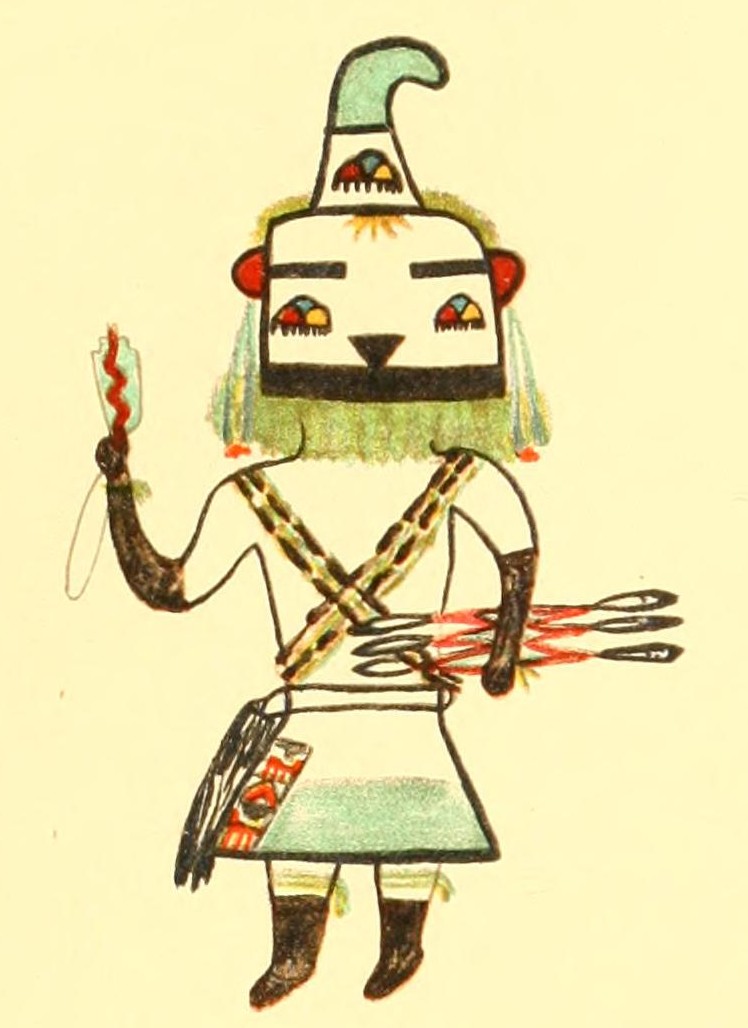
In the winter of 1934 Hotevilla staged a puppet play for the Palulukonti, the Water Serpent ceremony, though that year no serpent puppets came out; only the songs remembered them. A painted screen stood across the room, and in front of it corn sprouts set in little clay cones made a miniature cornfield before the puppet maidens, who were worked to look as if they were grinding sweet-corn meal. Behind the screen crouched the sky god Sotukinangwa'a, carrying a whizzer and a lattice lightning frame. From time to time he rose to the shoulders and shot lightning 'over—but not directly at—the cornfield.' Now and then a sandpiper puppet was made to skate across the top of the screen.
One katcina dressed as the sky god, Sotukinangwa'a, and carrying a whizzer (bull-roarer) and a lightning frame, was also behind the screen.
Titiev 1972, The Hopi Indians of Old Oraibi, pp. 324–325
Particulars
- Object
- A whizzer carried, with a lattice lightning frame, by the katcina personating the sky god Sotukinangwa'a.
Sources
- Mischa Titiev, The Hopi Indians of Old Oraibi: Change and Continuity (Ann Arbor: University of Michigan Press, 1972), pp. 324–325 View
- William R. King, 'Dionysos Among the Mesas: The Water Serpent Puppet Play of the Hopi Indians', American Indian Culture and Research Journal 11:3 (1987), pp. 17–49 View