No. TSCHOPIK1946-001
Aymara child's bull-roarer, Chucuito
Peru · Chucuito, Puno — northwestern Lake Titicaca basin · South America
Play / practical
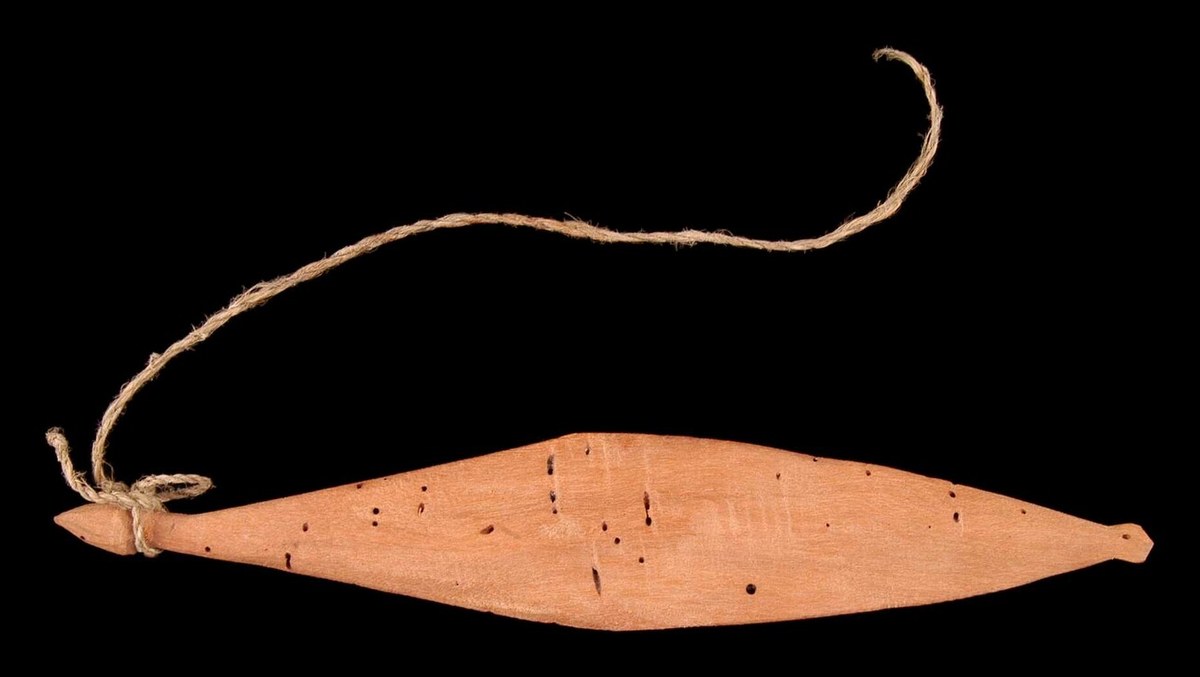
Source term: bull-roarer
Among the Aymara of Chucuito, on the Peruvian shore of Lake Titicaca, the bullroarer is a child's toy — a slat swung on a cord, ranked with the tops and the slings. It has no ceremonial life here at all. Across the whole Andean area that is nearly the entire record of the instrument: in the heartland of the old Andean states, where the panpipe, the notched flute and the conch trumpet were instruments of empire and worship, the whirled slat is reported for two peoples only, the Chocó of the Panama–Colombia forest and these Aymara. Even the Aymara armoury against hail has no place for it — cow-horn trumpets blown at the clouds, bowls of coals sprinkled with pepper and fish bones, a woman's skirt waved to embarrass the hail spirit into passing by.
Boys play with wooden tops and baked clay marbles, although these games may not be aboriginal. The bull-roarer is a child’s toy.
Harry Tschopik, Jr., "The Aymara," Handbook of South American Indians 2 (BAE Bulletin 143, 1946), p. 553
Particulars
- Object
- A slat whirled on a cord.
- Function
- A children's plaything, alongside wooden tops, clay marbles and slings.
Source
Harry Tschopik, Jr., "The Aymara," in Julian H. Steward (ed.), Handbook of South American Indians, vol. 2: The Andean Civilizations (Bureau of American Ethnology Bulletin 143, Washington 1946), p. 553; Harry Tschopik, Jr., "The Aymara of Chucuito, Peru: I. Magic," Anthropological Papers of the American Museum of Natural History 44, pt. 2 (New York, 1951), p. 198