MUS2026-209 - museum specimen
Central Arctic baleen bullroarer
Canada - Central Arctic - North America
Play / practical
Source term: Bullroarer
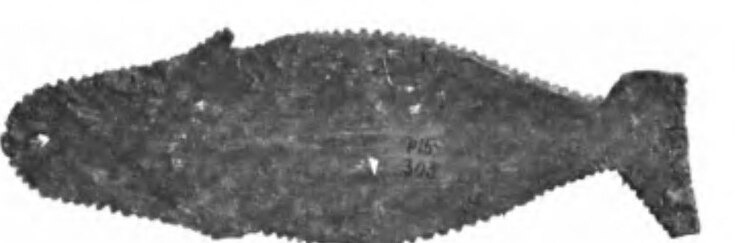
A strip of baleen twenty centimetres long, cut from the plates of a whale's jaw and worked down to a narrow blade, with rows of deep teeth cut along both edges and one end drawn to a point. Its cord is still tied on at the other end. It reached Oxford in May 1907, bought by the Pitt Rivers Museum, from Cecil Vincent Goddard, somewhere in the Central Arctic of Canada. What a Central Arctic bull-roarer was for, Diamond Jenness recorded among the Copper Inuit of Coronation Gulf: the imilguptak was one of two toys confined to children, the other being the buzz, nilitak. A single cord at one end makes this the imilguptak kind.
- Object
- Carved baleen blade, 200 x 30 mm. The museum photograph shows a long narrow strip with deeply serrated edges running most of its length, one end tapered, and a surviving cord attached at the opposite terminal end - single-end free-air suspension rather than an axial double-cord buzzer.
- Function
- Across the Central Arctic the whirled blade belonged to children: Jenness found the bull-roarer, imilguptak, one of two toys confined to them (Jenness 1922, p. 220).
- Source
- dimensions length max 200 mm, width max 30 mm; description "'Bullroarer'"; geographical provenance "Northern America -> North America -> Canada, Central Arctic"; cultural groups "Inuit (Greenland)" and "Inuit"; date made before 1907; purchased 05/1907; Cecil Vincent Goddard listed as field collector (certainty: uncertain) and as PRM source; keywords…
- Source location
Page references
PRM catalogue record 1907.72.1 and photograph PRM_RS486220_1907.0072.1.jpg (retrieved 2026-08-01)
- Source confidence
- low Broad regional anchor for the Canadian Central Arctic, the only geography the museum records. This is a region-level point somewhere in the Kitikmeot / central mainland-and-islands area, not a community, camp or collection locality, and it should not be read as a findspot.
- Toy / secular survival