No. ARCTIC-002
Mackenzie River mouth BM Am1929-0412-54
Canada · Northwest Territories · Mackenzie River mouth · North America · Arctic
Play / practical
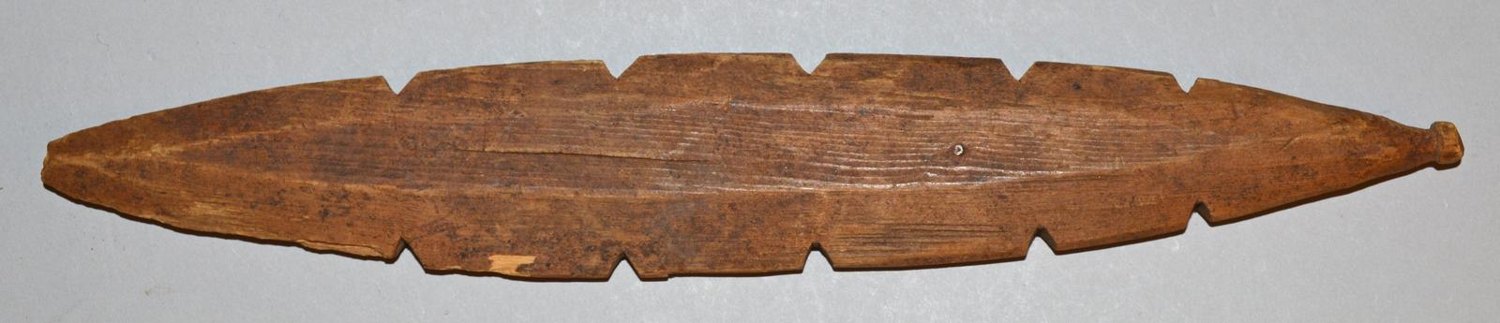
Source term: bullroarer
A leaf-shaped wooden blade, notched down both edges, collected near the mouth of the Mackenzie River and now in the British Museum. Among the Western Arctic Inuit it was a child's noisemaker: a thin board hung on a length of sinew braid and swung until it gave off a loud whizzing roar. John Murdoch, who gathered such toys at Point Barrow on the international polar expedition of 1881-83, recorded the name as ĭmĭglúta and was emphatic that the thing carried no ritual weight — he never saw one in adult hands, and the specimen he brought home had been made for sale by a lad about thirteen or fourteen years old.
It is the well known “whizzing-stick” found among savages in so many widely distant parts of the world, and often used in religious ceremonies.
Murdoch 1892, Ethnological Results of the Point Barrow Expedition, p. 379
Particulars
- Object
- Carved leaf-shaped wooden bullroarer with notches down both sides
- Function
- Western Arctic Inuit child's whizzing-toy (imigluta); no ritual significance per Murdoch
Sources
- British Museum, object Am1929,0412.54 View
- John Murdoch, Ethnological Results of the Point Barrow Expedition (1892), p. 379