No. HELGI1979-001
Ormr swings his beam like a hreytispeldi
Rangárvellir, south Iceland (Ormr Stórólfsson's home district); belief unlocalised · Northern Europe
Play / practical
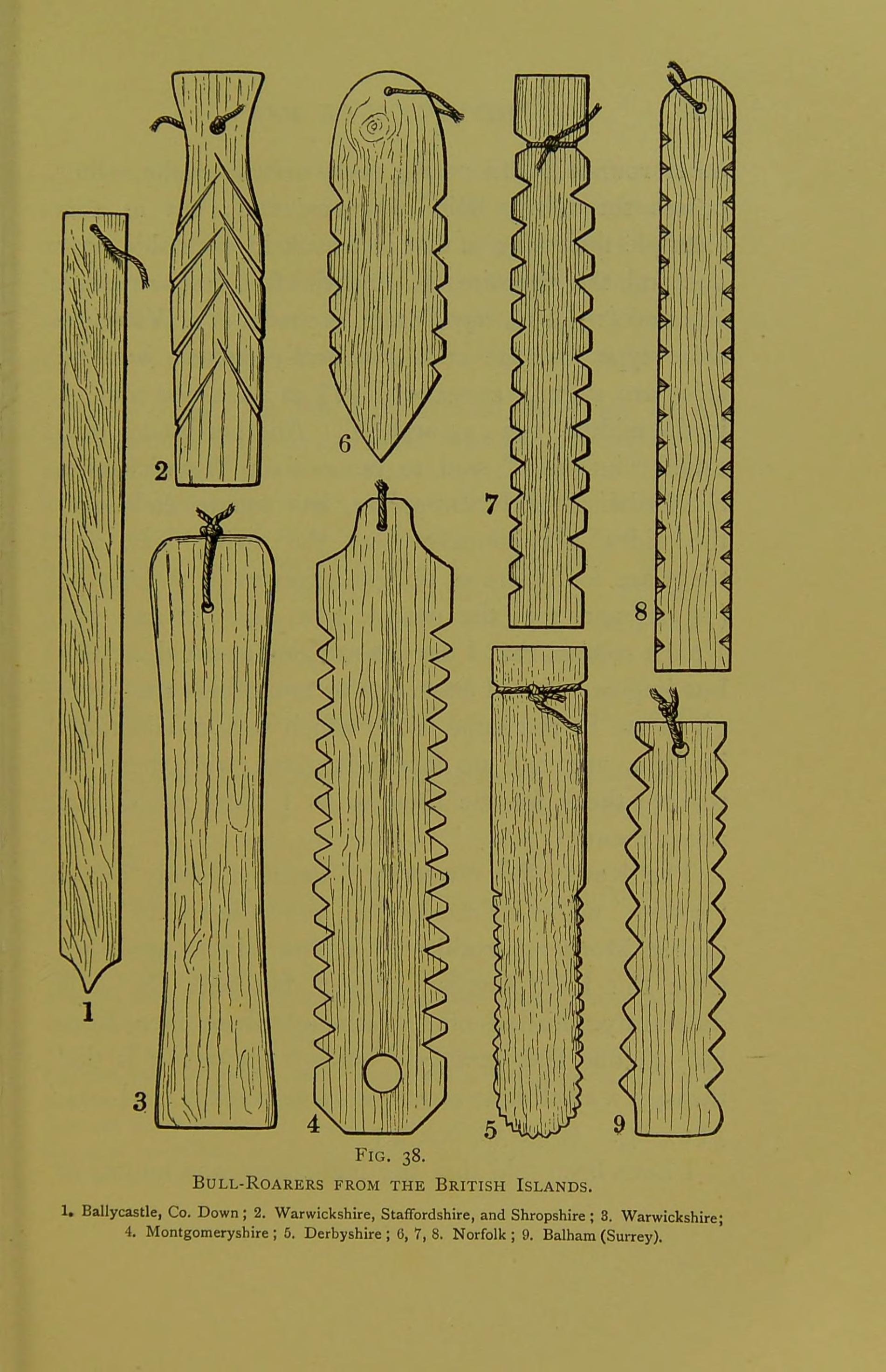
hreytispeldi
Source term: hreytispeldi; 'bull-roarer' (Helgi; Faulkes)
hreytispeldi: 'flung slat', from hreyta 'to throw, fling' and speldi 'small slat of wood'.
In the fourteenth-century Icelandic tale of Ormr Stórólfsson, Earl Eiríkr sends sixty men against Ormr, who has no weapon but a wooden beam. He swings it around himself like a hreytispeldi, so that no one dares come near. The word means a flung slat, and the Icelandic philologist Helgi Guðmundsson identified it as the bullroarer: a thin strip of wood whirled on a cord, which the saga's audience evidently knew as a boys' toy. Anthony Faulkes, editing the tale, judged that the bullroarer reading fits the scene exactly.
Ormr hafde ekki uopna nema asinn ok ueifde honum vm sig sem hreytispelldi
Ormr had no weapon but the beam, and swung it around himself like a hreytispeldi.
Orms þáttr Stórólfssonar, Flateyjarbók I (1860), p. 532, quoted in Helgi Guðmundsson, 'Hreytispeldi,' Gripla 3 (1979), p. 224.
Particulars
- Object
- A thin wooden slat swung around the body on a cord.
- Function
- A children's toy in fourteenth-century Iceland, known from a saga simile.
Sources
- Helgi Guðmundsson, 'Hreytispeldi,' Gripla 3 (1979), pp. 224-225 View
- Anthony Faulkes (ed.), Two Icelandic Stories: Hreiðars þáttr, Orms þáttr, 2nd ed. (Viking Society for Northern Research, 2011), pp. 34-36, 101