No. MUS2026-139
Nivala suhistuspuu herding bull-roarer
Finland · Pohjois-Pohjanmaa (North Ostrobothnia) · Nivala · Northern Europe
Play / practical
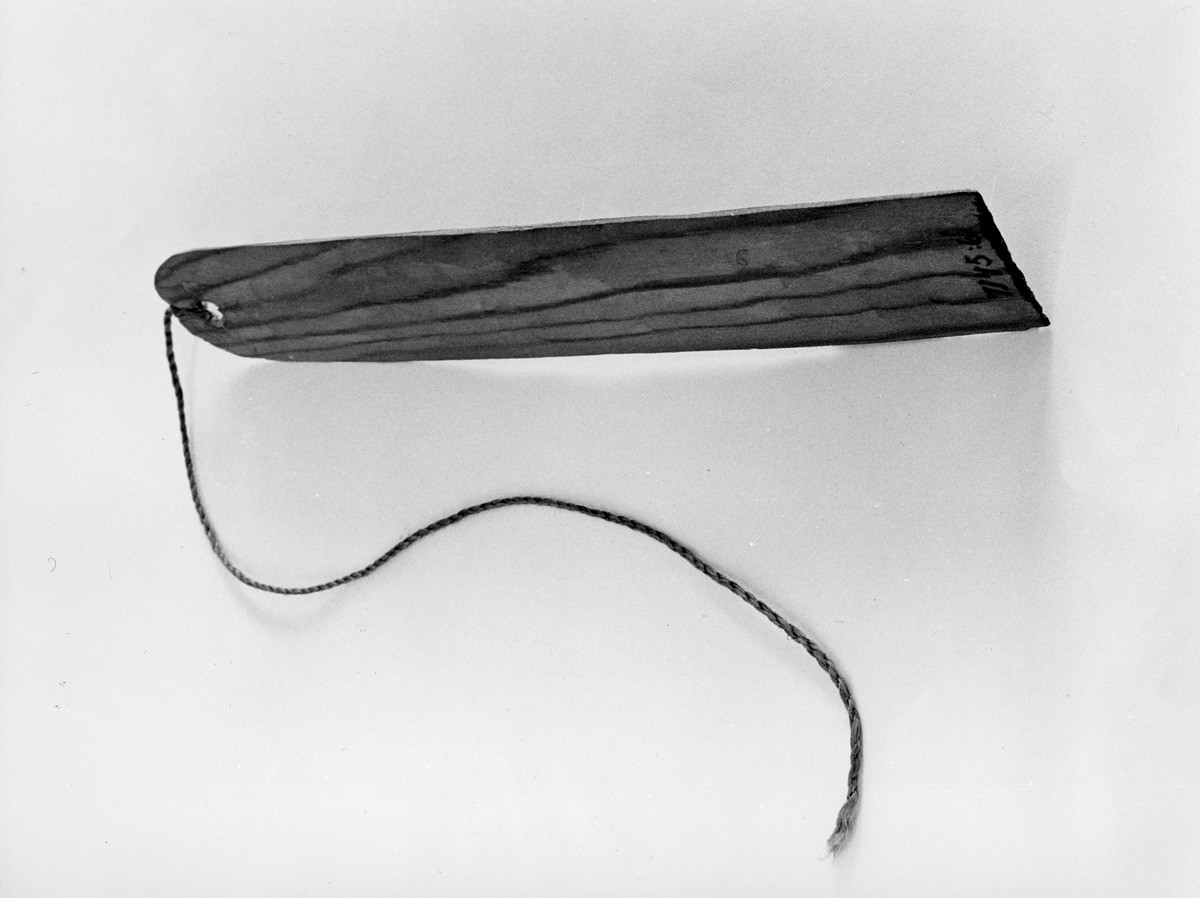
suhistuspuu
Source term: suhistuspuu; hyrrä (catalog heading)
suhistuspuu = "whirring-wood" (suhista, to whirr/swish + puu, wood)
Children whirled the suhistuspuu, the "whirring-wood", for fun; herders used its noise to frighten the cows. This one is a pine splint 26 centimetres long on a 77-centimetre braided cord, made before 1928 in Sarjankylä in Nivala and brought to the National Museum that year by Kustaa Vilkuna. Before the first swing the cord needs a slight twist to set the wooden leaf turning, or it will not whirr; how it hums depends on its size, its speed and the angle of the swing.
Eräänlainen suhistuspuu, jota lapset pyörittelevät huvikseen ja jolla paimenet pelottelevat lehmiä.
A kind of whirring-wood that children spin for amusement and with which herders frighten the cows.
Suomen kansallismuseo, catalogue entry K7145:6 (via Finna)
Particulars
- Object
- Pine splint (päre) 26 cm long, whirled on a 77 cm braided cord. Suomen kansallismuseo K7145:6, ethnological collections, 1928, through Kustaa Vilkuna.
- Function
- Children spin it for amusement; herders use its sound to frighten cows.
Source
Suomen kansallismuseo (National Museum of Finland), ethnographic collections, K7145:6, catalogued as a toy (leikkikalu) and whirligig (hyrrä)