No. COQUET1987-001Africa
Didiro, the fish that vomited the blades
Houndé, Tuy province, Hauts-Bassins, western Burkina Faso · West Africa
Sacred / spirit
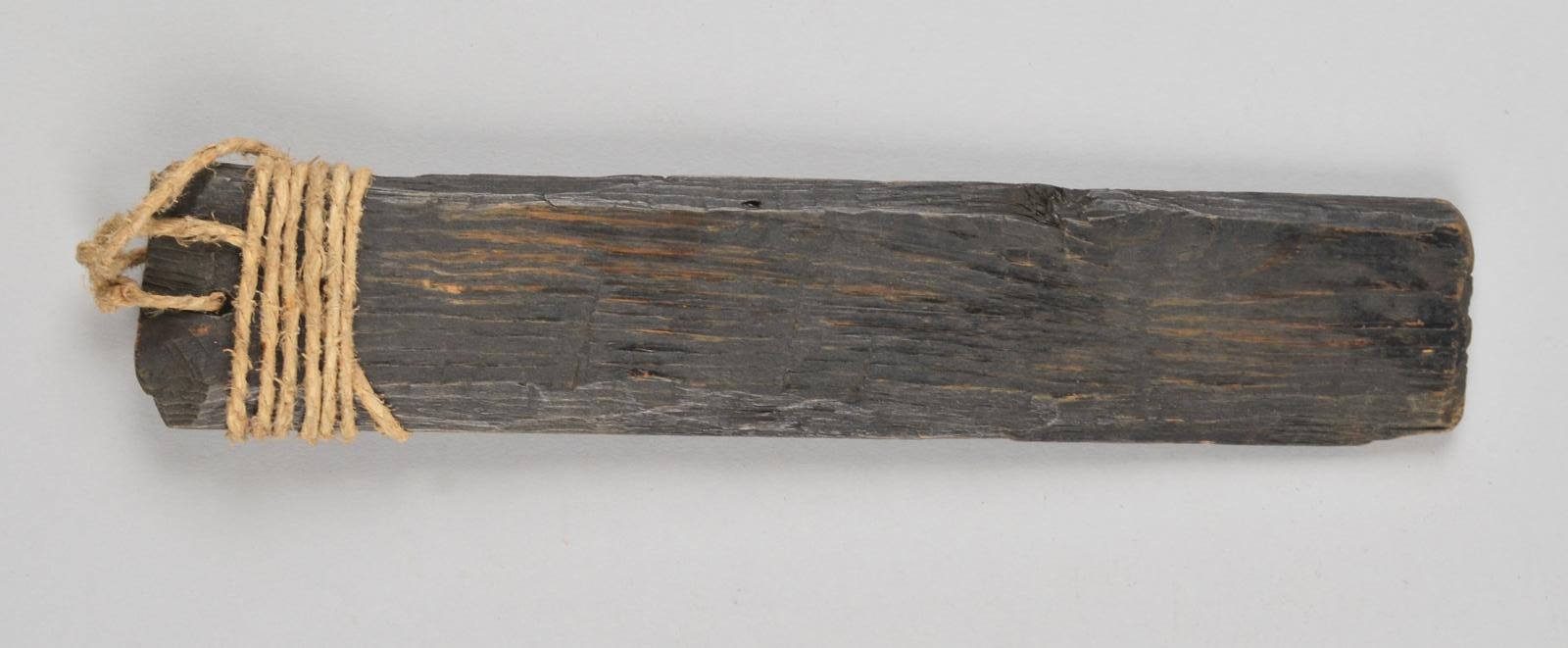
doo
Source term: rhombe; couteau doo
doo: the Bwaba divinity sent by the god dofini, and the name of the sacrificial knife and bullroarer. didiro: the electric fish, the clan's own form of doo, also called doo henbeni, 'twin' of doo. nazii: the clan altar object. binluio lunnuu: 'Binluio's head of the forge', the altar under the anvil post.
An electric catfish gave the Houndé smiths their sacred blades. When Zama and his band fled, the fish didiro helped them across a flooded river and struck their pursuers dead with its shock. It also vomited the doo knives. With the first, the first cord was cut at the first birth and the first scars were made on human skin, and the same blade could be whirled as a bullroarer. Didiro asked that its flesh never be eaten and that it be fed with sacrifices. But Binluio, first son of doo and first of the smiths, killed it and ate it, and so death came: Binluio was the first man to die, and he lies under the post of the forge's anvil. Every Bwaba face carries the tear-lines of that murder, and every lineage knife carries the fish's skeleton cut as a row of chevrons. The smiths say didiro gave them everything, even death.
il leur a tout donné, même la mort
it gave them everything, even death
Michèle Coquet, Systèmes de pensée en Afrique noire 8 (1987), p. 125
Particulars
- Object
- Metal blades named doo, kept by each lineage of the didiro smith clan; a blade can serve as a sacrificial knife or as a bullroarer, and each lineage's knives are engraved with a line of chevrons that is the fish's skeleton.
- Function
- Embodiment of doo within the clan cult of didiro: the blades are the first knives the fish gave the smiths, sounded as bullroarers or used to support sacrifice, and kept with the clan altar and its waterside shrines.
Source
Michèle Coquet, « Une esthétique du fétiche », Systèmes de pensée en Afrique noire 8 (1987), pp. 111–140, at pp. 123–128, 137