No. BOAS1890-001
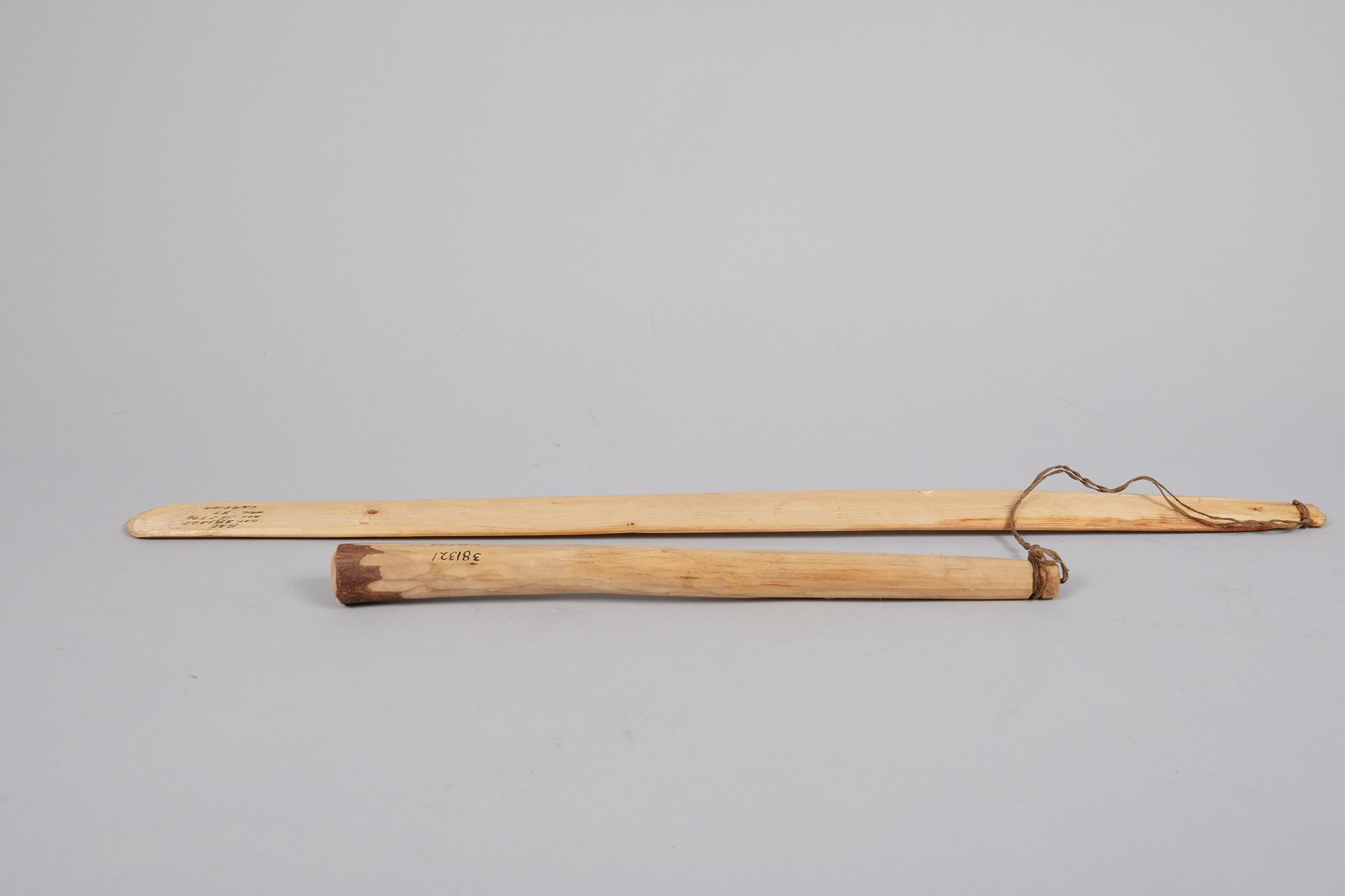
Shuswap twins' clear-weather implement
Canada · Kamloops, Thompson River, interior British Columbia · North America · Plateau
Weather / fertility magic
skumku'mq-sisilt (Secwepemctsin), 'young grizzly bears' - the word for twins.
Among the Shuswap of the Thompson River country, weather was the business of twins. A woman who bore them took her children to a hut on a mountain slope above a creek and stayed there until they could walk, and they were never to enter the village, or her other children would die. Twins were called skumku'mq-sisilt, young grizzly bears, and the power that came with the birth stayed with them for life. They could make good weather and bad, and each kind of weather had its own technique. For rain they filled a small basket with water and threw it into the air. For storm they strewed down on the ends of spruce branches. For clear weather they took a small stick with a string tied to the end of it and a small flat piece of wood tied to the end of the string, and they shook it. The rest of the twins' childhood was of a piece: the mother watched them at play to learn whether her husband was killing anything — success if they tumbled about biting at each other, an empty-handed return if they lay quiet.
If one of a couple of twins should die the other must clean himself in the sweat-house 'in order to remove the blood of the deceased out of his body.'
Franz Boas, Sixth Report on the North-Western Tribes of Canada (BAAS, 1890), printed p. 644
Particulars
- Object
- A small flat piece of wood on a string, tied to the end of a small stick.
- Function
- Shaken by twins to bring clear weather.
Source
Franz Boas, 'Second General Report on the Indians of British Columbia,' in Sixth Report of the Committee on the North-Western Tribes of Canada, Report of the Sixtieth Meeting of the BAAS (Leeds, 1890), pp. 553-715, at p. 644