No. MUS2026-101
Burunga, purely a toy
India · Bastar, Chhattisgarh · South Asia
Play / practical
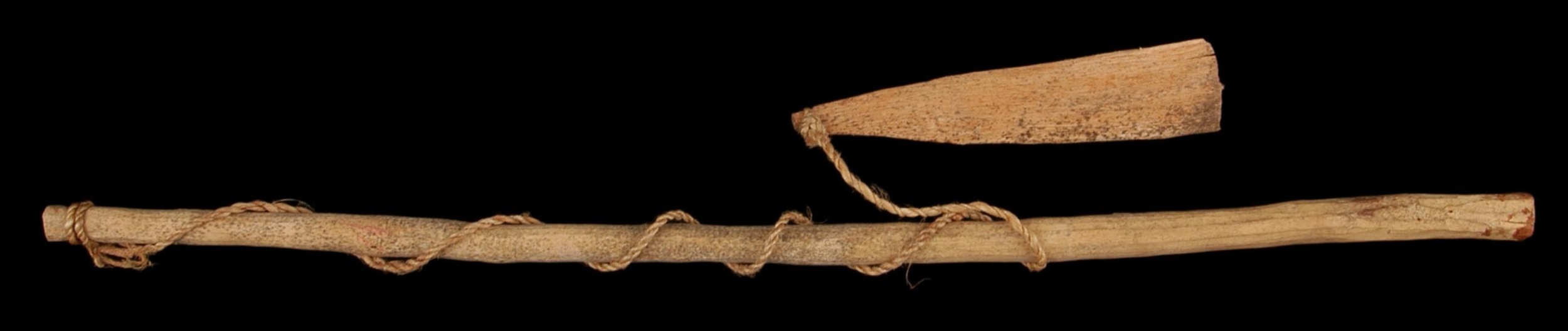
Burunga (halbi)
Source term: bull-roarer
Burunga: the Halbi-language name recorded for this bull-roarer (rhombe) among the Maria/Muria Gond of Bastar.
For the Maria Gonds of Bastar, the bull-roarer was a thing for boys. Grigson watched Hill Maria lads cut them from a strip of split bamboo, point one end, notch it for a bark string looped round a finger, and whirl the blade counter-clockwise until it roared — "purely a toy," he decided, with "no religious or magical significance." This wooden example, called Burunga in Halbi, was collected at Gotpal by the ethnomusicologist Geneviève Dournon and passed from the Musée de l'Homme to the Quai Branly.
It seems to be purely a toy, and to have no religious or magical significance. At various camps the lads present made them on request; none were holed at the bottom.
W. V. Grigson, The Maria Gonds of Bastar (1938), p. 183
Particulars
- Object
- A wooden blade 15 cm long, tied by a cord to a 53 cm stick.
- Function
- A boys' toy, whirled until it roars.
Sources
- Musée du quai Branly – Jacques Chirac, object 274061, inv. 71.1979.20.19.1-2: bull-roarer and its stick, local name Burunga (Halbi), Maria/Muria Gond of Gotpal, Dantewada, Bastar; collected by Geneviève Dournon, from the Musée de l'Homme View · archived
- W. V. Grigson, The Maria Gonds of Bastar (1938), p. 183 View · archived