No. MUS2026-050
Chakhesang boys' bird-scaring roarer
Nagaland (Phek), NE India · South Asia · Northeast India
Play / practical
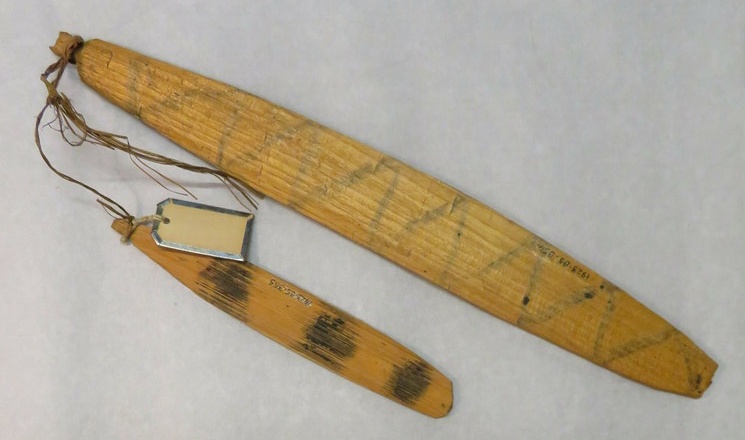
Source term: bull-roarer
athapuka = Southern Sangtam name for a toy bull-roarer of light wood, the cord tied to a swinging stick; threm-threm (Lhota) = a boys' toy bull-roarer; kampi (Konyak) = a bull-roarer swung to induce rain.
A bull-roarer of the Chakhesang Naga of the Phek hills in northeast Nagaland, collected by J. H. Hutton and still in the Pitt Rivers Museum. The Chakhesang were classed as "Eastern Angami" until 1946; wherever the instrument was recorded across these hills it was a boys' plaything. Among the neighbouring Angami, boys swung it for fun or to scare birds from the growing crops; the Southern Sangtam, one of the three peoples who later joined to form the Chakhesang, called their light-wood toy roarer the athapuka, and old men would stop children swinging it for fear the noise drew tigers.
Bull-roarer used as a toy by boys or for scaring birds.
J.H. Hutton, field documentation of an Angami bull-roarer (Khonoma), 1922 — Univ. of Cambridge, "The Nagas" online database, rec. r10541
Particulars
- Object
- Bull-roarer of the Chakhesang Naga, Pitt Rivers Museum, Oxford (acc. 1923.85.354; J. H. Hutton coll.).
- Function
- A boys' toy, and a bird-scarer at the crops.
Sources
- Pitt Rivers Museum, Oxford, accession 1923.85.354
- University of Cambridge, “The Nagas” database, record r10539, J. H. Hutton’s Southern Sangtam field documentation, object 1923.85.448 View · archived
- University of Cambridge, “The Nagas” database, record r10541, J. H. Hutton’s Angami field documentation (Khonoma, 1922), object 1923.84.958 View · archived