No. GRIGSON1938-001
Hill Maria ait, Abujhmarh
Abujhmarh, Bastar State · Central Provinces · South Asia · Central India
Play / practical
ait
Source term: bull-roarer
ait: the Hill Maria (Abujhmarh) name for the bull-roarer, recorded by Grigson.
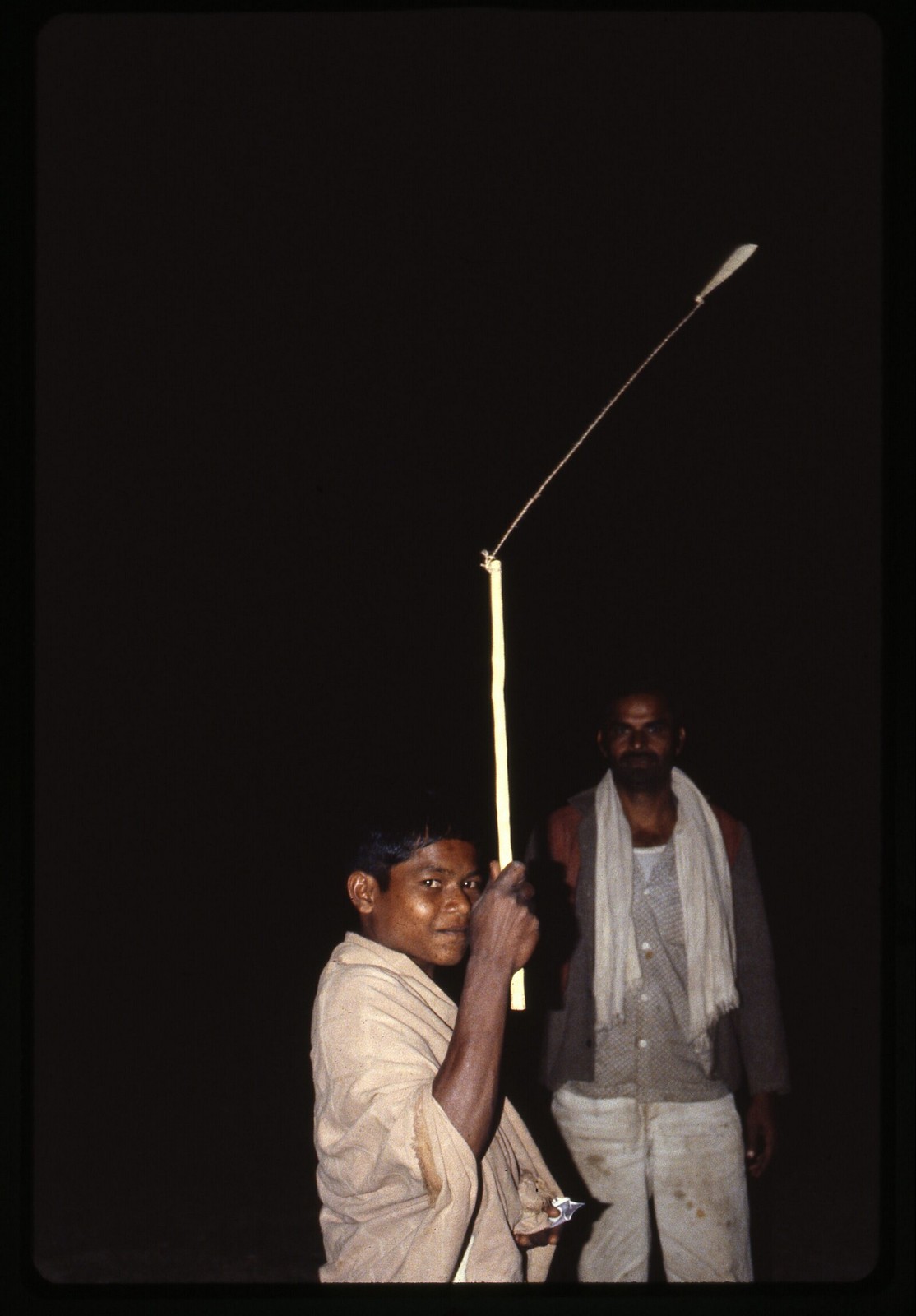
In the Abujhmarh hills the Hill Maria boys' roarer is called ait: a strip of split bamboo, one end sharpened and notched just below the point to take a bark string. The string loops round a finger and the blade goes round counter-clockwise until it roars. It is never pierced — where the roarers of Chota Nagpur are drilled and swung from a whip-handle, the Bastar blade is only notched, and spins from the fingers. There is no rite in it, no secret and no spirit. The ait sits with the spinning-top and the jew's-harp among the handful of amusements open to Hill Maria youth. Forty years on, Geneviève Dournon photographed the instrument at work in Bastar: a boy holding a pole taller than himself, a small leaf-shaped blade whirling from a long cord at its tip, put up — her caption says — to drive the birds off the crops.
…the bull-roarers, which Hill Maria boys call ait and make of a strip of split bamboo, pointing one end and notching it near the point for a bark string, with which, looped round one finger, they whirl the bull-roarer round counter-clockwise.
W. V. Grigson, The Maria Gonds of Bastar (1938), p. 183
Particulars
- Object
- A strip of split bamboo, one end pointed and notched near the point to take a bark string; the string is looped round one finger and the blade whirled counter-clockwise. Grigson notes that none of the examples made for him were holed at the bottom. A 1979 field photograph by Geneviève Dournon (musée du quai Branly PF0147257) shows the same people's instrument at work in Bastar: a small leaf-shaped blade flying from a long cord at the end of a pole taller than its player, captioned by Dournon as a bullroarer for driving birds away from the crops.
- Function
- A boys' toy, made on request at various camps and whirled for the noise; Grigson found no religious or magical use for it. A 1979 field photograph records a long-handled form used to drive birds from the crops.
Sources
- W. V. Grigson, The Maria Gonds of Bastar (London: Oxford University Press, 1938), pp. 183, 187, glossary s.v. ait View
- musée du quai Branly – Jacques Chirac, Geneviève Dournon photograph PF0147257, slide MPD9 (Bastar, 1979), “Rhombe pour éloigner les oiseaux des récoltes”