No. NAGA-010
Ao Naga ungungtsü boys-only illness-taboo bullroarer
Ao country, Mokokchung district, Nagaland (Naga Hills, Assam at time of source) · South Asia · Northeast India
Play / practical
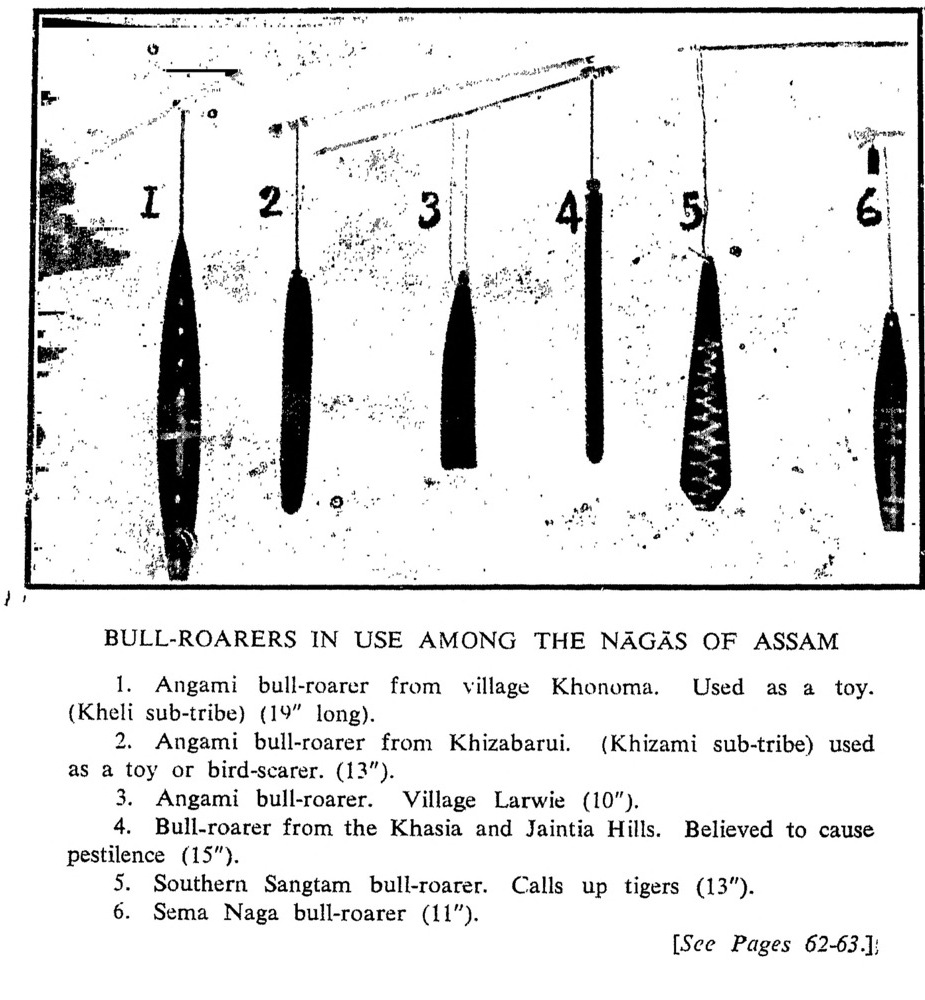
ungungtsü (Chongli); ahpü chayip (Mongsen)
Source term: bull-roarer
ahpü chayip (Mongsen Ao) = "bat's-wing"; ungungtsü (Chongli Ao), the bull-roarer
Etymology. ahpü chayip, the Mongsen Ao name for the bull-roarer, means "bat's-wing" — naming the flat whirling slat for the wing it resembles in flight.
Among the Ao Naga of the Mokokchung hills, the bull-roarer — ungungtsü in the Chongli speech, ahpü chayip, "bat's-wing," in Mongsen — was a flat slat of wood or bamboo about nine inches long, and it belonged to boys alone. By the 1920s J. P. Mills saw them only rarely, and he learned why: parents scolded any child caught whirling one, for the sound was held apt to bring illness upon the village. When sickness was actually about, both the Aos and their Chang neighbours forbade the instrument outright. What elsewhere in the Naga Hills was a bird-scarer or an open toy was here a noise that adults feared could call disease down on the community.
I have been assured that only very naughty children ever use them and that they are invariably scolded by their parents... as the sound of a bull-roarer is apt to bring illness to the village.
Mills, The Ao Nagas (1926), pp. 155-156
Particulars
- Object
- Flat slats of wood or bamboo about nine inches long, whirled by boys.
- Function
- Boys-only toy under strong adult disapproval; the sound is believed apt to bring illness to the village, and use is strictly forbidden whenever there is sickness about
Source
J. P. Mills, The Ao Nagas (Macmillan, 1926), pp. 155-156