Atlas Essay —
Turning Thunder
A Chinese music historian’s answer to why China’s thunder god spins his drums
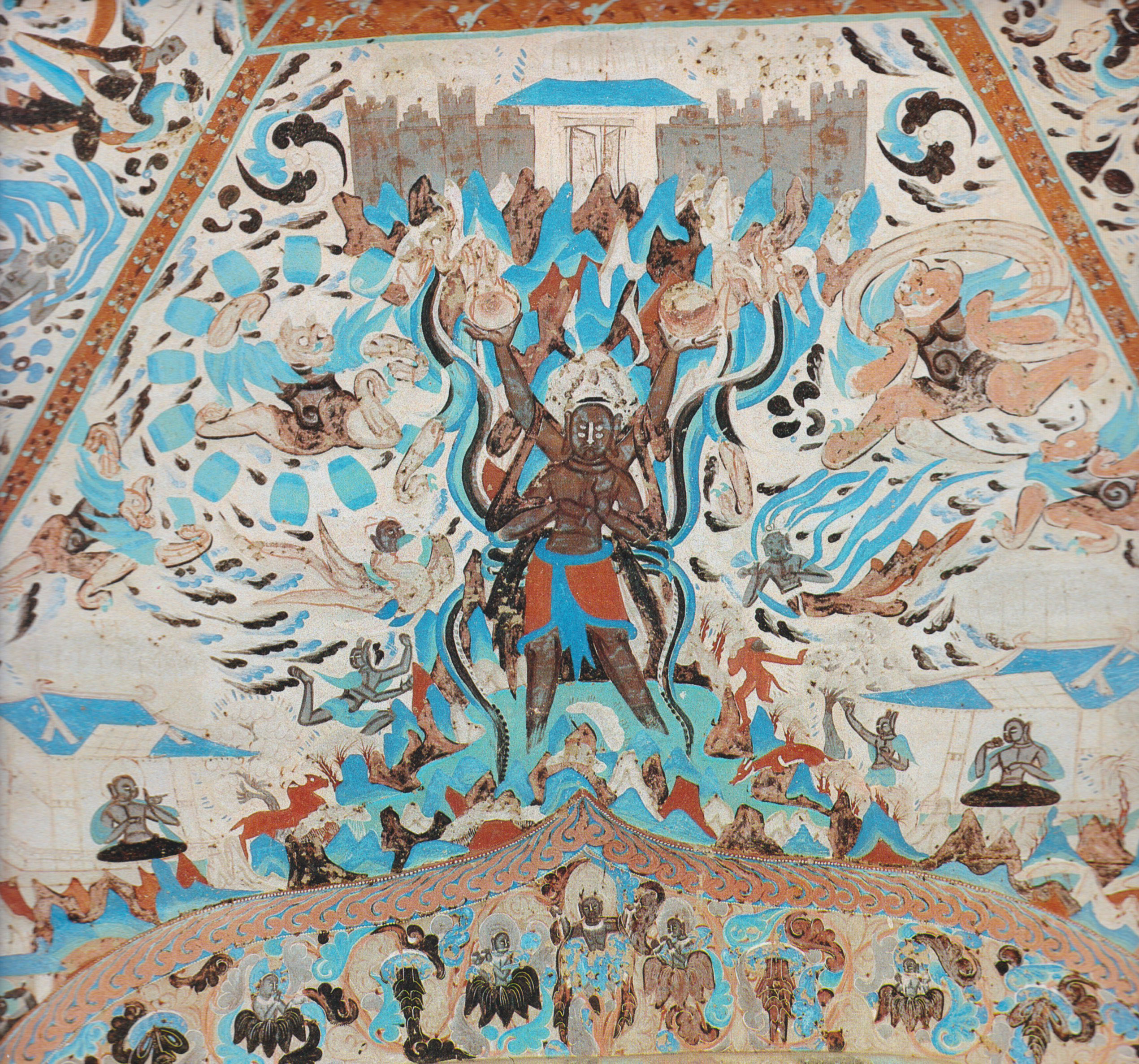
In the early 1980s the music historian Niu Longfei, who wrote as Long Fei, was cataloguing every instrument painted in the caves of Dunhuang, the oasis at the western end of China’s Gansu corridor. On one ceiling a thunder god runs across the sky inside a ring of drums. The drums do not stand in a row to be struck. They wheel round him, bound together, as if the whole ring were spinning. Long Fei could not see how a drum could sound by turning, until he read about the bullroarer of the Australian Aranda and remembered the flat wooden plaque he had swung on a cord as a boy in Lanzhou.
China’s Thunder Duke was once a bullroarer. The music historian Long Fei saw that the ring of drums wheeling round the god at Dunhuang keeps the motion of a wooden board whirled on a cord, the “turning thunder”, and he had swung one himself as a boy in Lanzhou.
In brief
- Han painters drew the Thunder Duke striking a row of drums. By the sixth century the painters of Dunhuang had the drums wheeling round him in a closed ring, and Han writers already called thunder a thing that turns.
- Long Fei found the answer in the bullroarer, a board on a cord that roars when it is whirled, which he had played with himself in Lanzhou in the 1950s.
- What unlocked it was reading about the Aranda of Australia, whose roarer is the secret voice of a great spirit, and the Hopi of Arizona, whose Snake priests carry a roarer and a lightning frame round the village at dawn.
- China’s thunder and lightning began as a pair, a boy hauling the thunder cart and a girl snapping the lightning whip, and its oldest thunder god is an ox whose voice was thunder.
- The drum replaced the roarer, but the painters kept the drums turning from Dunhuang to Kyoto, and children in Lanzhou and Turfan were still swinging the roarer itself in the last century.

Drums that turn
The Thunder Duke, Lei Gong, is one of the oldest faces in Chinese art. In the first century the philosopher Wang Chong described how the painters of his day drew him:
When painters paint the look of thunder, they draw it heaped up like a row of linked drums. They also draw a man with the look of a strongman, whom they call the Thunder Duke. They have him pull the linked drums with his left hand and push a mallet with his right, as if striking them.
Wang Chong, Lunheng, “Lei xu” (“Thunder Is Empty”), c. 80 CE (translated from the Chinese)
That is a drummer with a row of drums and a mallet. Five centuries later the painters of Dunhuang drew something else. On the ceiling of Cave 249, painted in the first half of the sixth century, twelve drums wheel round the god in a closed ring, and in a Tang silk painting from the cave library the drums circle him again, tied together with cords and bands into one turning thing. On the star-map ceiling of a Northern Wei prince’s tomb at Luoyang, the old capital on the Yellow River, sealed in 526, the drums already stand round the god in an arc.
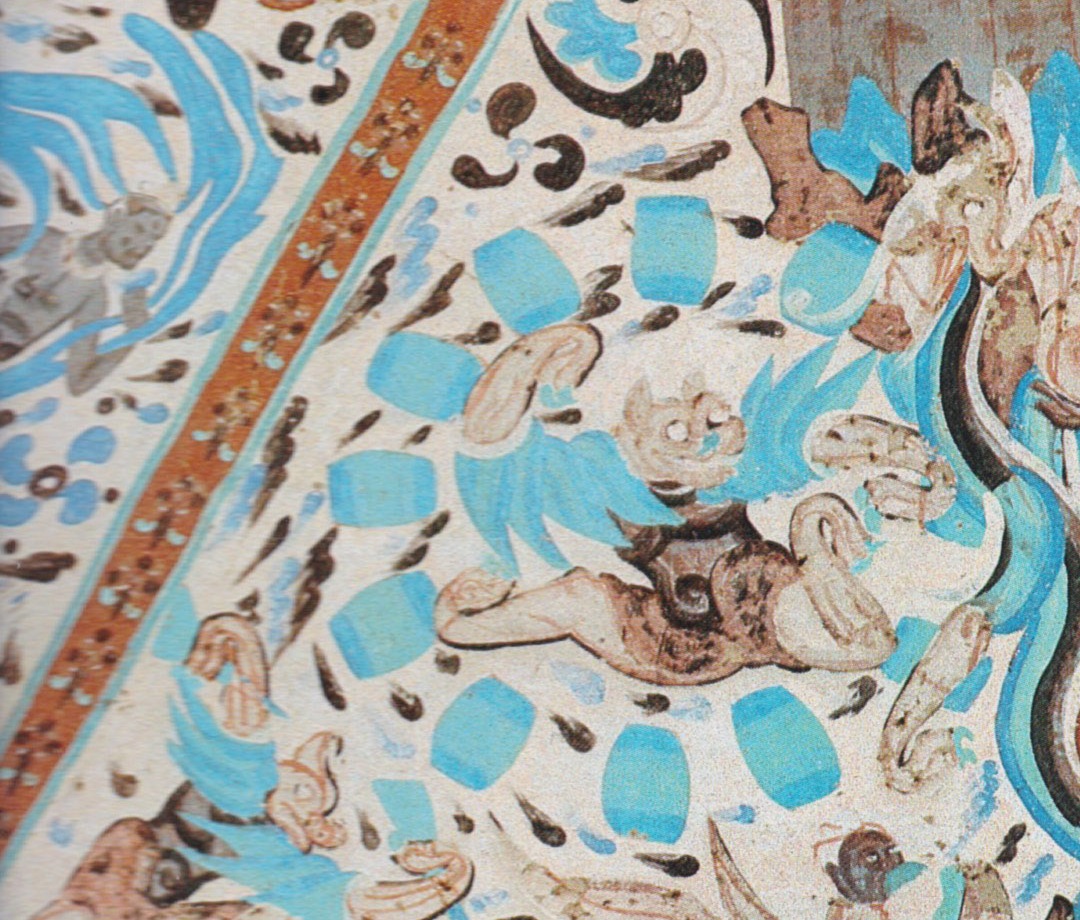
The old texts had heard the thunder turning long before. Zhang Heng’s rhapsody on the Eastern Capital, written about 107, speaks of “turning thunder” that stirs a sudden wind. The Huainanzi of the second century BCE gives the sage who rides with the Way “the thunder for wheels”. A Buddhist hymn from the Dunhuang library has a thunder god who “roars like thunder” and turns “left and right”. Long Fei put the question plainly:
We can see from this that the thunder drum used by the Thunder Duke originally made its sound by turning, like a cartwheel. The question that follows is: how does a percussion instrument make its sound by turning?
Long Fei, “Lei Gong Dianmu kao” (“An Examination of the Thunder Duke and the Lightning Mother”), 1986 (translated from the Chinese)
I turned it over a hundred times and could not work it out, until I saw the material on the bullroarer, and then everything came through.Long Fei, “Lei Gong Dianmu kao” (1986)
What Long Fei read
The material was George Peter Murdock’s Our Primitive Contemporaries of 1934, a survey of eighteen peoples that circulated in China in translation. In its chapter on the Aranda, the Arrernte of Central Australia, Long Fei found the sacred boards of the totem centres:
Some have a hole at one end, to which a string is attached, and can be whirled so as to produce a roaring noise. The women and children attribute the sound of these “bull-roarers” to a great spirit; only the men are privy to the secret.
Murdock, Our Primitive Contemporaries (1934), p. 32
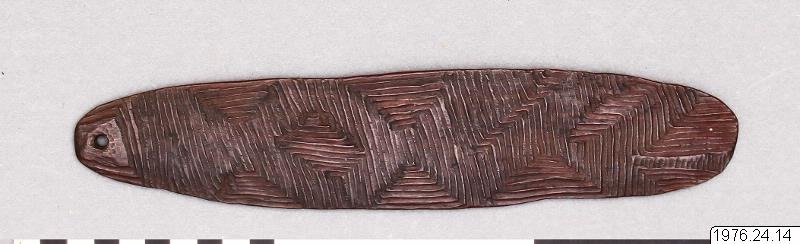
A board on a cord, a roar, a great spirit: a voice made by turning. The same book then gave him the Hopi of Arizona and their Snake ceremony:
At dawn on the ninth or final day, two Snake priests circumambulate the village with bull-roarers and curious lightning-frames of crossed sticks so constructed that they can be projected and returned in imitation of lightning.
Murdock, Our Primitive Contemporaries (1934), p. 353
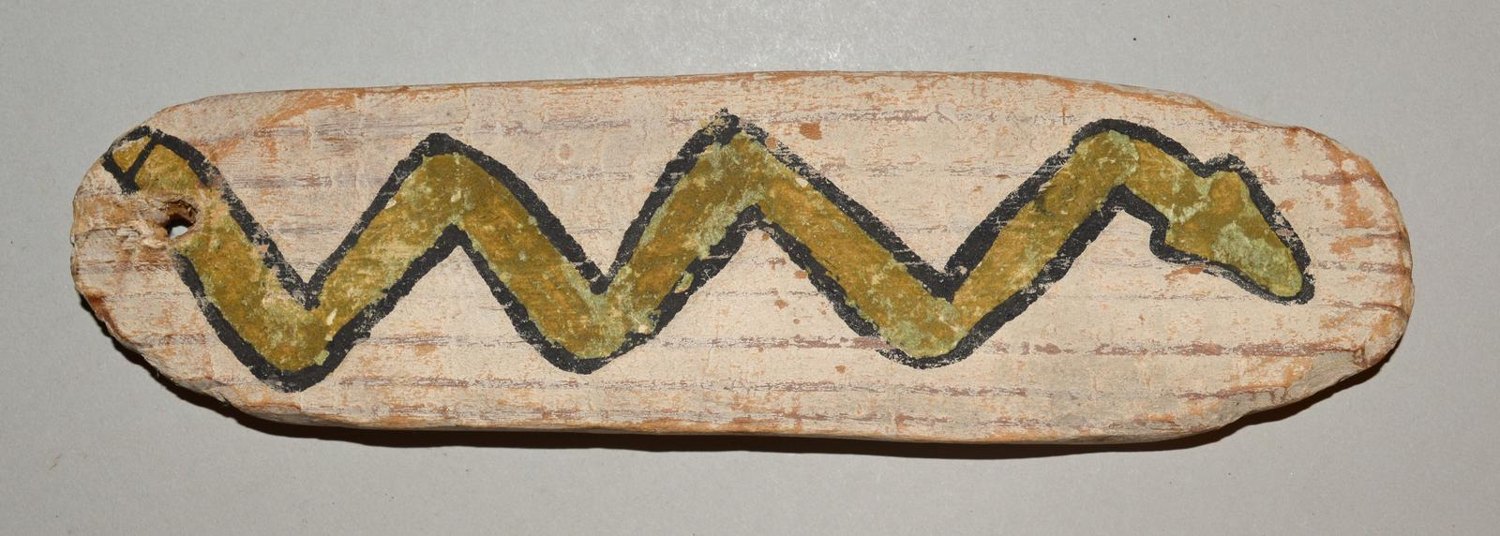
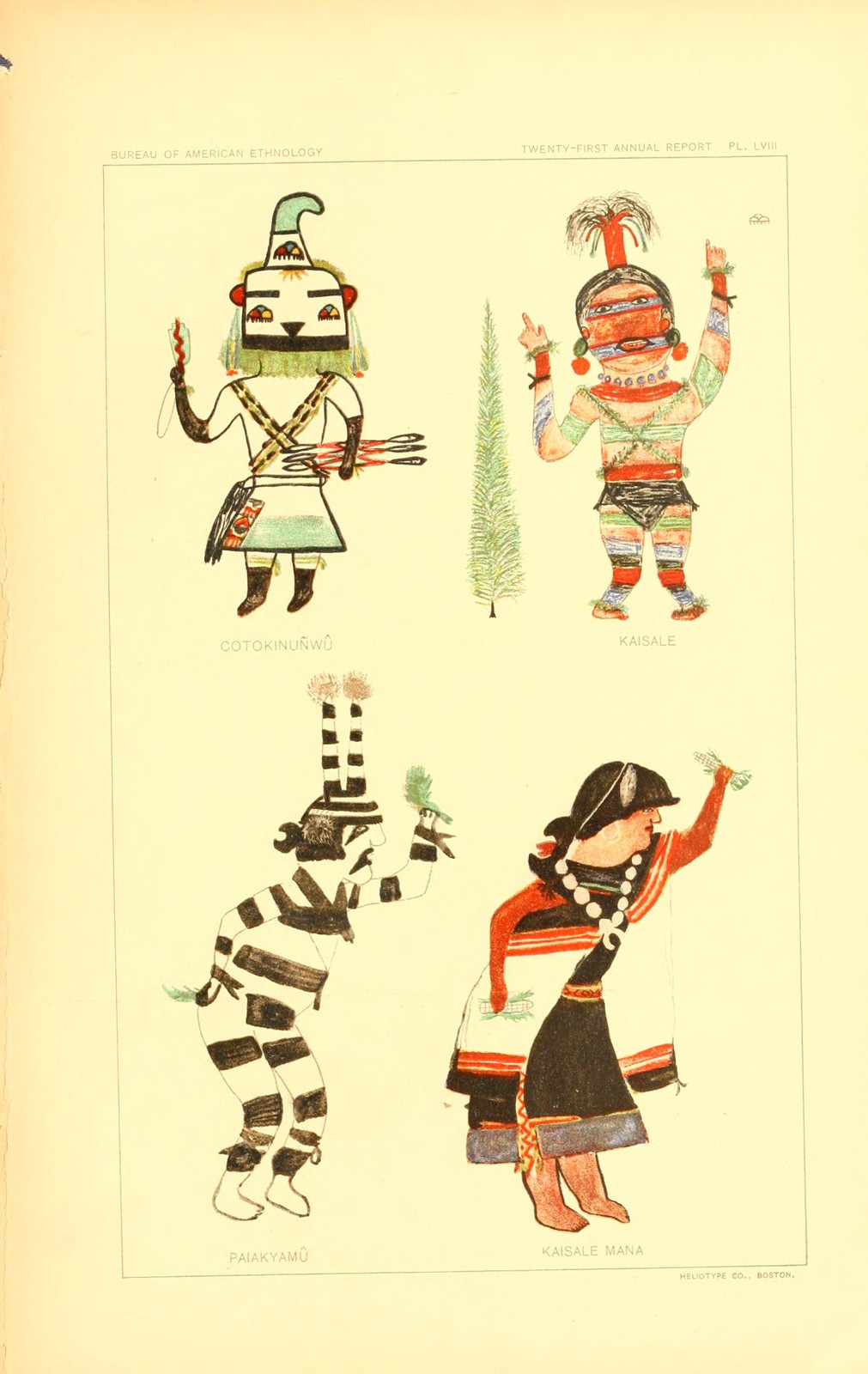
The roarer is the thunder and the frame is the lightning. At Walpi the snake-dance bullroarer was painted with a serpent, and its whirring was the “gust of rain-laden wind”. At Mishongnovi the blade was called the thunder-stick. Hopi painters drew Cotokinuñwû, the Heart-of-the-Sky god, raising a lightning whizzer in his hand: a sky god holding the thunder on a string.
China had the same pair the Hopi priests carry. The Thunder Duke has a partner, Dianmu, the Lightning Mother, who flashes a pair of mirrors while he drums. Long Fei traced the couple back to a poem by Fu Xuan in the third century, describing a journey through the gates of heaven:
Girls snap the lightning whip,
Fu Xuan, “Yunzhong Baizi gao xing”, in Yuefu shiji, ch. 63 (translated from the Chinese)
boys haul the thunder cart.
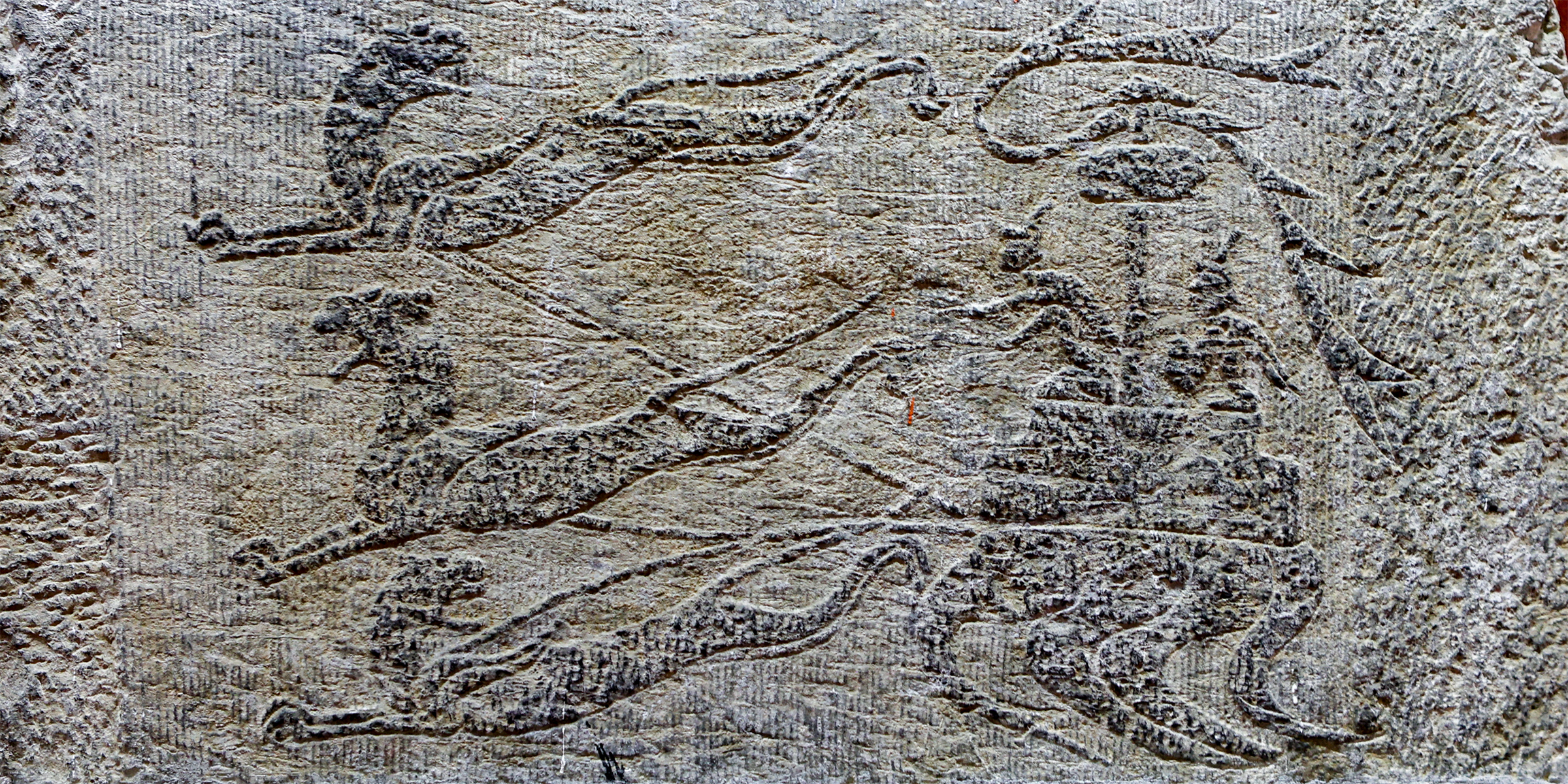
The lightning whip, Long Fei suggested, was a frame like the Hopi one, thrust out and drawn back. The thunder cart is a wheel, the thing that turns, and on a carved stone from Han Nanyang the Thunder Duke rides one, a drum on a carriage drawn through the sky by running beasts.
The ox that thundered
The Dunhuang thunder god is no strongman. He has a beast’s head and horns, and Long Fei found the beast in the Classic of Mountains and Seas, the great bestiary of early China:
In the Eastern Sea is the Mountain of Flowing Waves, seven thousand li out into the sea. On it is a beast shaped like an ox, grey-bodied, with one leg. Whenever it goes into or comes out of the water there is wind and rain. Its light is like the sun and moon; its voice is like thunder. Its name is Kui. The Yellow Emperor caught it and made a drum of its hide, and beat it with a bone of the Thunder Beast. The sound carried five hundred li, and with it he awed the whole world.
Shanhaijing, “Dahuang dong jing” (translated from the Chinese)
Kui brings wind and rain, its voice is thunder, and its story ends in a drum. Long Fei read two layers in it. First Kui is the sky god of an ox people, lord of thunder and rain. Then a conqueror kills it and beats its hide as a war drum: the drum is what the thunder became once its god was defeated. He identified Kui with Di Ku, the high god to whom the Shang made their greatest offering, and the Chinese name for the bullroarer, niuhou, “ox-bellow”, fell on ground that already held a thundering ox. His answer follows straight on from his memory of Lanzhou:
Di Ku, that is Di Kui, was originally the chief god of an ox-totem people, and the sound made by his spirit-tablet, a wooden plaque tied to a cord and whirled until it sounded, was the “turning thunder”, the “ox-bellow”. The images from Dunhuang of the Thunder Duke turning his ring of linked drums are what remains of that turning thunder. The drum is a struck instrument, yet the Thunder Duke turns it: this is just the ancient way of the turning thunder, whirled to make its sound.
Long Fei, “Lei Gong Dianmu kao” (1986) (translated from the Chinese)
There is a second Kui in Chinese tradition, and he is a musician. In the Book of Documents he is the music master of the sage-emperor Shun, who strikes the sounding stones until “the hundred beasts lead one another in the dance”. Later tradition gave him the thunder beast’s single leg, and Confucius, in the Annals of Lü Buwei, had to explain it away as a misreading of Shun’s remark that one Kui was enough. For Long Fei the storm beast and the music master were one figure: the god of the thunder was also the lord of music.
The drum takes over
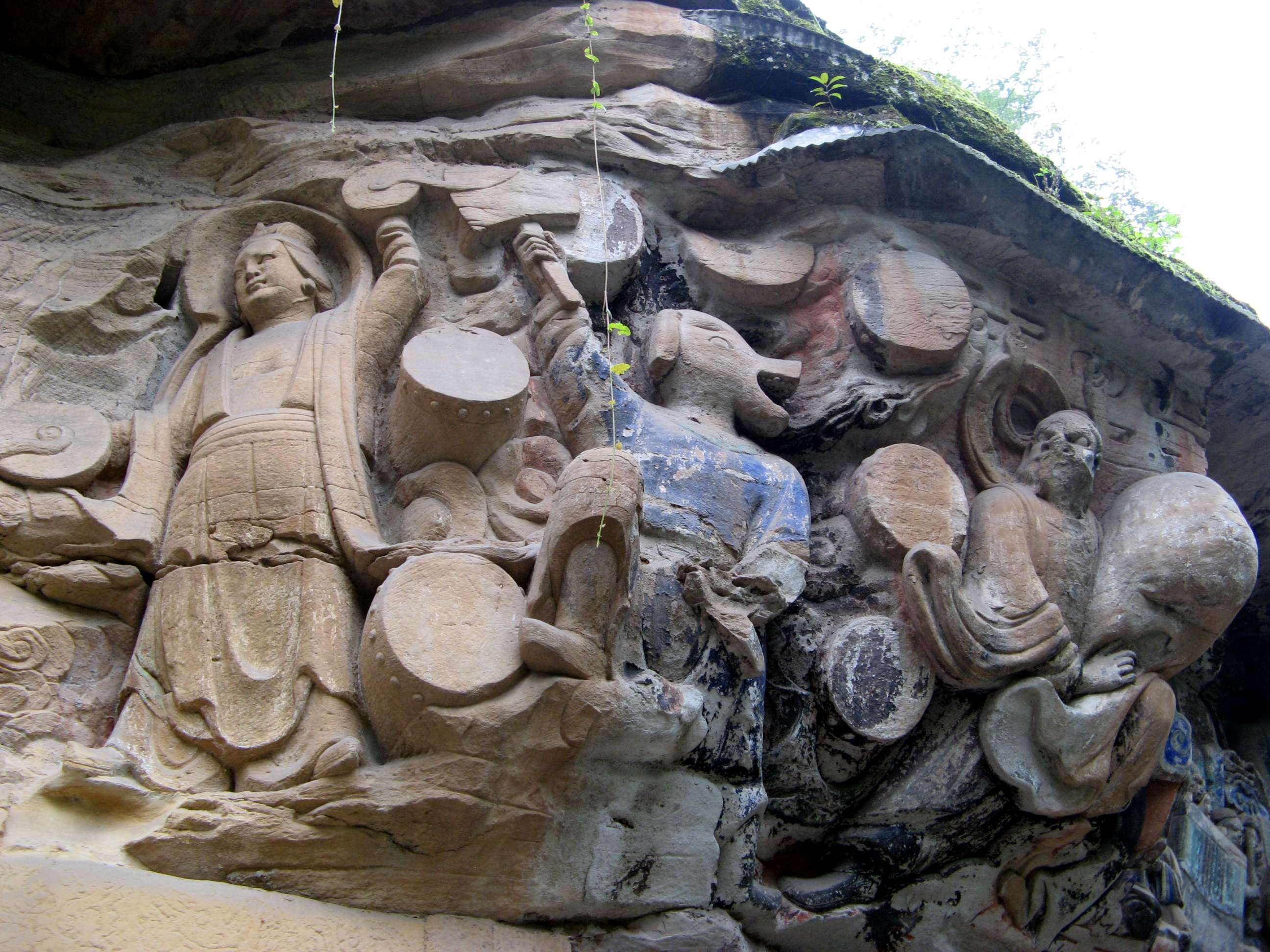
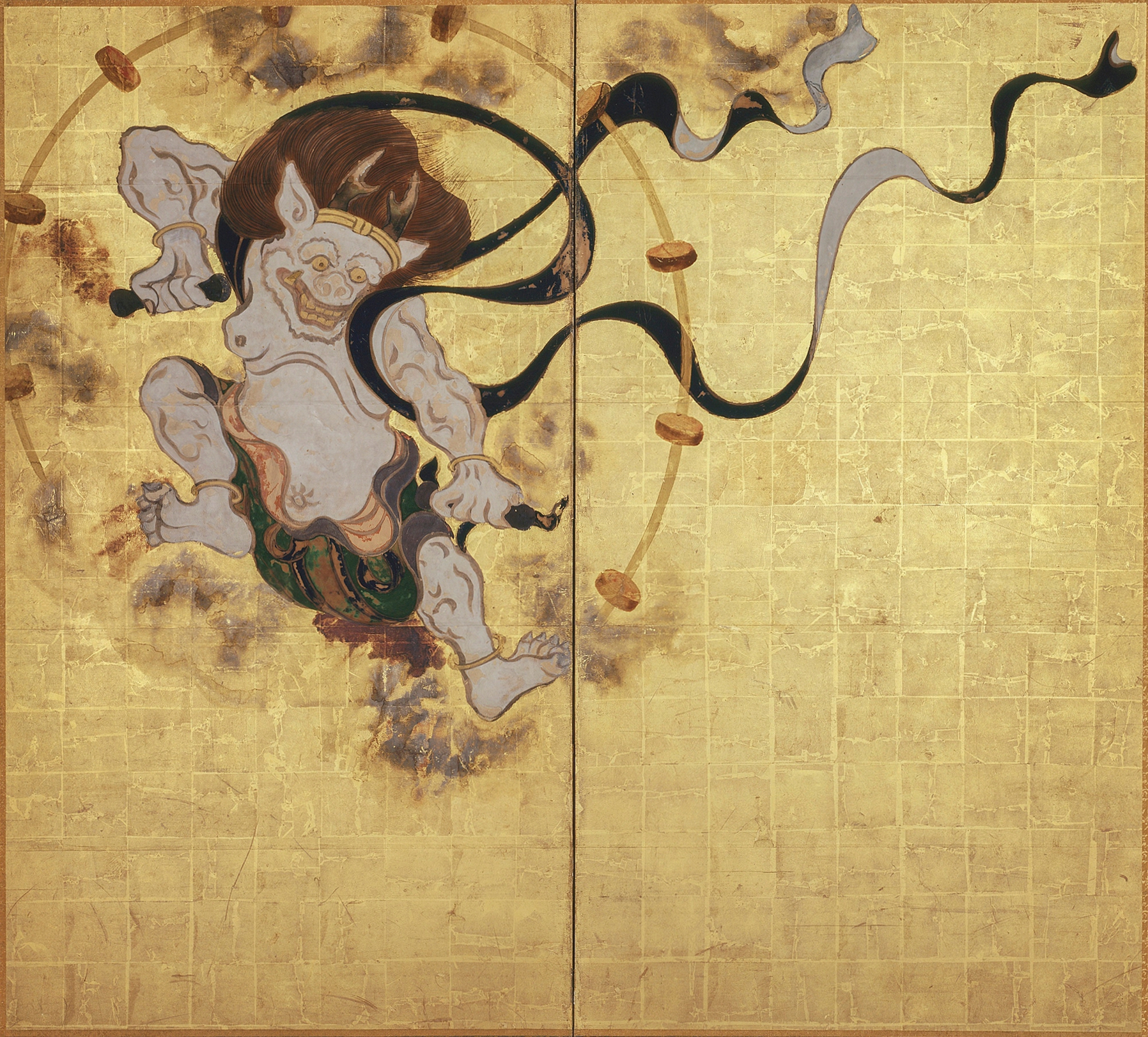
Imitating thunder with a drum, Long Fei wrote, was a step forward over imitating it with a whirled board: the drum was louder and could be carried into war. As the ox god gave way to a thunder god with a dragon’s body, the drum took the roarer’s place. The painters kept the old motion. The drums went on wheeling round the god long after anyone whirled the tablet, because that was how the thunder had always moved. In the Song carvings at Baodingshan, in the Dazu hills west of Chongqing, the Thunder Duke stands among his drums with a mallet, the Lightning Mother beside him. The image travelled east with Buddhism, and in Japan the thunder god Raijin still runs through the clouds inside a hoop of linked drums.
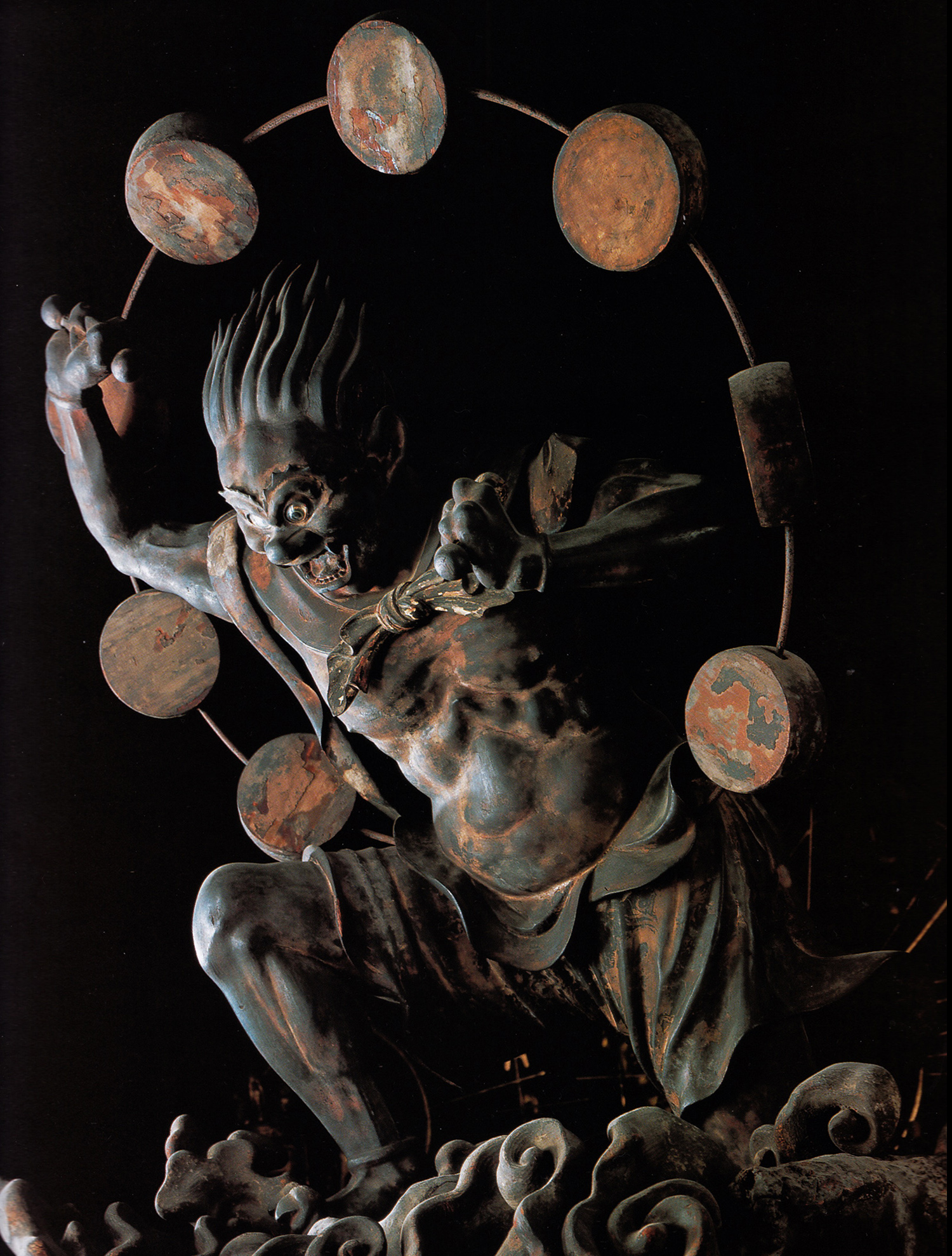
The roarer itself survived where gods leave their instruments: in children’s hands. Long Fei says so in the passage at the centre of his paper:
In my childhood I too saw, with my own eyes, and played with a wooden-plaque bullroarer in Lanzhou. It seems the bullroarer survived in north-west China right down to the fifties and sixties of this century.
Long Fei, “Lei Gong Dianmu kao” (1986) (translated from the Chinese)
The Lanzhou plaque stood at the eastern end of the Gansu corridor, the old Silk Road west to Dunhuang, and it was not alone on that road. From the corridor the New Zealander Rewi Alley gathered a whirled wooden whistle, now in the museum he left to the town of Shandan: a wooden body set with four bamboo whistles, swung round on a cord until it sounded four notes. Long Fei called it an advanced instrument that “still keeps the primitive form of the bullroarer”. Further west, in the Turfan oasis, the German orientalist Albert von Le Coq found Uyghur children at Kara Khoja swinging the yongpuldurpic, a small flat board tied with cotton cord to a twig.
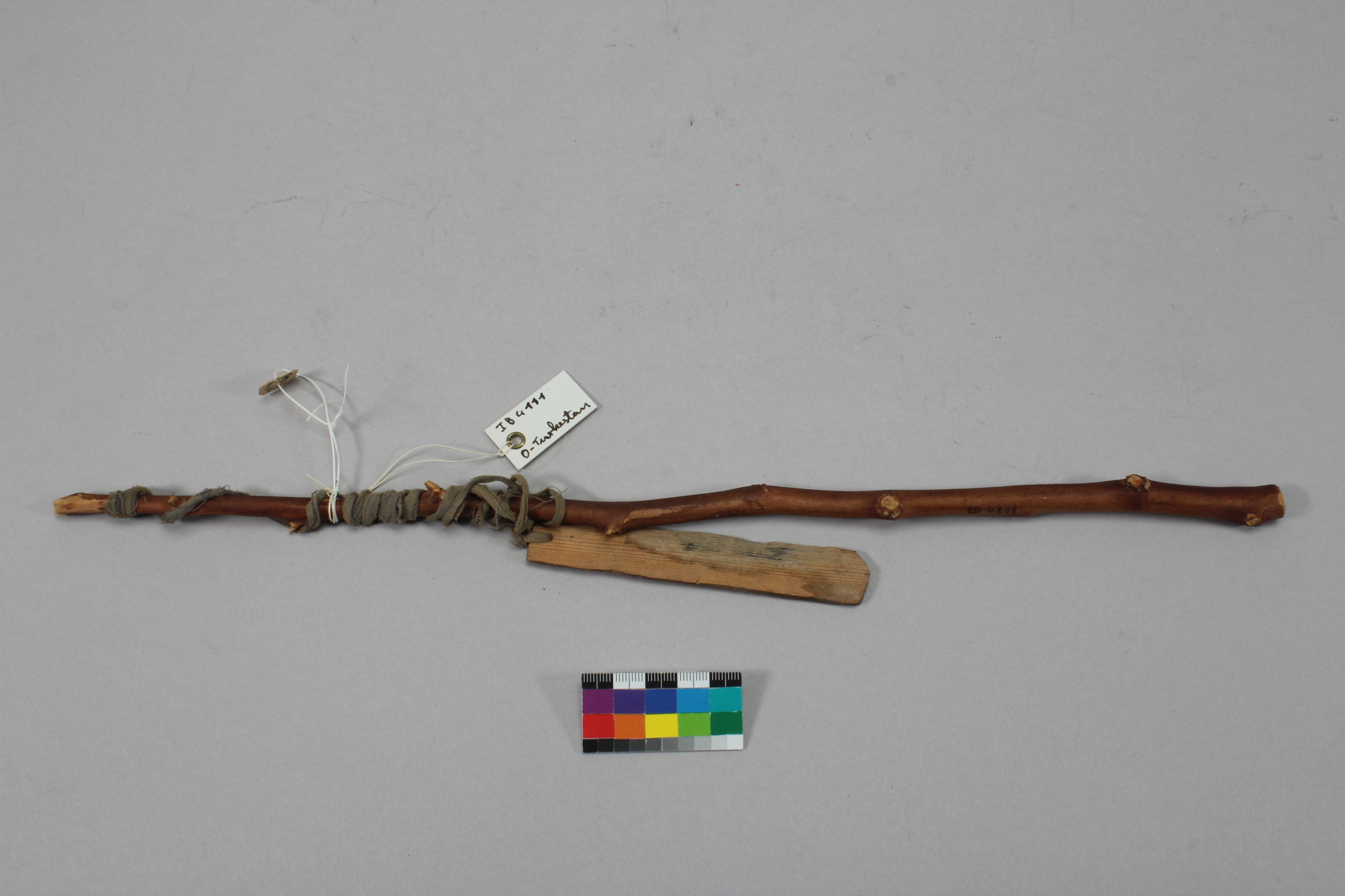
In the south-west the instrument is not a toy. In the Ailao mountains of Yunnan the Nisu Yi priest, the bimo, whirls a pine knife, a slat of pine shaved thin, until it drones, to drive a sickness-bringing spirit back into its oak. Long Fei knew the Yi bimo of the Liangshan mountains further north, whose ancestor god Adu Lupu could “roar into thunder and blink into rain”.
In north-west China the toy outlived its name. Long Fei swung it as a boy and never knew what it was called. The voice of the thunder was in the children’s hands, and the painted god on the cave ceiling still held it, turned into drums.
The thunder on a string
Everything in the old Chinese picture of thunder points the same way. The thunder turns, like a wheel. It stirs a wind. Its oldest god is an ox whose voice was thunder and whose hide became a drum. It travels with the lightning as a pair, a boy with a cart and a girl with a whip. And its god runs inside a ring of drums that he does not beat.
What China added was the drum. A state that went to war with drums and drummed its rites made its thunder god a drummer, and wrote the drum into his myth as the hide of the beast whose voice had been thunder. But the painters remembered how that voice was made. They kept the drums turning round the god, bound together like one whirling thing, even when they put sticks in his hands, from Dunhuang to the screens of Kyoto. Long Fei was a boy with a plaque on a string in Lanzhou, and later a scholar who had read about the Aranda, and he looked up at the Thunder Duke and saw what the god was doing. The drums turn because the thunder was once turned. The Thunder Duke is swinging a bullroarer.
Key sources
- Long Fei 陇菲 (Niu Longfei 牛龙菲). 1986. “Lei Gong Dianmu kao” 雷公电母考 (An Examination of the Thunder Duke and the Lightning Mother). Zhongguo wenhua yanjiu jikan 3:237–249. Shanghai: Fudan University Press. Written 1983, presented to the 1983 national Dunhuang conference. The turning drums; Murdock’s Aranda and Hopi; Kui and Di Ku; the Lanzhou plaque and the turning thunder; the Shandan whistle, note 9. Full-text reprint.
- Murdock, George Peter. 1934. Our Primitive Contemporaries. New York: Macmillan. Aranda bull-roarers, p. 32; the Hopi Snake priests’ bull-roarers and lightning-frames, p. 353. Scanned book.
- Wang Chong 王充. Lunheng 論衡, ch. 23, “Lei xu” 雷虛 (c. 80 CE). The painters’ Thunder Duke and his linked drums. Chinese text.
- Zhang Heng 張衡. “Dongjing fu” 東京賦 (Rhapsody on the Eastern Capital), in Wenxuan, with Li Shan’s commentary. “Turning thunder” 轉雷. Chinese text.
- Huainanzi 淮南子, “Yuan dao” 原道訓. The thunder for wheels. Chinese text.
- Shanhaijing 山海經, “Dahuang dong jing” 大荒東經. Kui. Chinese text.
- Lüshi chunqiu 呂氏春秋, ch. 22, “Cha zhuan” 察傳. Confucius on the music master Kui’s one leg. Chinese text.
- Fu Xuan 傅玄. “Yunzhong Baizi gao xing” 雲中白子高行, in Guo Maoqian, Yuefu shiji 樂府詩集, ch. 63. The lightning whip and the thunder cart. Chinese text.
- Le Coq, Albert von. 1916. Volkskundliches aus Ost-Turkistan. Berlin: Reimer, pp. 9 and 11, fig. 8. The Kara Khoja bullroarer. Scanned book.
- Bourke, John G. 1892. “The Medicine-Men of the Apache.” Ninth Annual Report of the Bureau of Ethnology, pp. 443–603. The Hopi bullroarer and the rain-laden wind.
- Fewkes, Jesse Walter. 1903. “Hopi Katcinas Drawn by Native Artists.” Twenty-first Annual Report of the Bureau of American Ethnology, pp. 3–126, pl. LVIII. Cotokinuñwû.