No. STEWART1942-007
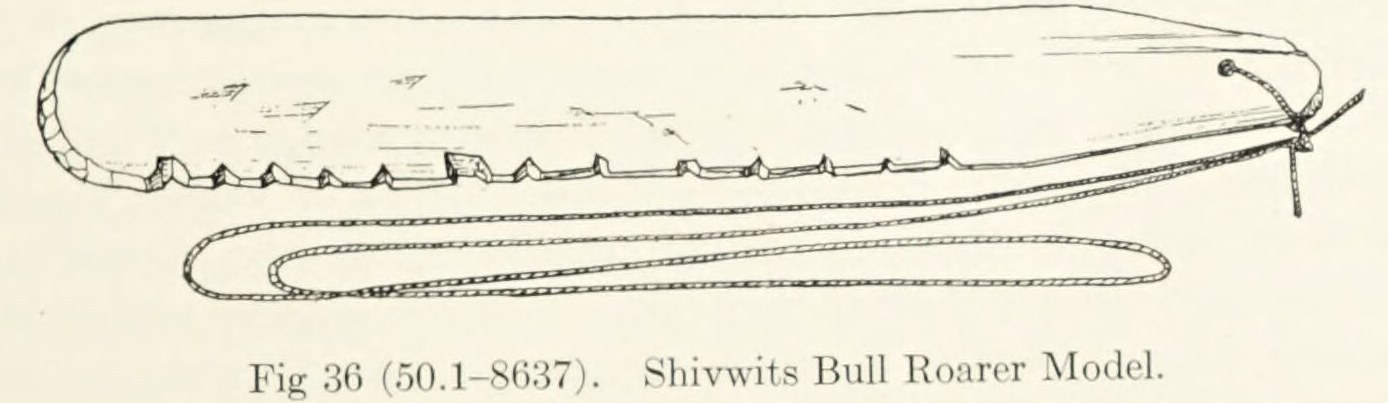
Shivwits Southern Paiute bullroarer
United States · Shivwits Plateau, Arizona Strip, northwestern Arizona · North America · Great Basin
Weather / fertility magic
nanemotö
Source term: Bull-roarer: whirrer of wood
nanemotö: the Shivwits term for the bull-roarer in Stewart's comparative vocabulary — unlike the naiyaratinömpö family of terms among neighboring bands; no literal gloss is given.
On the Shivwits Plateau, the dry tableland reaching to the Grand Canyon's north rim, the nanemotö was a boy's noisemaker that could also work: whirled on its handled string, the wooden blade made the wind blow. Lowie learned that the mythical Wolf had instituted it as a children's toy, and a father would make one for his children to play with. By Omer Stewart's time the Shivwits had left the plateau for a small reservation on the Santa Clara River near Saint George, where Frank Mustache, about seventy, was among the elders who described it.
Particulars
- Object
- Whirrer of wood swung on a string with a wooden handle.
- Function
- A toy; also swung to make the wind blow.
Sources
- Omer C. Stewart, Culture Element Distributions: XVIII, Ute–Southern Paiute, University of California Anthropological Records 6(4) (Berkeley, 1942), pp. 237, 239, 291, 352 View · archived
- Robert H. Lowie, 'Notes on Shoshonean Ethnography', Anthropological Papers of the American Museum of Natural History 20(3) (1924), p. 257, fig. 36 View