SPINDEN1919-001 - ethnographic attestation
Mayangna roarer of the Dead
Eastern Nicaragua, Mosquitia interior (middle Río Coco with the Bocay and Waspuk rivers) - Mesoamerica - Central America
Restricted
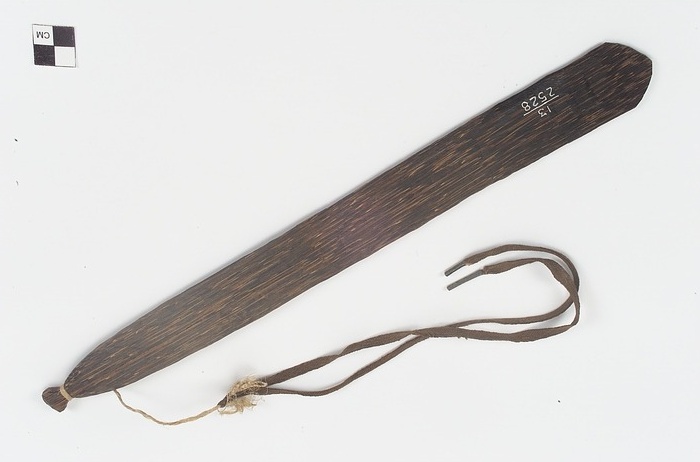
Source term: a sort of bull-roarer
About a year after a death, the Mayangna held sau, the ceremony of the Dead, at which a bullroarer was set whirling and from which women were rigorously barred. They cooked in a nearby hut while the men, smeared black past recognition, ate and drank. The sukya, or shaman, ran a cotton thread spun by the dead person's kinswomen from the grave to the feast house, lifted over branches so it never touched the ground. Along it the soul came in, and he gave it its last directions in a mysterious language. When the thread broke, the soul had reached the Great Mother, Itwana.
The most impressive ceremony is that of the Dead, at which a sort of bull-roarer is set in motion and from which women are rigorously barred.
Spinden, American Anthropologist (1919)
- Object
- A whirled instrument, "a sort of bull-roarer", set in motion during the ceremony of the Dead.
- Source
- H. J. Spinden, "The Indians of Eastern Nicaragua, dealing more particularly with the Sumu and Miskito" (lecture abstract), in "Proceedings of the American Ethnological Society", American Anthropologist n.s. 21 (1919): 473-474. Ceremony: Eduard Conzemius, Ethnographical Survey of the Miskito and Sumu Indians of Honduras and Nicaragua (Bureau of American…
- Source location
Page references
p. 474 (meeting of 24 February 1919)
- Source confidence
- low to medium
- Location note
- Bocay-Coco confluence (San Andrés de Bocay, OSM), in the Panamaka Sumu country of the middle Río Coco named by Conzemius (1932, p. 14); Spinden names no village.
Regions: The Americas · North America
- Death and rebirth
- Forbidden to women