No. MUS2026-002
Canela pimpó, the pepye's night alarm
Brazil · Maranhão (Sardinha) · South America
Restricted
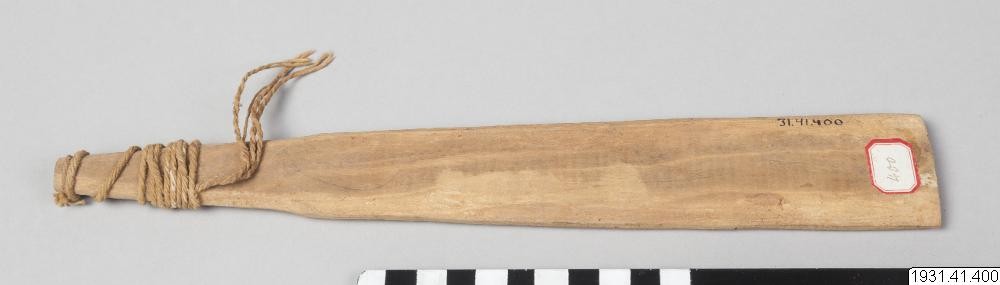
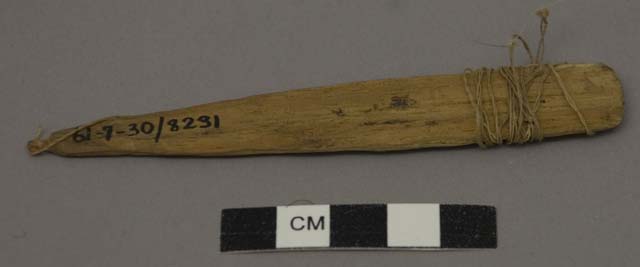
pimpó; pî-kwek
Source term: bull-roarer
Pimpó: the Canela Ramkokamekrá name for the bull-roarer, recorded with the three boards the Museu do Índio bought in 1950. Pî-kwek: the name recorded for a blade Curt Nimuendajú collected, now in Göteborg — “Vinare (pî-kwek). Användes vid Pepyé-festen.” (“Whirrer (pî-kwek). Used at the Pepyé festival.”) — and in his 1946 account, which prints it pĩkwęk.
Among the Ramkokamekra-Canela of Maranhão the bull-roarer belonged to the pepye — the youths shut away in the second initiation. Curt Nimuendajú, taken into the tribe as a participant, only later learned its work: after nightfall and before dawn the class leader swung it, the alarm passing from cell to cell, and any initiate who did not stir was reckoned asleep and punished by the commandant. Once he overheard two pepye trade the proof: "Did you hear my bull-roarer this noon?" "Yes!" "I thought you were asleep." The vanished Chakamekra had made larger and finer ones; by Nimuendajú's day the instrument had dwindled at initiation, though it had plainly once counted for more. This specimen is held in the Smithsonian's anthropology collections. Three more, bought from the collector Roberto Tamára in 1950 out of Aldeia do Ponto on the Corda River, are in the Museu do Índio in Rio: oblong boards of 27, 25 and 22 cm, each pierced beside one end with a single cotton thread, catalogued as sounded at festivals and games. The Canela called them pimpó.
Although it is now an instrument of comparative insignificance among the Ramkokamekran (Canella), it formerly played a greater part at initiation, especially among the nowadays extinct Chakamekra.
Zerries 1953, "The Bull-Roarer among South American Indians," Revista do Museu Paulista, n.s. vol. VII:294
Particulars
- Object
- Bull-roarer of the Canela (Ramkokamekra), in the collection of Smithsonian NMNH (NMNH Anthropology). The Museu do Índio (FUNAI, Rio de Janeiro) holds three companion Canela pimpó, items 3282-3284, each catalogued in identical words as an oblong wooden board pierced next to one of its ends, a single cotton thread hanging from the hole; lengths 27.2, 25.2 and 21.8 cm. Harvard Peabody 61-7-30/8231, from William Crocker's 1957–61 work at Ponto and Baixão Preto near Barra do Corda, is a palm-sized version: 11 × 1.5 × 0.5 cm, pointed at one end, perforated and still tied with its cotton string, catalogued simply as ceremonial.
- Function
- Canela/Ramkokamekra bull-roarer formerly played a greater part in initiation and was operated by initiates.
Sources
- Smithsonian National Museum of Natural History, Anthropology, bullroarer specimen View
- Curt Nimuendajú, The Eastern Timbira (University of California Press, 1946), p. 186, pl. 35e
- Museu do Índio (FUNAI), item 3282
- Museu do Índio (FUNAI), item 3283
- Museu do Índio (FUNAI), item 3284
- Peabody Museum, Harvard, 61-7-30/8231
- Världskulturmuseet, Göteborg, 1934.15.0048
- Otto Zerries, “The Bull-Roarer among South American Indians,” Revista do Museu Paulista, n.s. VII (1953), p. 294