SA-Z1953-011 - ethnographic attestation
Shipaya-Kuruaya wari wari sami
Central Brazil - lower Xingu - South America
Restricted
wari wari sami German / English extraction
Source term: Schwirrgerät / Schwirrholz / bullroarer
wari wari, "to turn / spin continuously"; sami, a male relative in the ascending line (Nimuendaju's gloss).
Etymology. Zerries preserves Nimuendaju's internal gloss: the term combines continuous turning/spinning with a male-kin element. (high confidence)
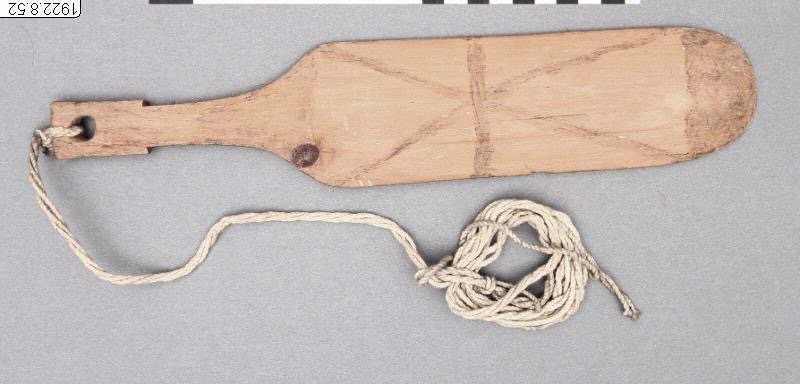
After midnight, into the all-night flute dance of the Shipaya of the lower Xingu, a new sound was brought: the wari wari sami, a roundish-oval bullroarer whose tone was tuned to the two great bamboo flutes already playing. People dreaded even to speak of it, Curt Nimuendaju recorded from his fieldwork in the late 1910s, for talk of it brought sickness and misfortune, and women and children were not allowed to come near it. Its howling was the voice of Kumaphari, "Our creator" — no faceless spirit but the tribal hero of Shipaya tradition: the elder Kumaphari kept the wild pigs of the forest as his herd, and the younger created humankind out of plants, fathered the twin heroes, and reigned as the demon of cannibalism to whom prisoners of war were sacrificed, sometimes taking jaguar shape under the name Marushawa. Nimuendaju himself was cautious, noting that the accounts were sparse and his informant's drawing unclear, so the identification rests on his hedged report. Paddle-shaped bullroarers he also found among the Shipaya — in that form, children's toys.
die Schipáia nannten es wari wari sami (wari wari: fortgesetzt drehen, sami: männlicher Verwandter in aufsteigender Linie) und scheuten sich ausserordentlich, darüber zu reden, denn es brächte Krankheit und Unglück; die Frauen und Kinder durften ihm deshalb auch nicht nahekommen.
the Shipaya called it wari wari sami (wari wari: to turn continuously; sami: a male relative in the ascending line) and were extraordinarily reluctant to speak of it, for it would bring sickness and misfortune; the women and children were therefore not permitted to come near it either.
Nimuendaju 1919/20, p. 1027, quoted in Zerries 1953:294
- Function
- Wari wari sami in flute dance probably a bullroarer; women and children kept away; paddle-shaped children's toy forms also present
- Map confidence
- medium - regional_anchor: Zerries preserves Nimuendaju uncertainty; source-sufficient for a caveated lower-Xingu plot row
- Source location
Page references
283; 294-295; 302
- Spirit voice
- Initiation rite
- Forbidden to women
- Women-linked
- Toy / secular survival