No. SA-Z1953-034
Carib Wun-wun medicine-man bullroarer
Suriname; Guyana; French Guiana · Circum-Caribbean · South America
Restricted
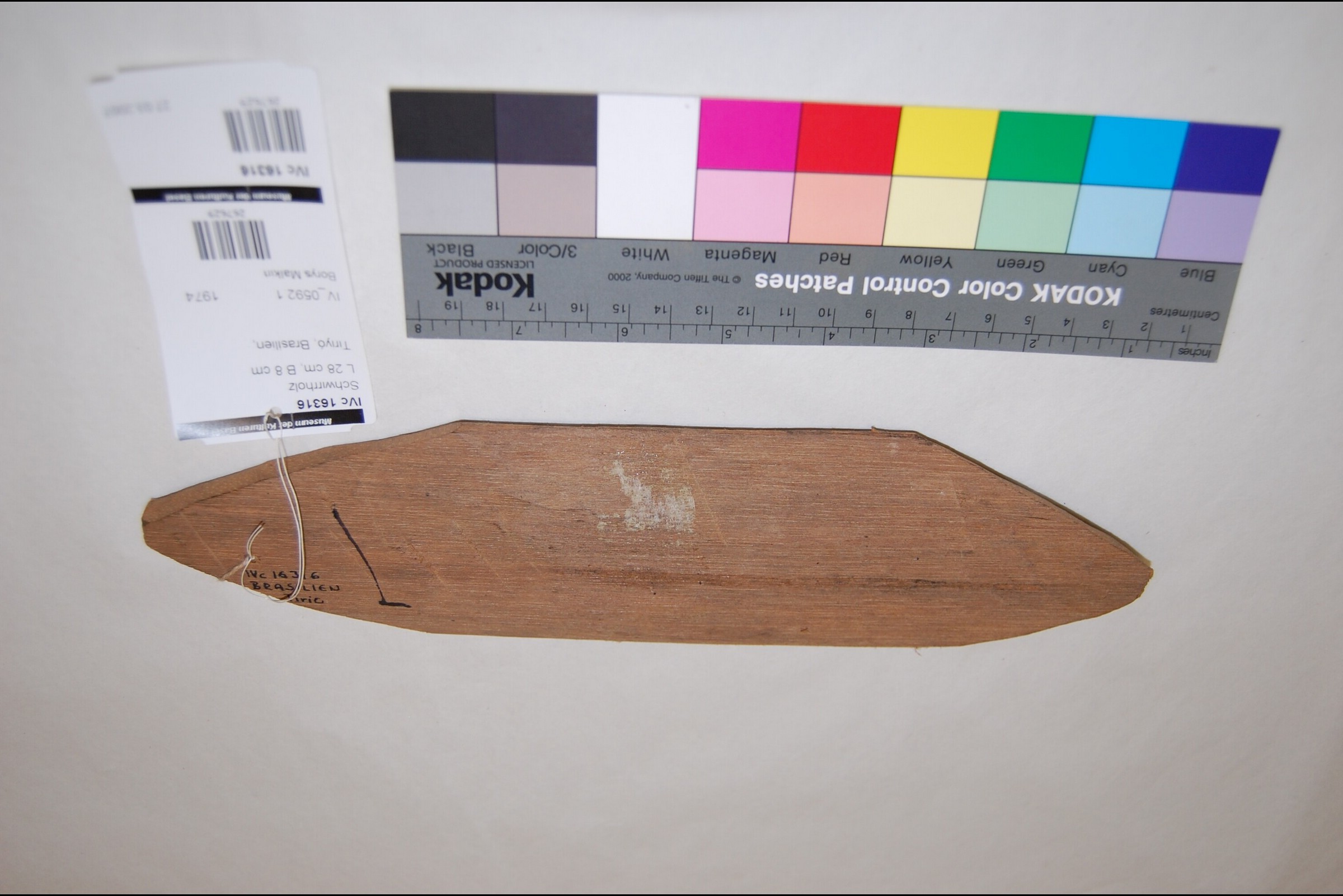
Source term: Schwirrgerät / Schwirrholz / bullroarer
Wun-wun / wun-wun: the Carib (Kalina) name for the bull-roarer, onomatopoeic for the roaring buzz it makes when whirled. puyei (piai, piaiman): the Carib shaman or medicine-man. warimbo (waruma): the Ischnosiphon cane reed split for the blade, also used in Carib basketry.
Among the Carib (Kalina) of the Guianas the bull-roarer is the Wun-wun, an instrument of the puyei or medicine man. The Dutch missionary-ethnographer W. Ahlbrinck, who worked among the Maroni and Cottica Carib, described it plainly: a string to which is tied a foot-long stalk of warimbo, the cane reed. At nightfall, when the puyei means to work his magic, he whirls the warimbo in a circle so that it gives off the roaring buzz that names it -- wun-wun. He does this so that the evil spirit will know of it; the spirit dislikes the noise and flees when it hears it. Boys bold enough to take the instrument up as a plaything are told by the adults that "this is not done."
When the Piai at nightfall begins with his magical actions he whirls at first the bull-roarer, "that the evil spirit know it (ahiwano-uhu-tome)". The evil spirit is said to dislike this noise and to flee from it. When the children want to handle the bull-roarer as a plaything, they are forbidden to do so by the adults.
Zerries 1953:289 (reporting Ahlbrinck 1931:405), "The Bull-Roarer Among South American Indians," Revista do Museu Paulista N.S. VII
Particulars
- Function
- Medicine man whirls Wun-wun at night to repel evil spirits; children forbidden to handle it as plaything
Sources
- W. Ahlbrinck, Encyclopaedie der Karaiben, Verhandelingen der Koninklijke Akademie van Wetenschappen te Amsterdam, Afd. Letterkunde, n.r. 27(1) (1931), pp. 405–406, s.v. puyei, §42 “Wun-wun”
- Otto Zerries, “The Bull-Roarer among South American Indians,” Revista do Museu Paulista, n.s. VII (1953), p. 289, reporting Ahlbrinck (1931), p. 405