No. SA-Z1953-032
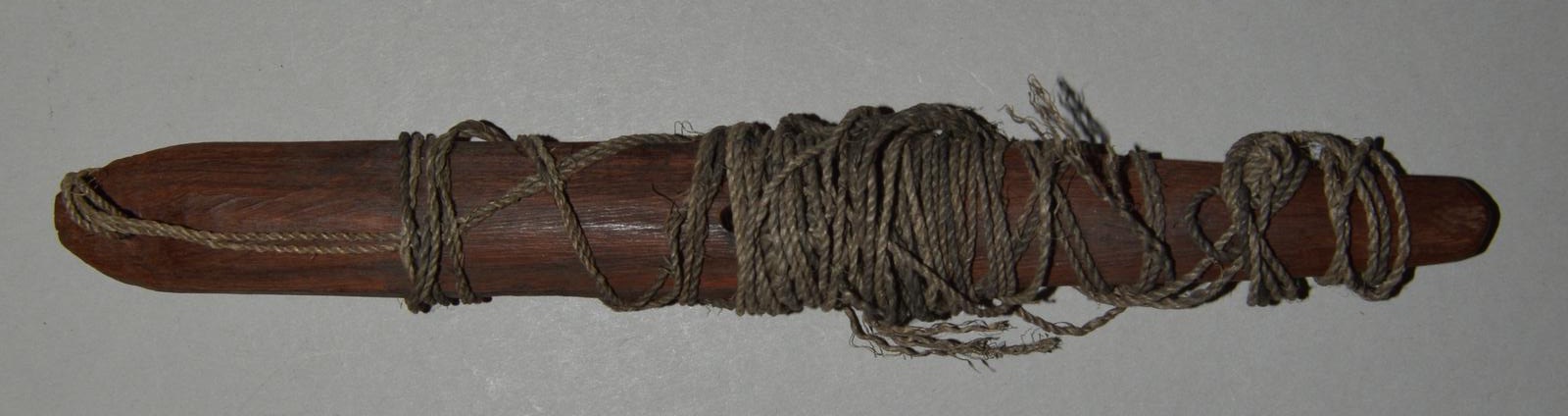
Mbaya-Caduveo funeral and toy bullroarer
Brazil; Paraguay · Gran Chaco · Paraguay River · South America
Sacred / spirit
Source term: Schwirrgerät / Schwirrholz / bullroarer
Among the Mbaya-Caduveo of the Paraguay River, the bullroarer carried the same characteristically involved designs the people were famous for. Alfred Métraux reported that they whirled these instruments at funerals; the same objects, as among the neighboring Mataco, were handed to children as playthings. Surveying South American attestations in 1953, Otto Zerries found that of the true Chaco tribes only the Mataco and the Caduveo had the bullroarer at all, and that the funeral use was the Caduveo's alone; elsewhere in the Chaco it surfaced only as a rare toy. Following Izikowitz, he put it down to diffusion: the Caduveo had taken the instrument, with other things, out of the Amazon.
The Mbaya-Caduveo have bullroarers decorated with their characteristically involved designs. They are said to whirl them during funeral ceremonies, but like the Mataco, they give them to the children as playthings.
Métraux 1946:343, quoted in Zerries 1953:288-289
Particulars
- Function
- Decorated bullroarers used in funeral ceremonies and also given to children as playthings
Sources
- Alfred Métraux, “Ethnography of the Chaco,” in Julian H. Steward (ed.), Handbook of South American Indians, vol. 1: The Marginal Tribes, Bureau of American Ethnology Bulletin 143 (1946), p. 343, via Zerries 1953, pp. 288-289
- Otto Zerries, 'The Bull-roarer among South American Indians,' Revista do Museu Paulista n.s. 7 (1953), pp. 288-289 View · archived
- Karl Gustav Izikowitz, Musical and Other Sound Instruments of the South American Indians (1935), pp. 209-212 (citing Rydén and Manizer)
- Nordenskiöld (1913), p. 70, via Zerries 1953