No. SA-Z1953-021
Kashibo taī, the voice of thunder
Northeastern Peru · South America
Restricted
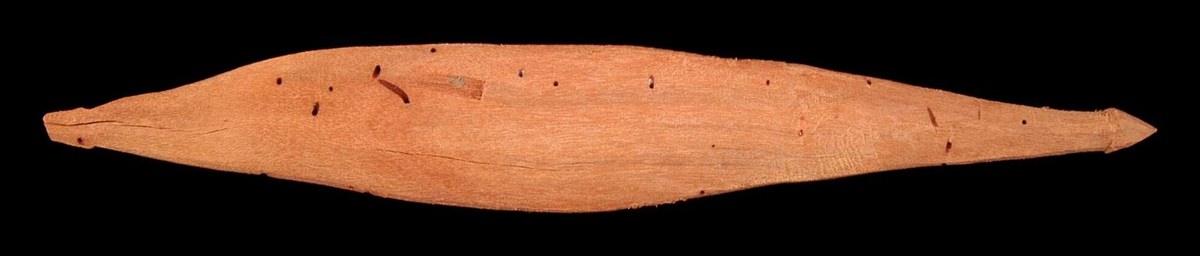
taī
Source term: Schwirrgerät / Schwirrholz / bullroarer
taī = Kashibo name for the bull-roarer; kaná-wanög = "thunder voice", what children are told the sound is; maya = hollow whirring stick; tsinkati = solid whirring stick (both stick-whirrers distinct from the bull-roarer proper); otanõ = the man disguised as a dead man to frighten children.
Among the Kashibo of northeastern Peru the bull-roarer, called taī, was a toy for the half-grown children and was whirled at the little ones to frighten them when they were naughty; to the children it was named as the voice of thunder, kaná-wanög, and it was the father who carved it. Günter Tessmann, whose 1930 fieldwork is the source here, recorded two further buzzing sticks kept alongside it — the hollow maya and the solid tsinkati, the latter likewise swung to scare children — and, in the same breath, a man called otanõ who veiled himself in palm leaves with a calabash on his head to play a dead man at the naughty children. In that pairing of roaring wood and dead-man bogey Otto Zerries saw the wreck of an older initiation, in which bush-spirits had been impersonated by mask and roaring wood.
Die kleinen werden auch durch Schreckmittel eingeschüchtert. Eins ist das auch als Spiel verwendete Schwirrholz = taī. Ein spitz zulaufendes Stück Holz ist an einer Schnur und diese an einem Stock befestigt.
The little ones are also cowed with frightening devices. One of them is the bullroarer, taī, also used as a game. A tapering piece of wood is fastened to a cord, and the cord to a stick.
Tessmann 1930:152 (Kashibo chapter, rubric 71)
Particulars
- Function
- Toy and child-frightening use; presented to children as the voice of thunder (kaná-wanög); Zerries reads the deceased-impersonator paired with the roarer as the survival of an older initiation.
Source
Günter Tessmann, Die Indianer Nordost-Perus: Grundlegende Forschungen für eine systematische Kulturkunde (Hamburg: Friederichsen, de Gruyter, 1930), p. 152 (Kashibo chapter); Otto Zerries, 'The Bull-roarer among South American Indians,' Revista do Museu Paulista n.s. 7 (1953)