No. SA-Z1953-037
Chocó toy and spirit-protection bullroarer
Colombia; Panama · Choco · Darien · South America
Play / practical
Source term: Schwirrgerät / Schwirrholz / bullroarer
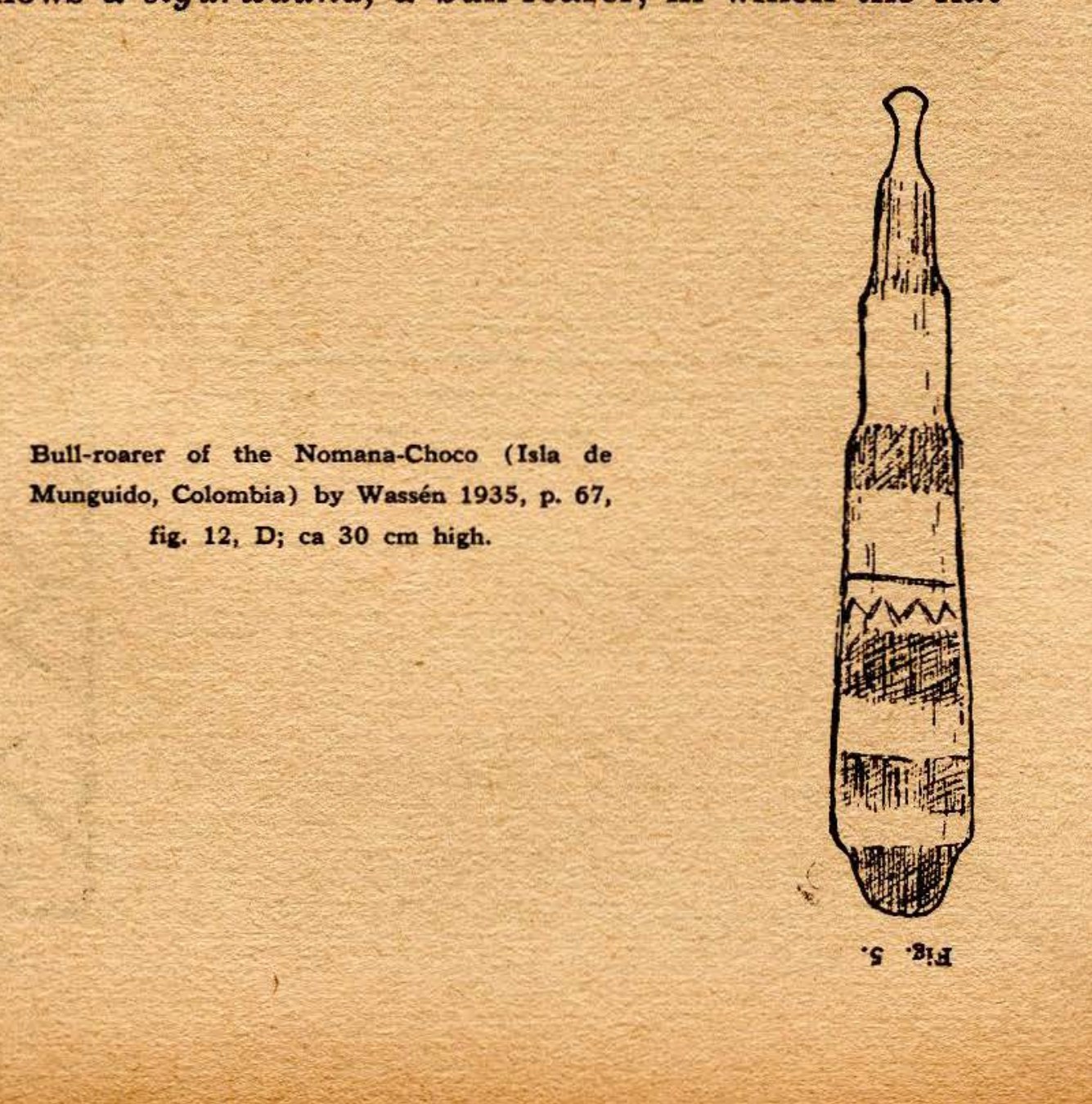
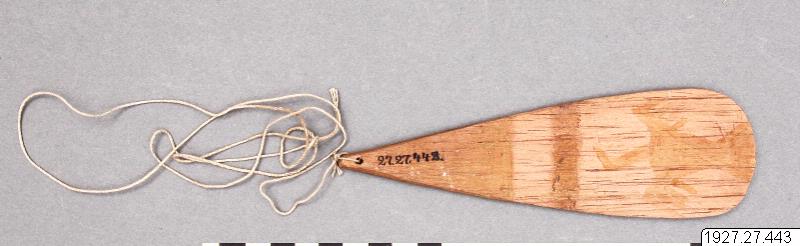
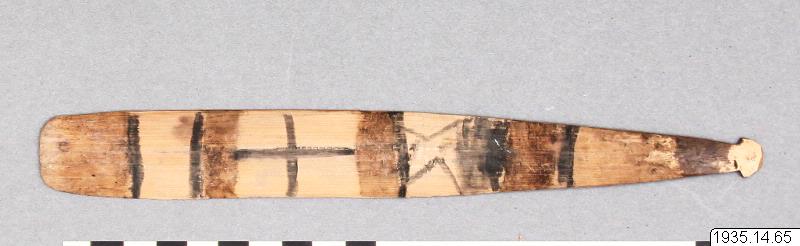
Among the Chocó of the Colombian and Panamanian rainforests the bull-roarer was chiefly a children's toy, roughly made and, in recent years, often painted with aniline dyes. Henry Wassén, working among the Noanamá in the 1930s, recorded its one magical use: an Indian who had to cross the forest alone at night, passing from one place to another, might carry a bull-roarer painted red with bija to frighten away evil spirits. Erland Nordenskiöld, on the Río Sambú, found painted wooden objects hung in the medicine men's huts during certain magical rites — figures of snakes, turtles, iguanas, eagles, and butterflies, some of them oval and giving the impression of bull-roarers, though the genuine whirled ones seemed to serve only as playthings. One Chocó bull-roarer he collected on the Sambú stood about sixteen centimeters high.
The bull-roarer is of course chiefly a toy, but I was told of one occasion where its use corresponds with its magical character among other tribes.
Wassén 1935:65-66 (Notes on Southern Groups of Choco Indians in Colombia), transcribed verbatim in Zerries 1953:290-291
Particulars
- Function
- Mostly a children's toy; sometimes carried through the forest at night, painted red with bija, to frighten evil spirits.
Sources
- Henry Wassén, "Notes on Southern Groups of Choco Indians in Colombia," Etnologiska Studier 1 (Göteborg, 1935), pp. 65-66, fig. 12 D, p. 67, via Zerries (1953) View
- Erland Nordenskiöld, Indianerna på Panamanäset (Stockholm, 1928), pp. 71-73, figs. 53 a-e, via Zerries (1953)
- Otto Zerries, 'The Bull-roarer among South American Indians,' Revista do Museu Paulista n.s. 7 (1953), pp. 290-291, 297-298, transcribing Wassén and Nordenskiöld