No. SA-Z1953-015
Bora tsíxtsi children's toy
Peru; Colombia · Northwestern Amazon · South America
Play / practical
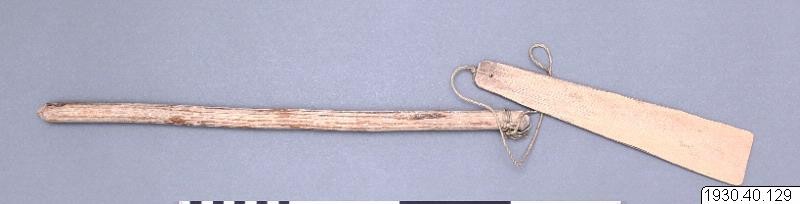
tsíxtsi
tsíxtsi = the Bora name for the bullroarer, which Tessmann found surviving only as a children's toy.
Among the Bora of the Peru–Colombia borderlands, Günter Tessmann recorded a men's festival, the emüõxa, for which a special house called baaxa was built; its first part he judged "evidently a renewal or resurrection festival," and at least in its main part a secret festival of the men. Each man blew a great trumpet before the house while the women were shut inside and danced there, and "the lord of the festival" carried the men's food out to them (Tessmann 1930:275). Tessmann took it for the same rite Koch-Grünberg had seen among the Tuyuka of the Rio Tiquié and called the Yurupary festival. The bullroarer itself does not figure in that account: Tessmann found it among the Bora only as a children's toy, recorded two pages earlier under its Bora name tsíxtsi (Tessmann 1930:273) — the same page from which Izikowitz independently lists the Bora bullroarer in his 1935 comparative survey. Otto Zerries, reporting Tessmann in his 1953 catalogue, supposed the instrument "had once been connected with ceremonial purposes" and suggested the Bora may have taken it from their Koto neighbors.
Der erste Teil des Festes ist offenbar ein Erneuerungsfest bezw. Auferstehungsfest. Es ist daher, wenigstens in seinem Hauptteil, ein Geheimfest der Männer. Jeder von ihnen bläst auf einer grossen Trompete ... vor dem Hause. Die Frauen sind dabei im Haus eingeschlossen und tanzen darin. Das Essen bringt "der Herr des Festes" den Männern heraus.
The first part of the festival is evidently a renewal or resurrection festival. It is therefore, at least in its main part, a secret festival of the men. Each of them blows a great trumpet ... in front of the house. The women are shut inside the house and dance there. "The lord of the festival" brings the food out to the men.
Tessmann 1930:275, quoted in Zerries 1953:286-287
Particulars
- Function
- Children's toy.
Sources
- Günter Tessmann, Die Indianer Nordost-Perus (Hamburg: Friederichsen, 1930), pp. 273, 275, via Zerries 1953, pp. 286-287
- Otto Zerries, 'The Bull-roarer among South American Indians,' Revista do Museu Paulista n.s. 7 (1953), pp. 286-287 View · archived
- Karl Gustav Izikowitz, Musical and Other Sound Instruments of the South American Indians (1935), p. 213