No. ROSTOVKP13042-001
Rostov engraved bone dragon
Russia · Rostov · Yaroslavl Oblast · Eastern Europe
Comparative object · Подвеска зооморфная (дракон)
Source term: Подвеска зооморфная (дракон)
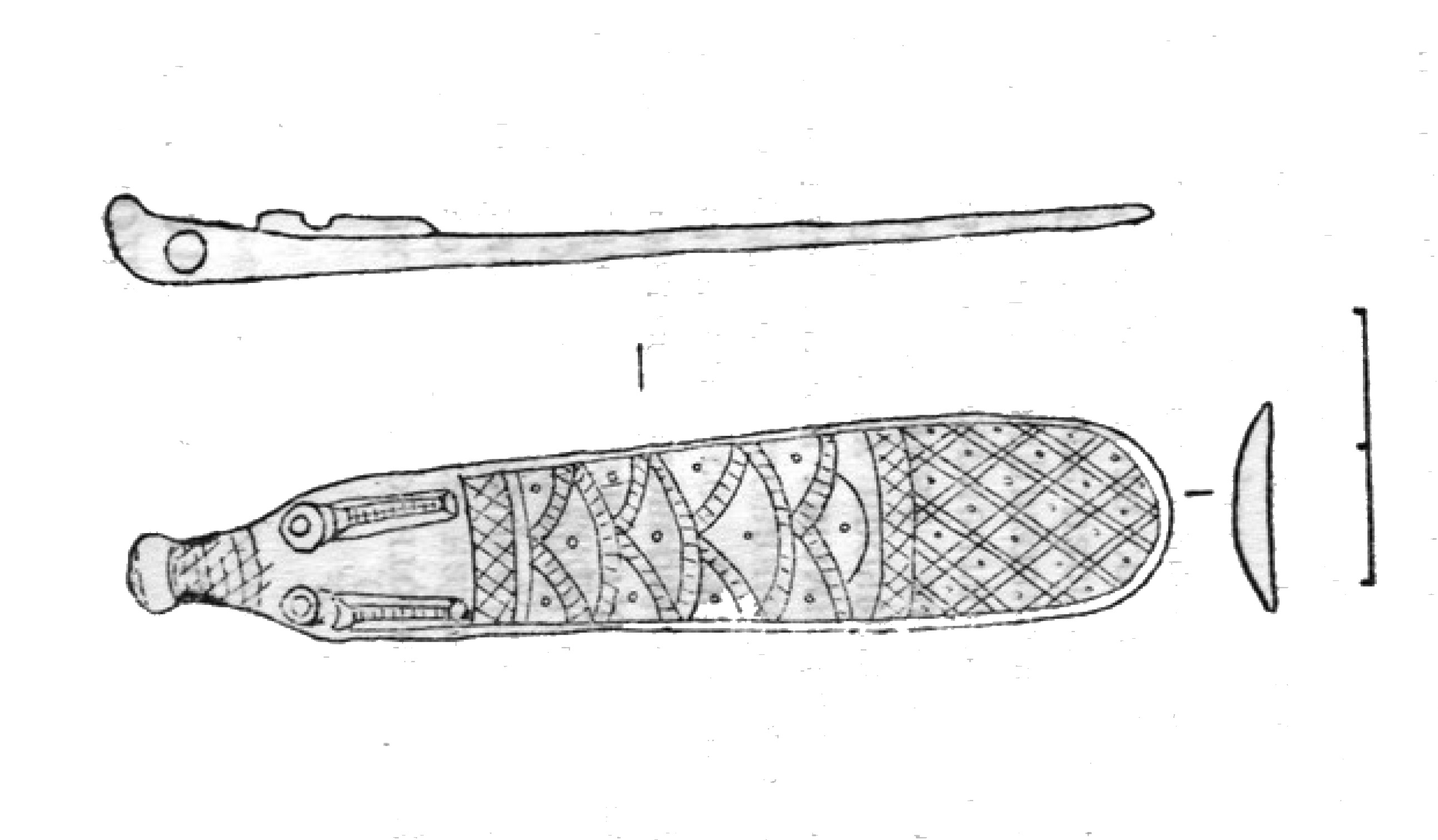
A flat bone dragon, no longer than a finger, narrows from its head to a rounded end. The head is the thick end, with relief eyes and ears and a hole bored clean through its jaws from side to side. Below, the polished body is engraved on one face only: tiers of dotted, scale-like arcs, then a net of dotted diamonds. Archaeologist Andrei Leontiev read the diamonds as signs of earth and the arcs above them as signs of heaven, a rare trace of the pre-Christian beliefs of Rostov’s first townspeople. It lay in a late-tenth-century layer, deposited just as Rostov became a Rus’ town. The Finnic Merya had long lived on this shore of Lake Nero; now a new town rose over their settlement, its earliest dated timber felled in 975, and in 988 the chronicle gave Rostov to Prince Yaroslav. The dragon’s three-lobed head matches carved ladle handles from Novgorod; its dots and arcs also decorate Merya bone scoops.
Вполне возможно и ее сакральное значение.
Its sacred significance is also quite possible.
A. E. Leontiev, Сообщения Ростовского музея III (1992), p. 129
Particulars
- Object
- Engraved bone dragon, 7.4 × 1.5 cm, with a shallow plano-convex body, thicker head and a 0.2 cm transverse bore through the mouth. The narrow body has dotted arc and scale patterns.
- Function
- Not recorded.
Sources
- Rostov Kremlin Museum / Yaroslavl State University CRIS. Подвеска зооморфная (дракон). РЯМЗ КП-13042/16, Инв. № А-153/16, ГК-8286871; attached drawing дракон2.jpg. View
- A.E.Leontiev, “Ростовская подвеска времен Ярослава Мудрого,” Сообщения Ростовского музея III (1992), pp.129–130. View
- A.E.Leontiev, “Заметки о ранней истории Ростова,” Сообщения Ростовского музея I (1991), pp.3–7. View