DAVIDSON2017-001 - archaeological find
Pig Bay bone kōrorohū
New Zealand - Pig Bay - Motutapu Island - Hauraki Gulf - Oceania - Polynesia
Archaeological datec. 1400–1500 ADPig Bay occupation range from radiocarbon dates; object came from a disturbance in Layer 8.
Play / practical Candidate only
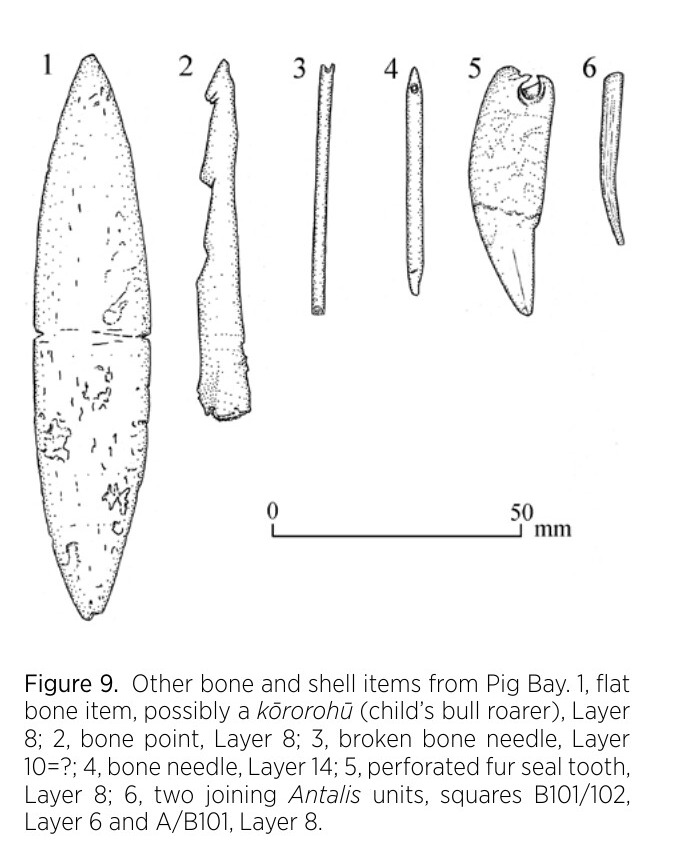
kōrorohū
Source term: probable bull roarer / kōrorohū
kōrorohū: Māori term used by the excavators for a child's bullroarer
Among Pig Bay's adze-making debris lay a carefully shaped piece of bone that looked like a child's kōrorohū. Its attachment was the puzzle: instead of drilled cord holes, the maker had cut only shallow notches. Those might never have held a whirling cord, and the object came from disturbed soil. It is a tantalising likeness, not a secure instrument.
In size and shape it resembles a kōrorohū, or child’s bullroarer.
Davidson and Leach 2017:17
- Object
- Carefully made flat bone object from a disturbance in Layer 8, square B101; its size and outline resemble a child's kōrorohū, but shallow edge notches replace the expected cord perforations.
- Function
- A possible child's kōrorohū: the excavators compare the bone blade to a toy bullroarer, while doubting that its shallow end notches could hold the cord.
- Source
- Janet Davidson and Foss Leach, Archaeological excavations at Pig Bay, Records of the Auckland Museum 52 (2017), with exact object description and figure
- Source location
Page references
printed p. 17; Fig. 9.1
- Source confidence
- low Approximate Pig Bay site anchor on northwestern Motutapu Island; not a square-level find coordinate.