The Bullroarer Atlas

PNG35 - ethnographic attestation

Bagabag Island

Papua New Guinea - Madang - Oceania - Sahul

Sacred / spirit

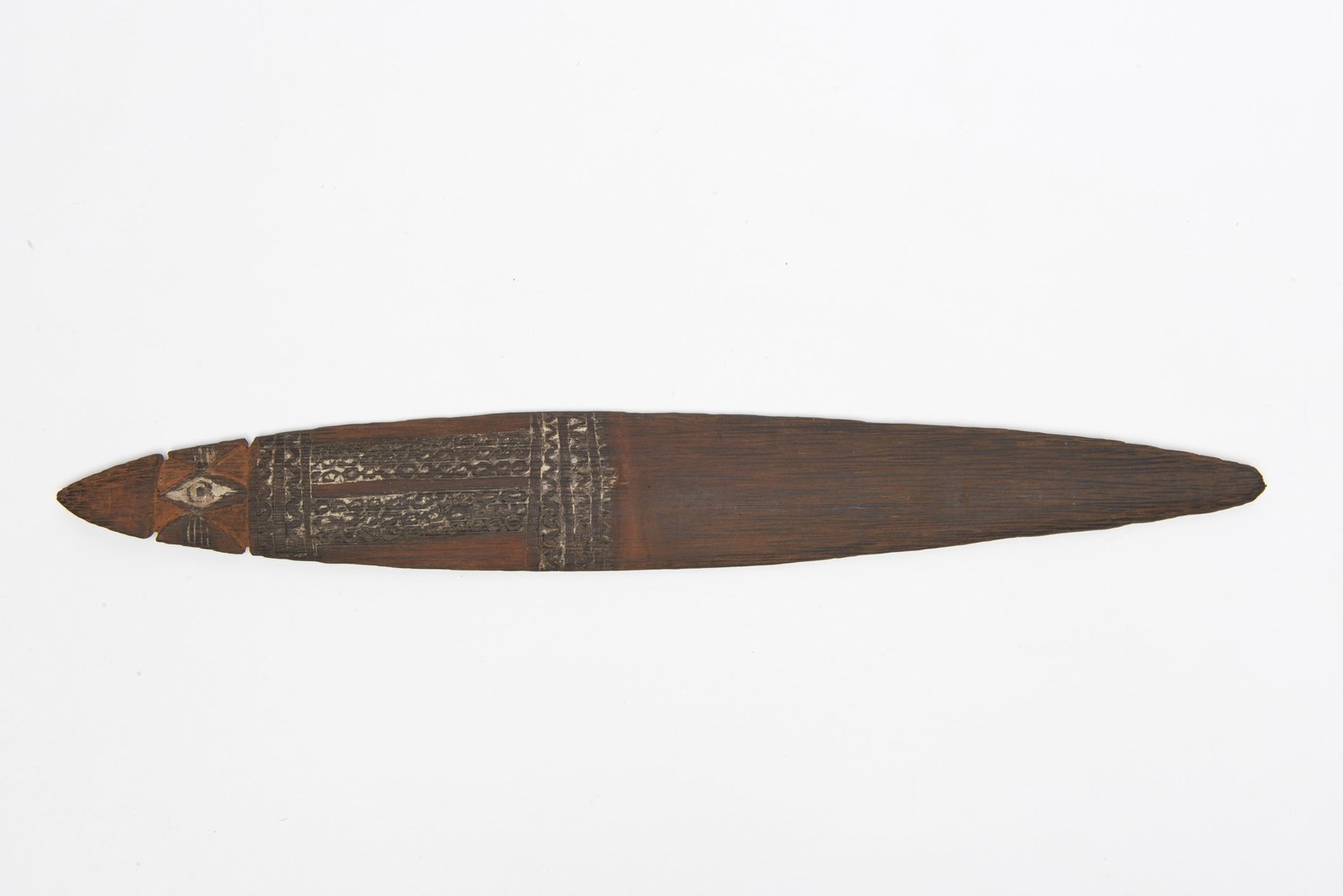
A bull-roarer from the Madang coast collected by Kapitän Rohde in the nineteenth century, its dark lens-shaped blade plain except at the head...
Representative image. A bull-roarer from the Madang coast collected by Kapitän Rohde in the nineteenth century, its dark lens-shaped blade plain except at the head end, where a white-rimmed eye stares from an ochre diamond above finely carved bands; no Bagabag Island bullroarer has been photographed, and the facing mainland coast is its nearest photographed neighbor. Übersee-Museum Bremen (D09870), coll. Kapitän Rohde CC BY-SA Image source

Source term: bullroarer / sacred flute / slit-gong flags

Bagabag is a roughly circular island, about seven kilometres across, lying off the Madang coast of New Guinea; its people speak Takia, an Austronesian language. The whole of its bullroarer record is one line in K.A. Gourlay's 1975 survey of New Guinea sound-producing instruments, where both the bullroarer and the slit-gong (garamut) are entered for the island. No rite, spirit-name, or local word for the bullroarer is preserved with the entry.

a Study of Esoteric Instruments and their Role in Male-female Relations

Gourlay 1975, Sound-Producing Instruments in Traditional Society (New Guinea Research Bulletin No. 60), subtitle
Object
bullroarer occurrence; bullroarer use; slit-gong occurrence; slit-gong use
Function
Gourlay source-catalog row with bullroarer use in PNG/Melanesia.
Map confidence
high - geocoded
Source location
Table 1, row 35

View source Open this point on the interactive map