No. PNG8
Tarawai Island
Papua New Guinea · East Sepik · Oceania · Sahul
Restricted
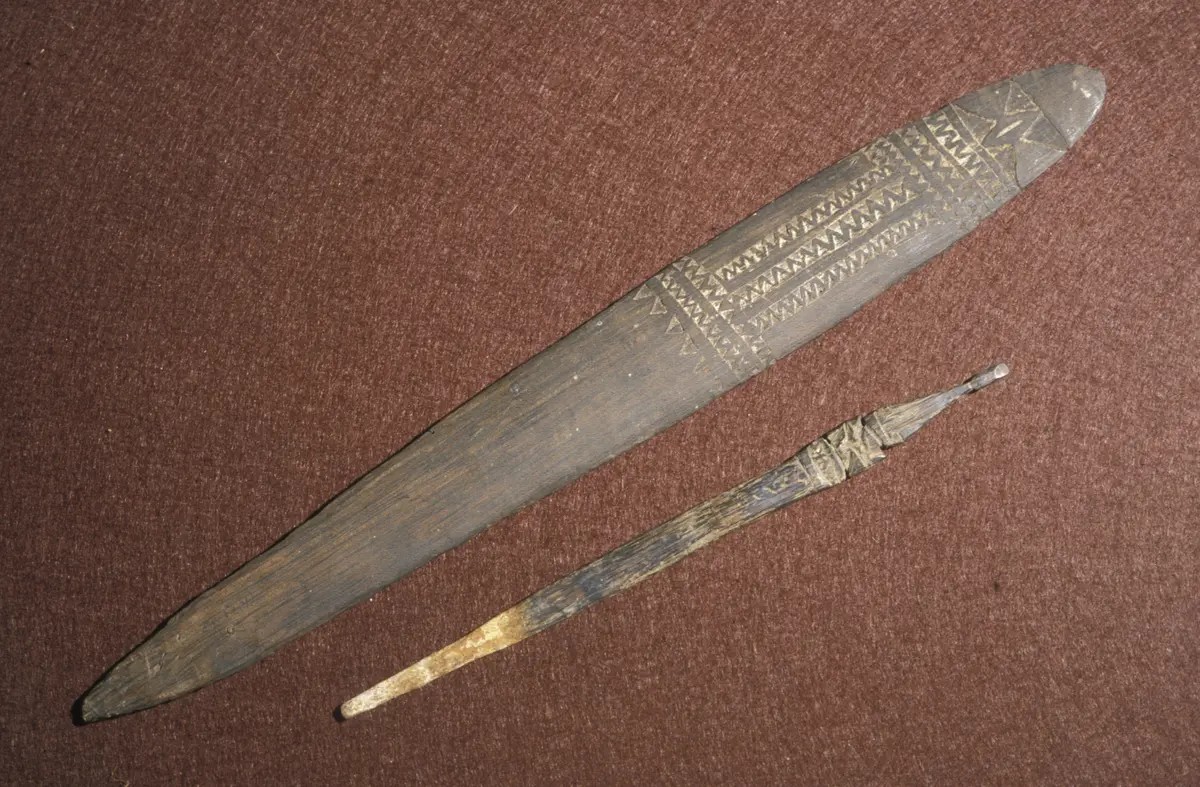
On Tarawai, one of three small islands in the Bismarck Sea that anchor the Boiken homeland off the East Sepik coast, the bullroarer was the voice of the wala. The wala were the Boiken supernaturals: great culture heroes of times past, some now incarnated as local mountains, others the male and female spirits of bush and stream. Their face was incised in abstract design on bullroarers, weapons, and even cooking and eating utensils. In former times, when the wife of an important man insulted her husband's sexuality, a band of men swinging the bullroarer came as "the wala" to destroy her household's belongings. The Boiken kept hand drums, monotone flutes, and the slit-gong on which relatives were summoned at a death.
All wala are believed to be formed by the mystical union of ancestral shades.
Paul B. Roscoe, “Yangoru Boiken,” Encyclopedia of World Cultures, vol. 2: Oceania (1991), pp. 388–391
Sources
- K. A. Gourlay, Sound-Producing Instruments in Traditional Society: A Study of Esoteric Instruments and Their Role in Male-Female Relations, New Guinea Research Bulletin 60 (Canberra and Port Moresby, 1975), Table 1, entry 8 View
- Paul B. Roscoe, “Yangoru Boiken,” Encyclopedia of World Cultures, vol. 2: Oceania (1991), pp. 388–391