No. PNG148
Möwehafen
Papua New Guinea · West New Britain · Oceania · Sahul
Restricted
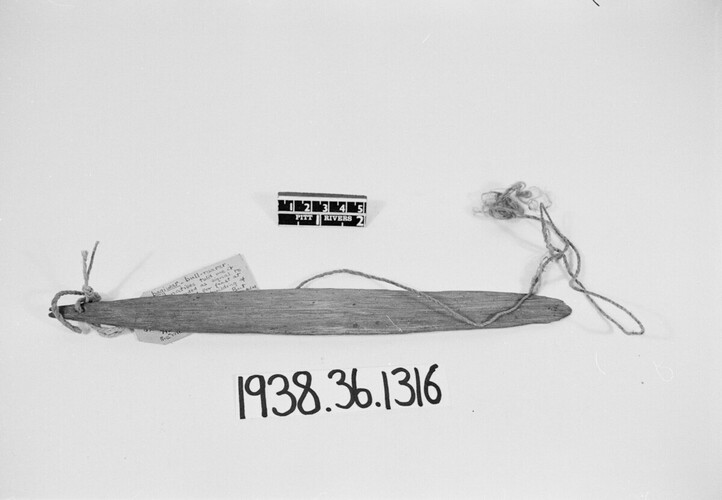
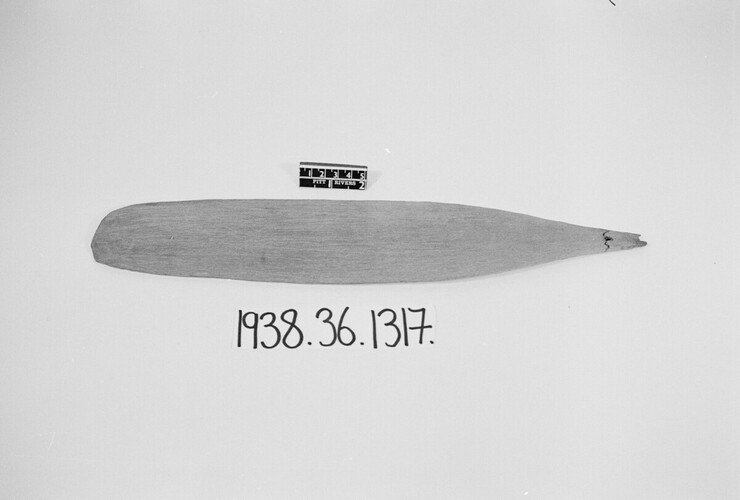
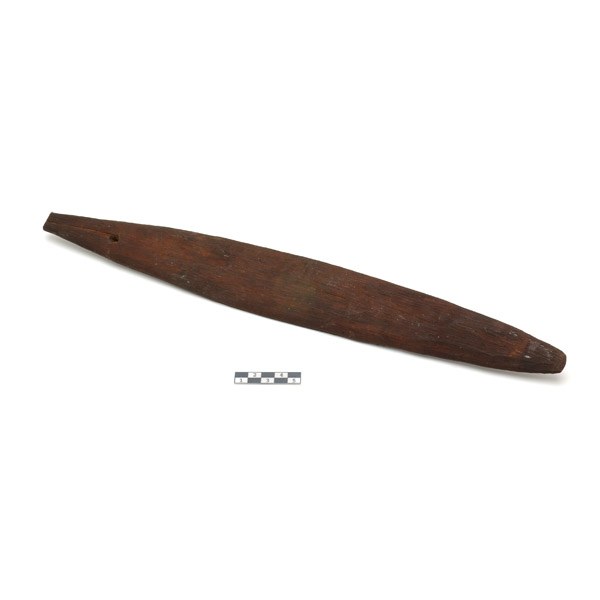
Each year on the south coast of West New Britain, boys bought their way into a circumcision cult with shell money, del, as a masked spirit named Mewo — cone-hatted, sheathed in banana leaves — emerged from a house set apart from the other huts. Across this coast, circumcision festivals also used the bullroarer, a wooden lancet on a three-metre cord whirled from a long pole: its drone was the voice of a spirit forbidden to women. The women cooked the feast but were barred from it, leaving the food at the ground's edge. Richard Parkinson recorded it at Möwehafen in 1907. Unusually, at Möwehafen girls as well as boys were shown the roarers at initiation.
Particulars
- Object
- Plain elongated wooden slats with terminal attachment points: two Arawe Pagiwar blades from Kandrian (Möwehafen), the smaller retaining its cord, and a 46 cm blade from Arawe Island.
Source
Richard Parkinson, Dreissig Jahre in der Südsee (Stuttgart, 1907), pp. 638–641, fig. 115; K. A. Gourlay, Sound-Producing Instruments in Traditional Society, New Guinea Research Bulletin 60 (Canberra, 1975), Table 1, entry 148, and p. 46; Pitt Rivers Museum, Oxford, 1938.36.1316–1317; Musée d'ethnographie de Genève, ETHOC 016688