No. PATTERSON2024-001Europe
Chumbley's rhomb in the Constantine grove
United Kingdom · Constantine, near Falmouth, Cornwall · Europe · British Isles
Sacred / spirit
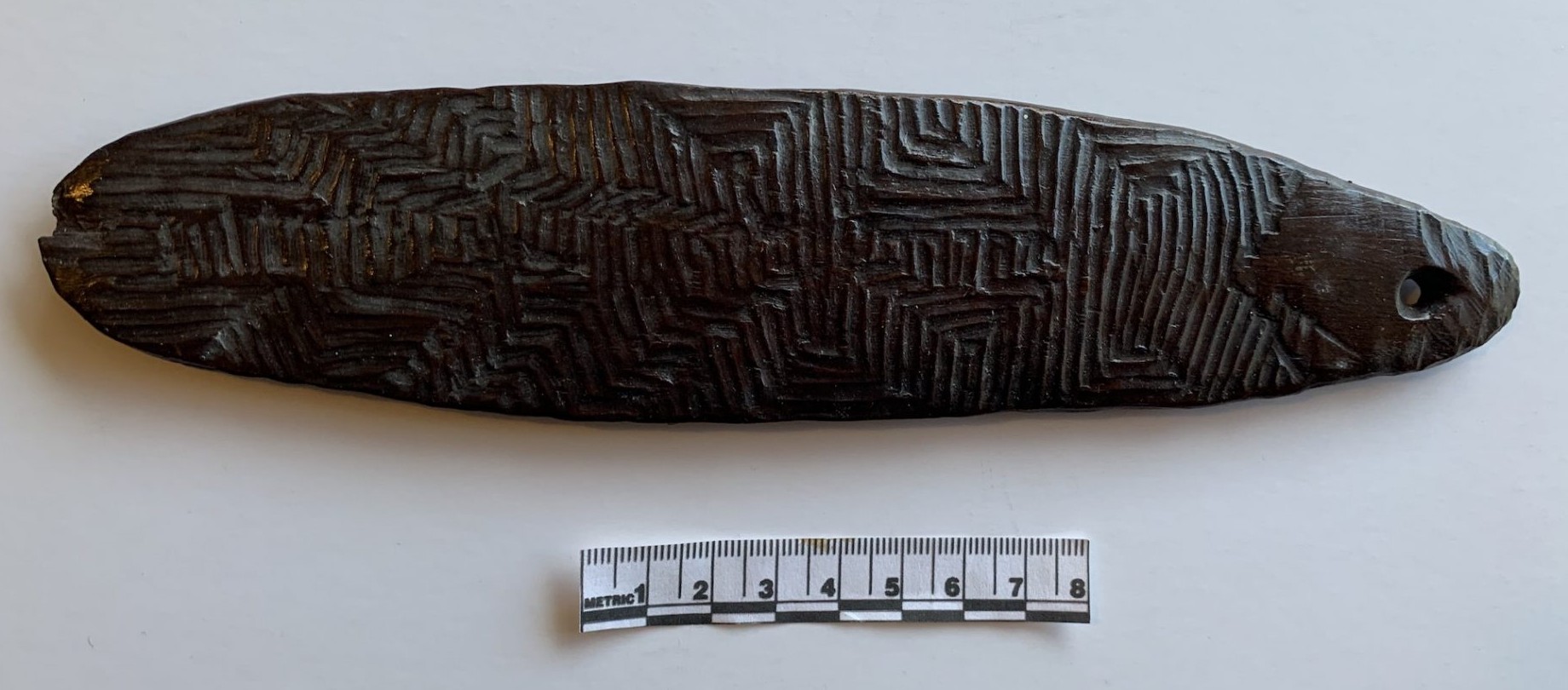
rhomb
Source term: bull-roarer or 'rhomb'
rhomb: from Greek rhombos, the whirled roarer of the ancient mysteries, a name taken up by modern magicians for the bullroarer.
In the last years before his death in 2004, the Essex magician Andrew Chumbley carried his Sabbatic witchcraft into Cornwall and stripped it down. The elaborate Draconian rites of his Dragon Book gave way to simple charms worked in the open, at places taken for nodes of power in the land. One was a quarry behind the village of Constantine, where a huge egg-shaped tolmen had balanced on two pillars of rock until it was dislodged in 1869. Steve Patterson, a Cornish Old Craft initiate who worked beside him, chose it, holding that quarries are charged with spirit where mines drain it. In a grove by the quarry Chumbley whirled a rhomb, a wooden blade on a thread that bellowed like a bull, while he worked magical formulae of charged syllables; a great stone in a nearby field served as the altar.
Chumbley and the Cultus also worked in a grove near the quarry itself, at which he used a bull-roarer or “rhomb” (a wooden device on a thread that emanated a bellowing, bull-like sound when whirled) in conjunction with magical formulae consisting of charged phonemes
Steve Patterson and Jeff Howard, Praxis-Knowledge 1 (2024), p. 9
Particulars
- Object
- A wooden rhomb on a thread, whirled to give a bellowing, bull-like sound.
- Function
- Whirled in a grove beside the quarry with magical formulae of charged phonemes, in the Cultus Sabbati's landscape spirit-contact workings of the early 2000s.
Source
Steve Patterson and Jeff Howard, 'To Reveal the Hidden Kingdom of Eld: Andrew Chumbley, the Cultus Sabbati, and Imaginal Space in Cornwall,' Praxis-Knowledge 1 (2024), pp. 5-9