No. HAD1898-002
North-east Ireland boomer bullroarer
United Kingdom · North-east Ireland · Europe · British Isles
Play / practical
Source term: bull-roarer / boomer
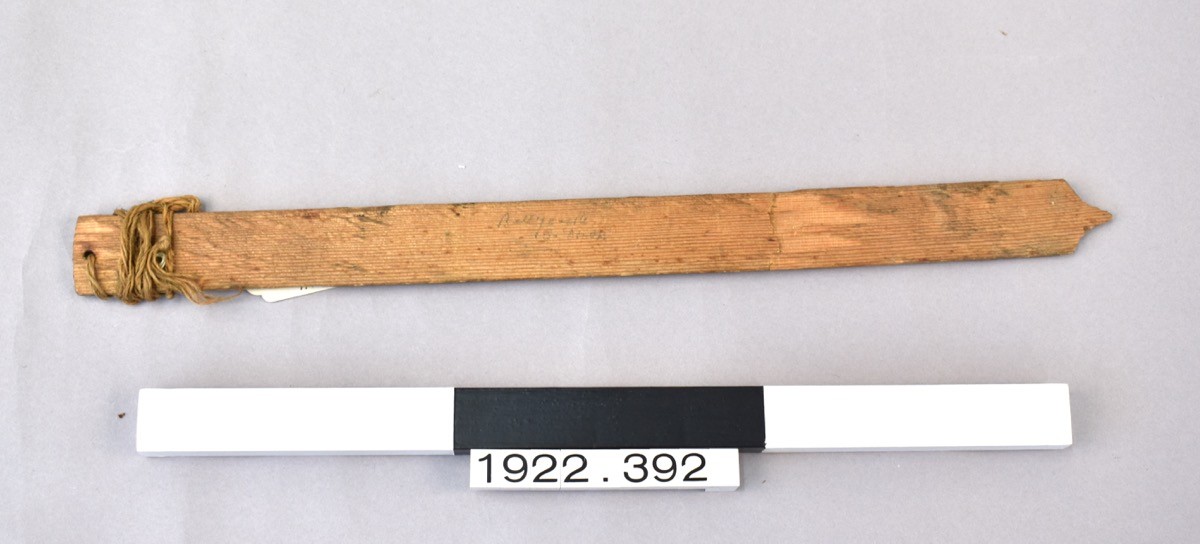
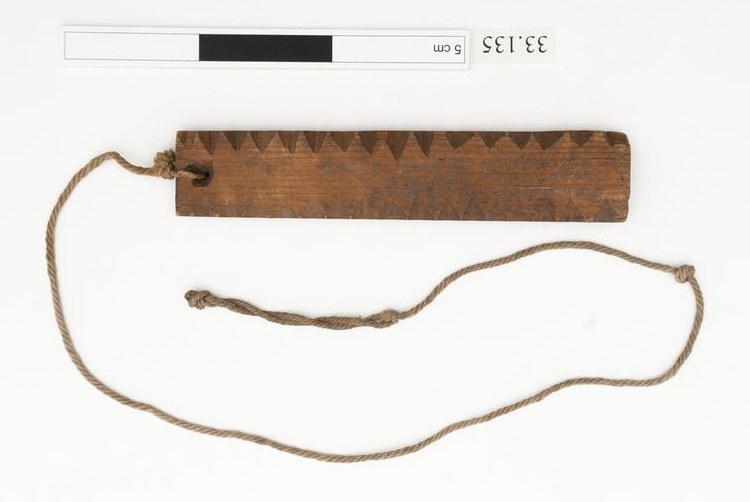
When Haddon wrote, he had only two notices of the bull-roarer from Ireland: one from Cork, the other a long narrow lath, pointed at one end, that the Rev. J. P. Barnes sent him from Ballycastle in County Antrim. Barnes concluded the thing was not indigenous but an importation. The boy who gave it to him had learned it from his father, a coastguard, who once tied a string to a piece of wood by the fireside and twirled it for the children's amusement, saying it was what he had seen done in the West Indies. The form, Haddon noticed, resembled the Oro-stick of West Africa—the whirled voice of Oro, the Yoruba god of terror and vengeance—more than any English example, and he allowed himself the thought that "the dreaded god of vengeance of West Africa should become the plaything of a boy in the north of Ireland." Schoolboys in Coleraine were said to make them often, and among boys in County Down the toy went by the name "boomer." One faint detail kept it from being wholly profane: an informant told Haddon that once, as a boy playing with a boomer, an old country woman said it was a "sacred" thing. Haddon added only that it would be worth while to follow up the clue.
Since the above was in type I have been informed that "boomers" are in common use among boys in Co. Down. They are notched in various ways, sometimes on one side only; they appear, in fact, to be of very diverse form.
Haddon 1898, The Study of Man, p. 283 (footnote)
Particulars
- Function
- Schoolboys' noise-maker, swung on a cord for its roar.
Source
Haddon 1898, The Study of Man, Chapter X: The Bull-Roarer