No. LANG1884-001
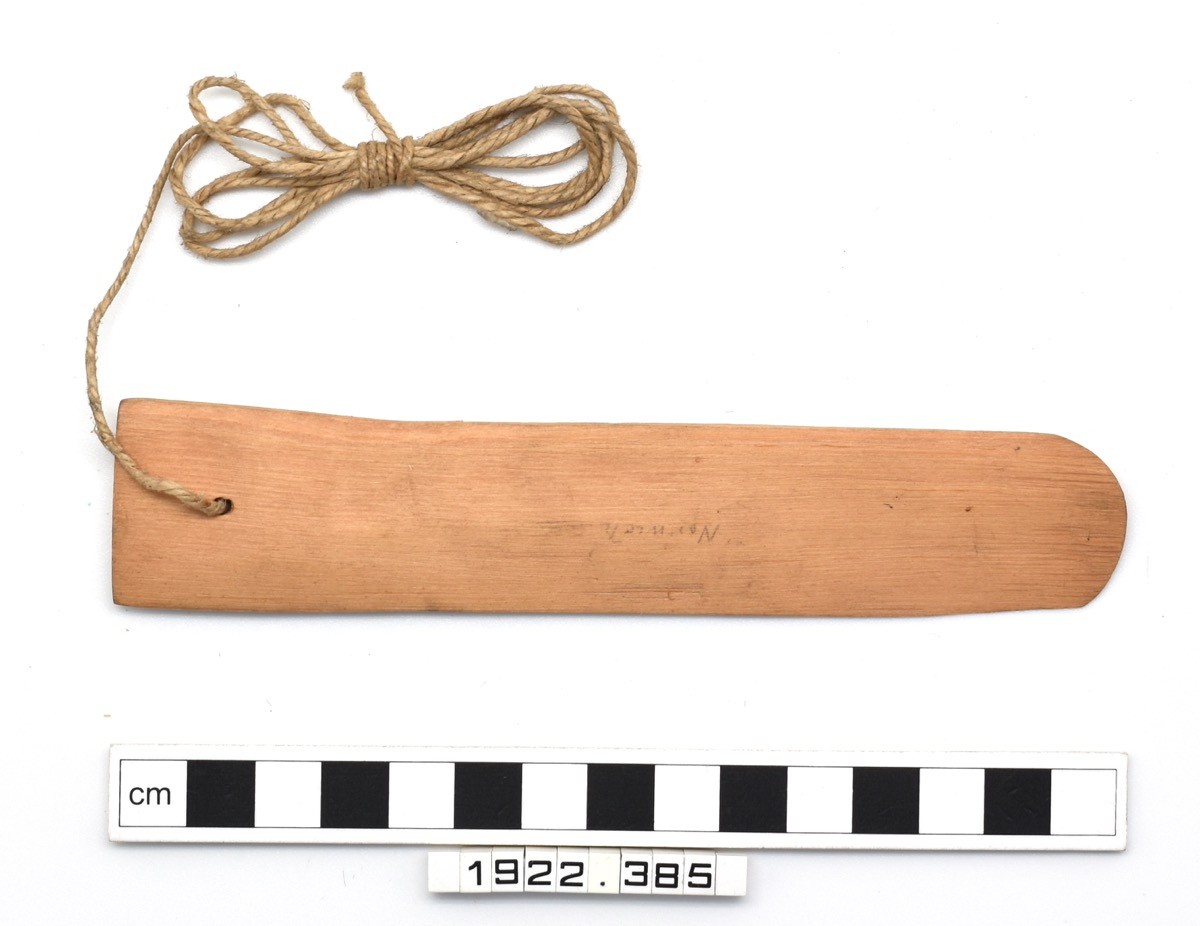
English country-boys bullroarer toy
United Kingdom · England · Europe · British Isles
Play / practical
Source term: bull-roarer
For Andrew Lang, the bull-roarer that warned women away from Australian tribal mysteries was no exotic instrument at all but "a toy familiar to English country lads." In Custom and Myth (1884) he set out, "in the interests of science," how it is made — a piece of the commonest wooden board, "say the lid of a packing-case," cut to roughly the shape of a large bay-leaf and tied to a strong string. Whirled fast on its cord it produced what Lang called "a most horrible and unexampled din," a mighty rushing noise as if some supernatural being "fluttered and buzzed his wings with fearful roar." He warned that the thing would "almost infallibly break all that is fragile in the house" and "probably put out the eyes of some of the inhabitants." The anthropologist E. B. Tylor had once whirled one before an audience at the Royal Institution, where at first it did nothing particular until it "warmed to its work." Boys, Lang wrote, had always known it in England as one of the most efficient modes of making the hideous and unearthly noises in which it is the privilege of youth to delight.
As the belated traveller makes his way through the monotonous plains of Australia … he occasionally hears a singular sound. … If he be an Englishman, country-bred, he says to himself, 'Why, that is the bull-roarer.'
Lang, Custom and Myth (1884), "The Bull-Roarer: A Study of the Mysteries," p. 29
Particulars
- Object
- A piece of common board about eight inches long, three broad and a sixth of an inch thick, its ends sharpened, on a string about thirty inches long.
- Function
- Secular toy/noise-maker in English country-boy use.
Source
Lang, Custom and Myth, Longmans, Green, and Co. 1884, chapter 'The Bull-Roarer: A Study of the Mysteries'; Project Gutenberg ebook 14080