No. NIMUENDAJU1919-001
Xipaya warī warī sámį, Curuá River
Brazil · Upper Curuá River · Iriri–Xingu, Pará · South America
Restricted
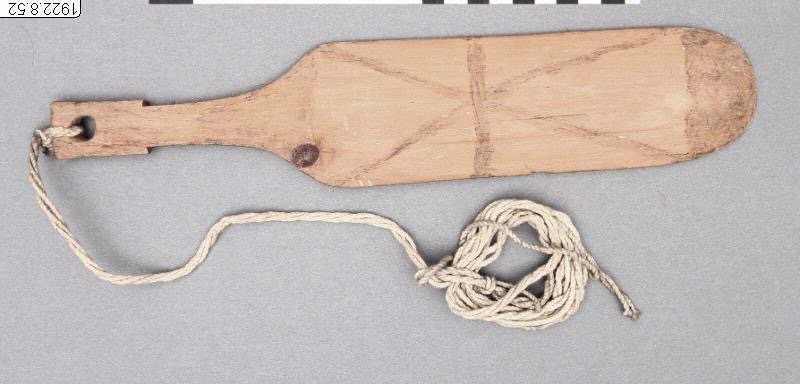
warī warī sámį
Source term: Schwirrholz
warī warī sámį = “ceaselessly turning” + the Xipaya word for a male kinsman in the ascending line (Nimuendajú’s gloss).
After midnight, in the night-long circle dance of the Zetáβia feast, a new voice joined the singing and the great bamboo flutes: the warī warī sámį — “ceaselessly turning,” joined to the word for a male forebear, a whirled forefather. It sounded for the cult of the national demon Kumãphári, whom the Xipaya of the Curuá River honored as Şękárika, “Our Creator.” His carved post stood in the festhouse, dressed by women given to the demon as wives — the same women who held the ends of his flutes — while the shaman sat motionless beside it until dawn. Around the whirring instrument the rules closed tight: speaking of it brought sickness and misfortune, and women and children could not come near. Yet the same people cut paddle-shaped bullroarers as open toys for their children; the blade Nimuendajú collected at Boca do Baú is one of them. By the time he asked, in 1918–19, the last shaman able to lead the cult was dead, and the whirled forefather survived only in memory.
die Šipáia nannten es Warī warī sámį … und scheuten sich außerordentlich, darüber zu reden, denn es brächte Krankheit und Unglück; die Frauen und Kinder dürften ihm deshalb auch nicht nahekommen
The Xipaya called it warī warī sámį … and were extraordinarily reluctant to speak of it, for it would bring sickness and misfortune; women and children, therefore, were not allowed to come near it.
Curt Nimuendajú, Bruchstücke aus Religion und Überlieferung der Šipáia-Indianer, Anthropos 14/15 (1919/20), p. 1027.
Particulars
- Object
- Paddle-shaped wooden toy bullroarer, 31 cm, with incised cross-hatch lines and a plied swing-cord through a hole in the handle end — SMVK 1922.08.0052, collected by Nimuendajú at Boca do Baú. The sacred warī warī sámį was round-oval; no drawing of it survives.
- Function
- Sacred: joined the singing and the parí zetáβia flutes after midnight in the Zetáβia dance of the Kumãphári cult — taboo to speak of, forbidden to women and children to approach. Paddle-shaped bullroarers were open children’s toys.