No. NAEXP-002
Teton Dakota bull-roarer toy (Dorsey)
United States · South Dakota (Teton Lakota territory) · North America · Plains
Play / practical
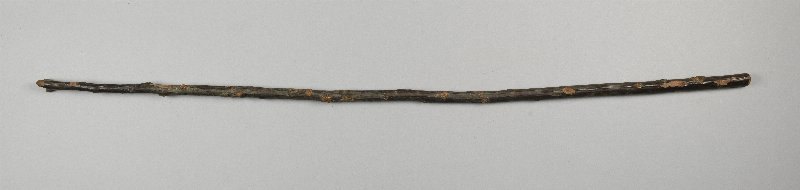
Chan'kabletuntun'pi
Source term: bull-roarer
"Wood having edges," the Teton Dakota name J. Owen Dorsey recorded for the four-edged whirling stick
Etymology. Dorsey glosses Chan'kabletuntun'pi as "wood having edges," matching the four-edged slat he describes.
Among the Teton Dakota, J. Owen Dorsey recorded a boy's whizzer: a straight stick worked to four edges, fastened by a strip of hide to a second piece of wood that served as a handle. Grasping the handle and whirling the four-cornered blade around his head, the boy set it moving with a whizzing noise. Dorsey's account appears in his 1891 paper on Teton Dakota children's games and was reprinted by Stewart Culin in his 1907 survey of North American Indian games, under the name Dorsey glossed as "wood having edges." Culin placed it among the playthings he took to be borrowed from the bull-roarers used ceremonially by the Hopi, Zuni, Navaho, and Apache; in Dorsey's report it is only a boy's toy.
A straight piece of wood is prepared, with four sides or edges, and is fastened by a strip of hide to another piece of wood which is used as a handle. The boy grasps the handle, whirls it around his head, making the four-cornered piece move rapidly with a whizzing noise.
J. Owen Dorsey, "Games of Teton Dakota Children," American Anthropologist o.s. 4:343 (1891), as quoted in Culin, Games of the North American Indians (1907:750)
Particulars
- Object
- Straight four-edged piece of wood fastened by a hide strip to a handle; whirled around the head with a whizzing noise.
- Function
- Boy's plaything described by J. Owen Dorsey; Culin's frame derives the toy from ceremonial use.
Source
J. Owen Dorsey, 'Games of Teton Dakota Children,' American Anthropologist o.s. 4(4) (1891): 329-346, at p. 343; quoted in Stewart Culin, Games of the North American Indians (BAE 24th Annual Report, 1907), p. 750