No. MUS2026-005
Chankabletuntunpi, a Lakota boy's toy
United States · South Dakota (Standing Rock) · North America · Plains
Play / practical
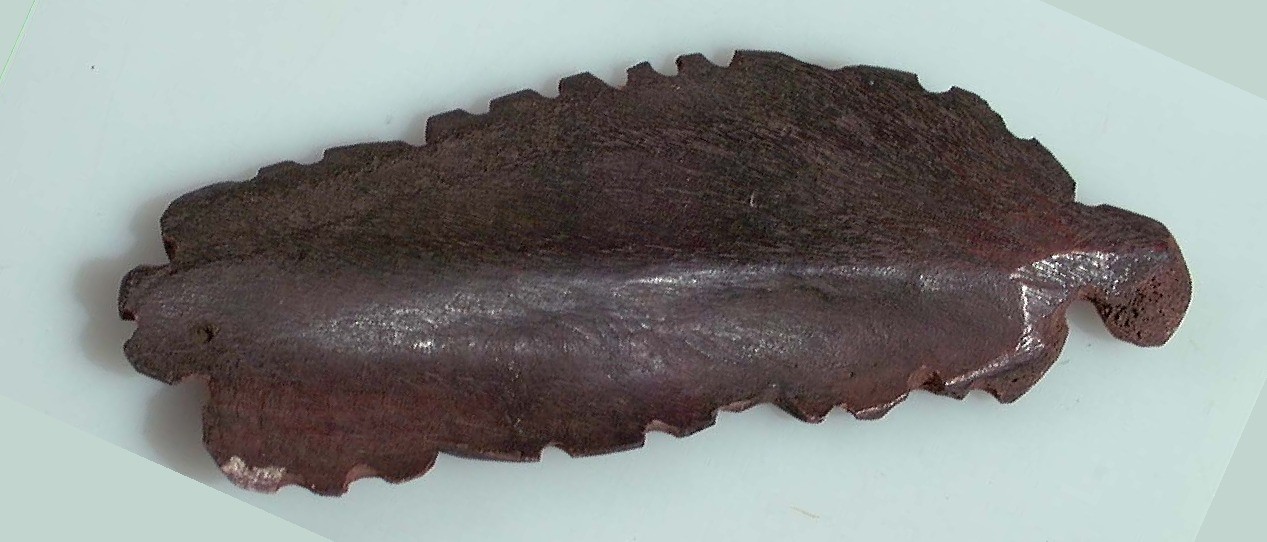
Source term: bull-roarer
chankabletuntunpi (Teton/Lakota): "wood having edges," the Dakota name for the bull-roarer, a four-edged slat fastened by a hide strip to a handle and whirled to make a whizzing roar (Dorsey 1891).
A Hunkpapa Lakota bull-roarer carved from animal bone and notched like a saw along both edges, held in the Smithsonian's National Museum of the American Indian. Where the Lakota use of the instrument is recorded, it is a boys' toy: J. Owen Dorsey, working among the Teton Dakota, set it down as chankabletuntunpi, "wood having edges" — a four-sided piece tied by a hide strip to a handle, which a boy grips and whirls around his head to make it roar. Collectors recorded the same among the neighboring Oglala (a boy's plaything) and Omaha. Tellingly, the ceremonial bull-roarer of the American West belonged to the Hopi, Zuni, Navaho, and Apache, not to the Sioux, for whom the documented life of the whirled slat was play, not cult.
Chan'kabletuntun'pi, Wood having edges... A straight piece of wood is prepared, with four sides or edges, and is fastened by a strip of hide to another piece of wood which is used as a handle. The boy grasps the handle, whirls it around his head, making the four-cornered piece move rapidly with a whizzing noise.
J. Owen Dorsey, "Games of Teton Dakota Children," American Anthropologist (o.s.) 4(4):343 (1891), as reproduced in Culin, Games of the North American Indians (1907), p. 750.
Particulars
- Object
- Bull-roarer of the Hunkpapa Lakota, carved from animal bone and notched along both edges; in the collection of the Smithsonian's National Museum of the American Indian (NMAI).
Source
J. Owen Dorsey, 'Games of Teton Dakota Children,' American Anthropologist o.s. 4(4) (1891): 329-346, at p. 343; Stewart Culin, Games of the North American Indians (24th Annual Report of the Bureau of American Ethnology, 1907), pp. 750-751