No. NAAIN-021
Sicangu Lakota Tateka yumunpi wind buzzer bullroarer
United States · South Dakota · Rosebud Sioux Reservation · North America · Plains
Play / practical
Tateka yumunpi
Source term: Tateka yumunpi; Wind Buzzer (Bull Roarer)
Lakota name glossed in the source as "Wind Buzzer (Bull Roarer)."
Etymology. Sicangu Lakota, glossed in the SDSU Extension source as "Wind Buzzer (Bull Roarer)." The name joins tȟaté 'wind' with the stem yumni 'to whirl, turn round' — the same root as in tȟaté-iyumni, 'whirlwind' — and the plural -pi, so it reads roughly as 'they whirl the wind.' It names a boys' toy spun by a handle until it buzzes.
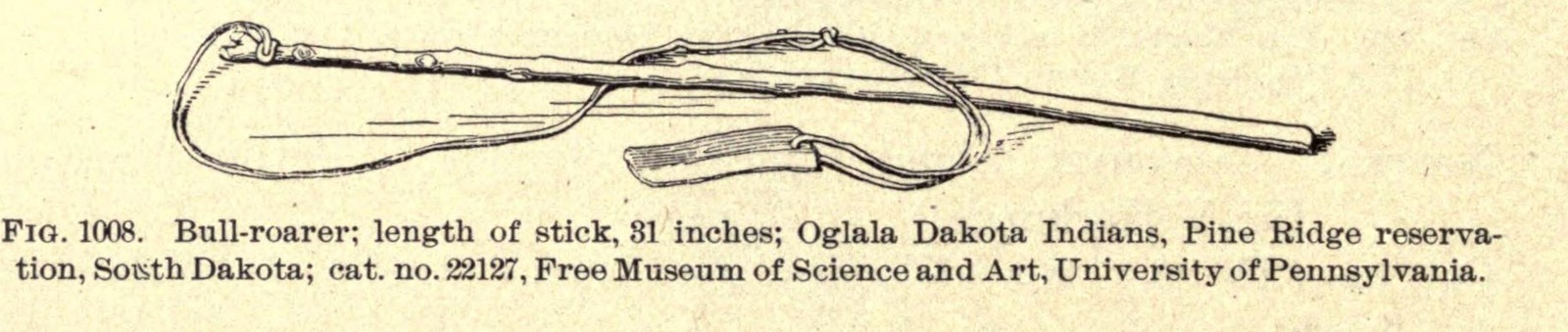
A Sicangu Lakota boys' game in which a rectangular wooden plank, tied by a leather thong to a wooden wand, is gripped by the handle and spun vigorously until it buzzes, with players competing to keep the sound going longest — an effort that strains and tightens the arm. The Lakota artist Mike Marshall, born on the Rosebud Sioux Reservation, says cedar is the best wood for a toy meant to make sound, and that the tip of the plank can be beveled to cut the wind and pull a louder note from it. Most buzzers are left plain, though some are decorated with burned-in designs. The same Lakota name was set down more than a century earlier in Stewart Culin's survey of North American games, where a thin rectangular plank on a thong, collected at Pine Ridge by Louis L. Meeker, is recorded as a boy's plaything called tateka yuhmunpi.
This game was traditionally played by boys. They held it by the handle and spun it around vigorously, thus creating a buzzing noise. Participants can compete to see who can keep it buzzing for the longest duration.
Red Eagle & Marshall, Dakota & Lakota Traditional Games Resource (SDSU Extension, 2019), "Tateka yumunpi / Wind Buzzer (Bull Roarer)," p. 17
Particulars
- Object
- A rectangular wooden plank joined by a leather thong to a wooden handle or wand; pierced for the thong, the plank may be beveled at the tip.
- Function
- Sicangu Lakota boys' traditional game / wind buzzer; players spin it vigorously by the handle to make a buzzing noise and can compete for duration.
Source
Jeremy Red Eagle & Mike Marshall, Dakota & Lakota Traditional Games Resource (SDSU Extension, 2019), “Tateka yumunpi / Wind Buzzer (Bull Roarer),” PDF p. 17