No. NAEXP-001
Oglala Dakota (Pine Ridge) bull-roarer toy
United States · Pine Ridge Reservation, South Dakota · North America · Plains
Play / practical
tateka yuhmunpi
Source term: bull-roarer
The name Louis L. Meeker recorded among the Oglala for the bull-roarer.
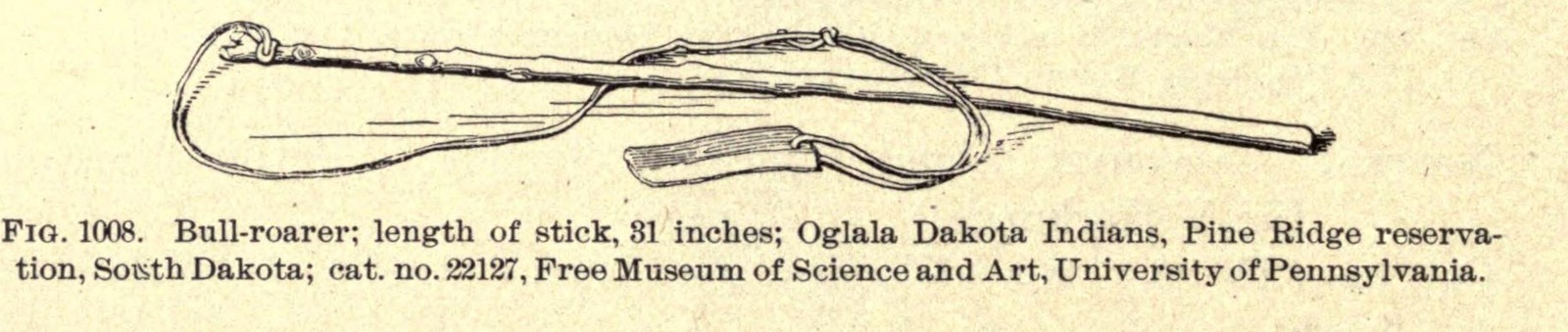
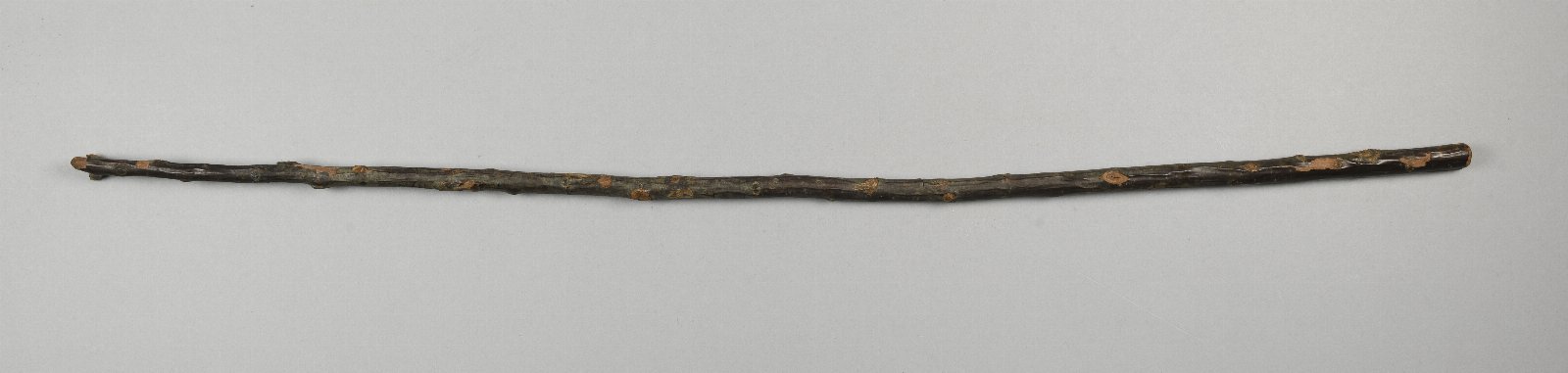
At Pine Ridge the collector Louis L. Meeker found a thin flat rectangular slat of wood tied by a thirty-six-inch thong to the end of a long stick, and recorded it as a boy's plaything that the Oglala called tateka yuhmunpi — the kind of bull-roarer a child whirls overhead to make a whizzing roar. Meeker gave it to the Free Museum of Science and Art at the University of Pennsylvania in 1900, and Stewart Culin figured it as number 22127 in his 1907 survey of Native games. Culin opened his bull-roarer section by calling the toy form "presumably borrowed from the implement used in religious rites" of the Hopi, Zuñi, Navaho, Apache, and other tribes, but for this Oglala specimen he recorded only the plaything and its name.
This is described by the collector, Mr Louis L. Meeker, as a boy's plaything, under the name of tateka yuhmunpi.
Culin 1907, Games of the North American Indians (BAE 24th Annual Report):750
Particulars
- Object
- Thin flat rectangular wood, 1¼ x 5¾ in., on a 36-in. thong tied to a 31-in. stick (Free Museum of Science and Art, Univ. Pennsylvania, no. 22127).
Source
Stewart Culin, 'Games of the North American Indians', BAE 24th Annual Report (1907), p. 750, fig. 1008, citing Louis L. Meeker, 'Ogalala Games', Bulletin of the Free Museum of Science and Art 3 (1901): 34