NA-S1952-014 - secondary catalog
Tonto Apache shamanic curing bullroarer
United States - Southwest - North America
Sacred / spirit
Source term: bullroarer
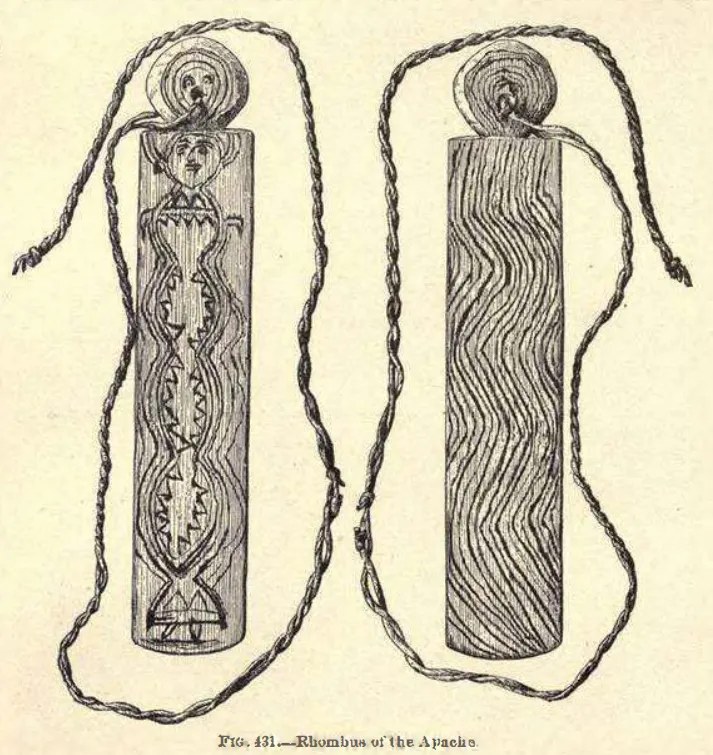
Among the Apache, the bullroarer was cut by the medicine-men from pine or fir that had been struck by lightning on the mountain tops — such wood, Captain John G. Bourke recorded, "is held in the highest estimation among them, and is used for the manufacture of amulets of especial efficacy." Bourke, who saw the instrument in the 1880s, gave its name as tzi-ditindi, "the sounding wood," and was told that the lines painted on its front were the entrails of the wind god and those on the rear his hair, of several colors, representing the lightning. Twirled rapidly about the head and from front to rear, it imitated the sound of a gust of rain-laden wind; by making that sound, one medicine-man explained, "they compelled the wind and rain to come to the aid of the crops." Among the Tonto Apache, Bourke noted, the brother of the head chief Cha-ut-lip-un was himself the great medicine-man.
The rhombus of the Apache was made by the medicine-men from wood, generally pine or fir, which had been struck by lightning on the mountain tops.
Bourke 1892, The Medicine-Men of the Apache (Ninth Annual Report of the Bureau of Ethnology), pp. 476-477
- Map confidence
- medium - regional_anchor: Representative central Arizona anchor; exact source and locality remain broad in Seder
- Source location
- 51-54