No. BOURKE1892-003
Verde Valley cliff-dweller rhombus
United States · Verde Valley, central Arizona · North America
Sacred / spirit
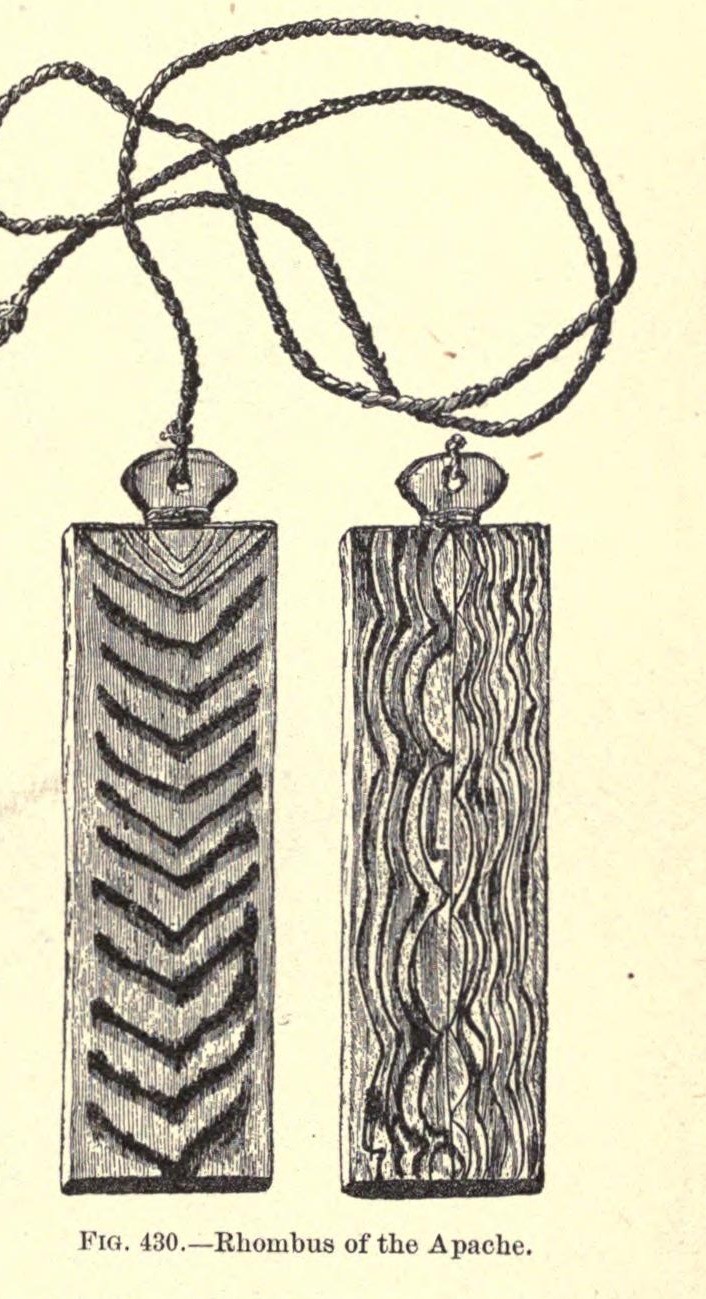
Source term: rhombus / bull roarer
Examining cliff-dweller ruins in the Verde Valley of central Arizona, the soldier-ethnographer John G. Bourke concluded that the prehistoric inhabitants had used the rhombus, or bull-roarer, in their dealings with their gods — the same rain-summoning whirled instrument he had documented among the living Apache. The Apache rhombus he describes was an oblong of pine or fir, seven or eight inches long, cut from a tree struck by lightning on a mountaintop, one end rounded to suggest a human head; medicine-men twirled it about the head to imitate the sound of a gust of rain-laden wind, and read the lines on its faces as the entrails and the many-colored, lightning-hued hair of the wind god. His 1884 Snake-Dance narrative dates the find and doubles it: digging in one of the old cliff-dwellings near the Rio Verde in 1882, he uncovered two small fragments of wood, "one shaped exactly like the snake sling of the Moquis, but unpainted," the other like an Apache fire-stick — and he offered them as evidence for the prehistoric reach of the snake cult, in the same breath as a potsherd from Camp Grant painted with a snake biting its own tail. Bourke classed the find with the serrated pattern Washington Matthews had recorded among the Navajo. He adds in the next breath that he found the rhombus also among the Rio Grande Pueblo tribes and the Zuñi.
Again, while examining certain ruins in the Verde Valley, in central Arizona, I found that the "Cliff Dwellers", as it has become customary to call the prehistoric inhabitants, had employed the same weapon of persuasion in their intercourse with their gods.
Bourke, The Medicine-Men of the Apache (1892), p. 477
Particulars
- Object
- Somewhat decayed wooden blade, serrated on both edges "to simulate the form of the snake or lightning"; the tip of its triangle broken off, no vestige of painting left.
- Function
- Whirled to persuade the gods.
Source
John G. Bourke, 'The Medicine-Men of the Apache,' Ninth Annual Report of the Bureau of Ethnology (1892), pp. 443-603, at pp. 477-478; Bourke, The Snake-Dance of the Moquis of Arizona (1884), pp. 158-159, 169 and 199-200