No. MUS2026-340
Massim pair, cords still attached
Papua New Guinea · Massim region · Oceania
Function not recorded
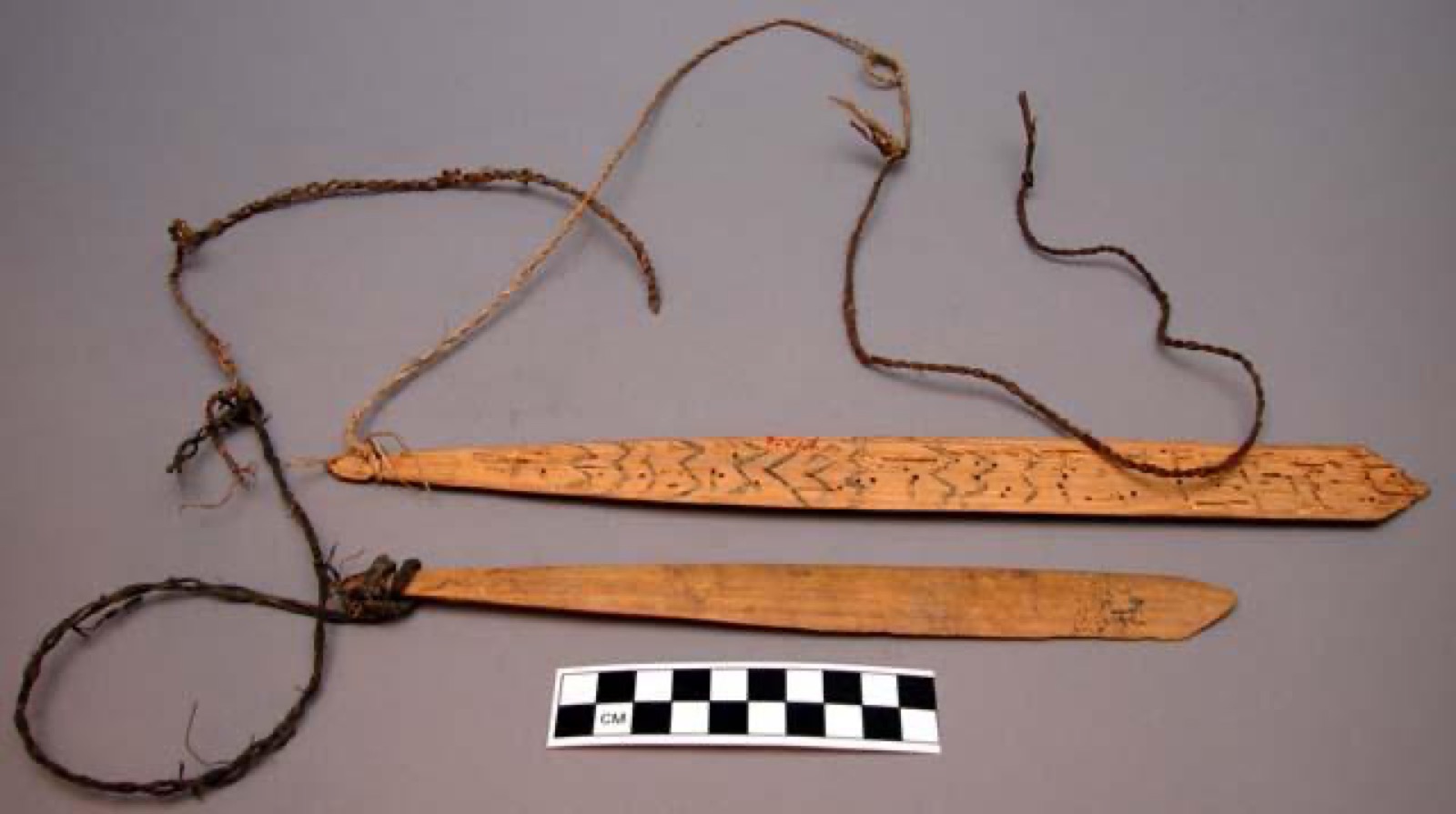
Source term: Bullroarer
Massim bullroarer use got written down once, and narrowly. At Awaiama and Taupota, east of Bartle Bay, Seligman was told that the fasting men swung bull-roarers the whole time the posts of the walaga feasting platform were being stepped into their holes — and at no other time. Nobody could tell him why. These two blades travelled together and share nothing else: two hands, two silhouettes, both cords still on.
Then [the medicine men] sucked through their hands, making a loud sucking noise; their object was to extract the arua (shade, spirit) of any dead man that might happen to be present in the post, so that it should not be injured by the erection of the post.
H. Newton, in C. G. Seligman, The Melanesians of British New Guinea (Cambridge, 1910), p. 592
Particulars
- Object
- Two separately carved wooden blades with their cords.
- Function
- Not recorded for this pair.
Sources
- Harvard Peabody Museum, object 69961, accession 18-25-70/D981 View
- H. Newton, in C. G. Seligman, The Melanesians of British New Guinea (Cambridge, 1910), p. 592