MUS2026-230 - museum specimen
Purari Delta face-carved bullroarer trio
Papua New Guinea - Gulf of Papua - Purari Delta - Oceania - Sahul
Restricted
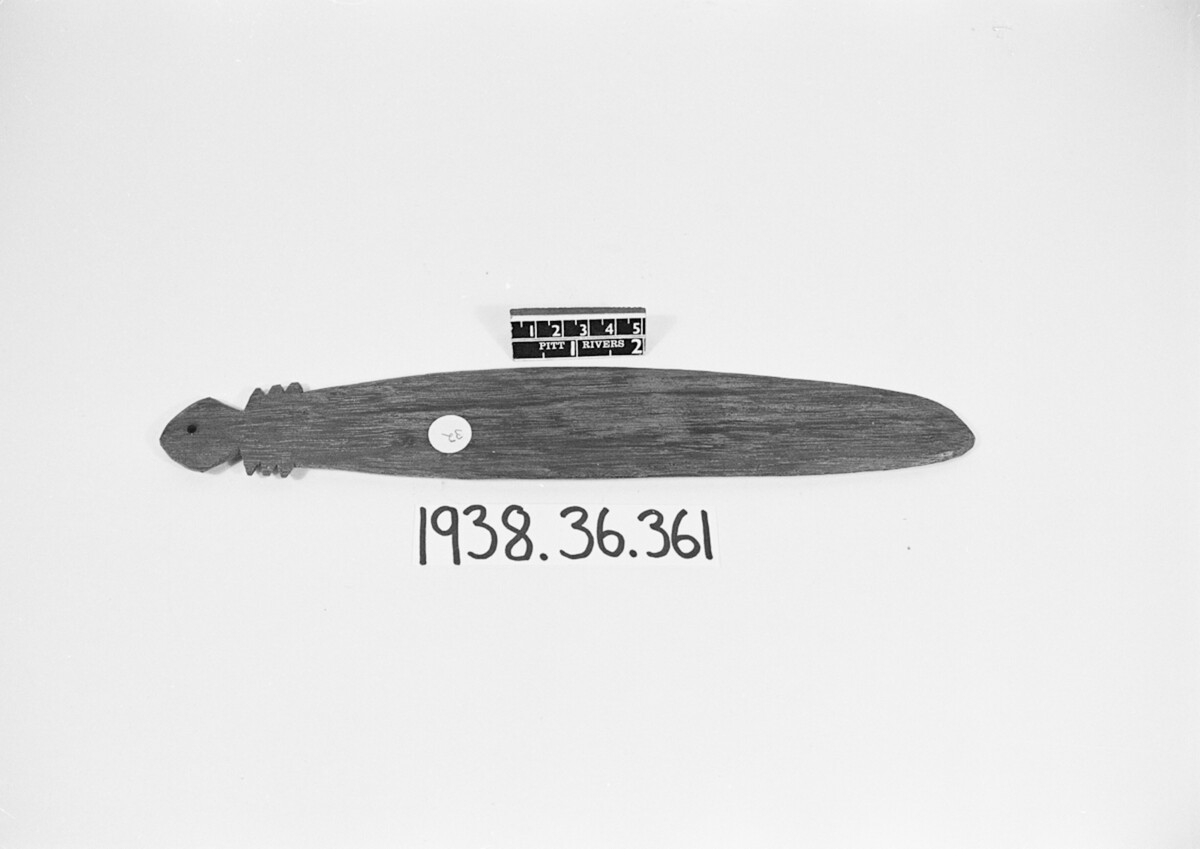
Source term: bullroarer
In the Purari Delta, one grade of male initiation was called upura ukua. There initiates learned to make the upura — also called imunu viki, the spirit-being's cry — whose voice belonged to initiated men. The three great face-carved blades that reached Cambridge from J. E. Foster in 1900 have no village or individual history, but their Purari provenance places them inside that named world of initiation, spirits, and guarded sound.
Upura ukua were taught how to make bullroarers (upura or imunu viki 'spirit-being's cry').
Joshua A. Bell, 'Out of the Mouths of Crocodiles' (2010), note 25
- Object
- Three pointed-ended wooden bullroarers, 30.5 to 35 inches long (about 77.5-88.9 cm), the upper portion of each carved with a human-face pattern in white and black on a red ground. The one carrying its own accession number, E 1900.103, has an incised, lime-infilled face, a short ridge for the nose, and a nick at the string end marking where the cord once was tied; no cord itself survives.
- Function
- In the Purari Delta the bullroarer was upura or imunu viki, the spirit-being's cry; boys of the upura grade were taught to make them, and learned that the voices heard from the men's house were these (Bell 2010, pp. 351-373).
- Source
- Museum of Archaeology and Anthropology, University of Cambridge, accession E 1900.103 (record 549744); reference chain as printed on the record, "E 1900.103; AR 1900.1544-1546". Place: Oceania; Papua New Guinea; Gulf of Papua; Purari Delta; Source: Foster, J. E. Material: wood; Cultural affiliation, period, local term and measurements are all blank…
- Source location
Page references
Cambridge MAA E 1900.103 (= Z 8293; AR 1900.1544-1546); Cambridge annual report for 1900, accessions 1544-1546
- Source confidence
- low to medium Broad Purari Delta regional anchor; the record's finest place field is "Purari Delta", with no village, ravi or collecting point.
- Spirit voice
- Initiation rite