MUS2026-207 - museum specimen
Yindjibarndi (Clement's "Ingibandi")
Pilbara - Western Australia
Sacred / spirit
cora / bonangharry English
Source term: devil scarer or bullroarer
cora / bonangharry (Clement's own spelling boonangharry; banangari in Radcliffe-Brown 1913): the Pilbara bullroarer, glossed 'devil-scarer' because it is swung to drive off the djuno, the evil spirit blamed for every illness and every death. A shared Ngayarta term; cora is recorded only in the Leiden catalogue headings and is never glossed.
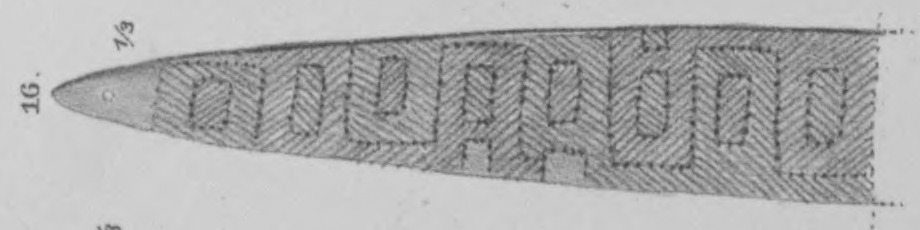
A forty-one-centimetre blade cut with a meander and rectangles set into its bends, pierced at one end for the cord, from the Yindjibarndi of the upper Fortescue. Emile Clement drew it as figure 16 on his plate, and figure 16 is on the short list he names when he explains what these were for: when someone fell ill the boonangharries were set going, and the taketa came painted in white and red stripes and walked round the sick person in circles that tightened until he pounced, rubbing the sore place and then drawing out of it, with his teeth, one or two semi-transparent pebbles the size of a hen's egg, which he carried away and buried in the sand. Illness had one cause and so did death: the djuno, which Clement translated as devil, and against which the only defence was noise. At the circumcision camp the blades were swung violently, night after night, to keep it out.
the "boonangharries" or "Devil-scarers" are violently swung in the camp, to keep the "djuno", or Evil-spirit away.
Emile Clement, "Ethnographical Notes on the Western-Australian Aborigines," Internationales Archiv fuer Ethnographie 16 (1904), p. 10
- Object
- Item 148 (inv. 1321/48), 41 x 4.2 cm, pierced at one end. The ornament is meander-shaped, with rectangles set between the undulations. Plate IV fig. 16 - one of the eight figures Clement names as set in motion over a sick person. Its pair in the same series, item 146 (inv. 1321/47, Plate IV figs. 18 and 18a), is a 32 x 3.8 cm blade held by MUS2026-040.
- Function
- Swung over the sick while the taketa circled the patient; swung at a death to drive off the djuno, held to be the cause of every death; and swung violently in the camp through the buckli circumcision gathering, roaring incessantly beside the nightly una and hibageh dances.
- Map confidence
- medium - approximate culture/locality centroid (upper Fortescue / Millstream)
- Source location
Page references
printed p. 26, item 148; Plate IV fig. 16
- Initiation rite
- Death and rebirth