No. MUS2026-202
Ancon perforated bone laths
Peru · Lima Region · Ancon necropolis (no period assigned) · South America · Central Andes
Function not recorded Candidate only
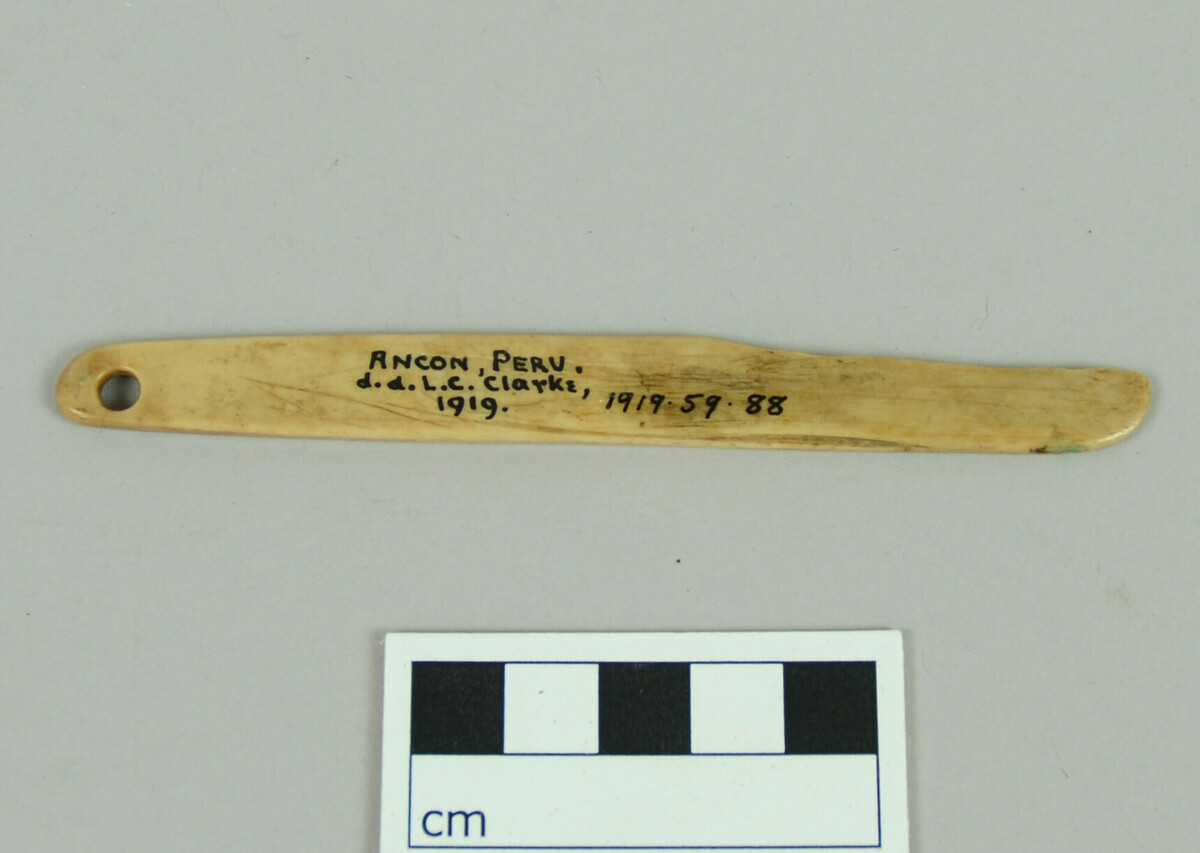
Source term: bone spatula, perforated for suspension
Two slender laths of bone came out of the graves of the Ancon necropolis on the Peruvian coast, the longer 119 mm and the shorter 69 mm, each tapering to a rounded working tip with a single clean hole bored through the opposite end. Louis Colville Gray Clarke gave them to the Pitt Rivers Museum in 1919, and the catalogue calls them what it has called them ever since: bone spatulas, perforated for suspension. The lot they arrived in makes that reading hard to argue with. Alongside them came five bronze spatulae and two more of spoon shape, seven spindles, a thread-winder, a woman's work-basket, a hundred and six spindle-whorls of pottery, stone and bronze, and powdered lime for chewing with coca leaves - every plausible everyday use for a perforated bone lath is present in that same grave lot, some of it in metal. Reiss and Stübel, who dug the site in the 1870s, illustrate weaving bands from Ancon carved and drilled, the drillings “apparently for passing strings to suspend them.” What keeps these two here at all is the profile: a long thin blade hung by a hole at one end, a shape that would whirl if anyone whirled it. Nothing else does. Karl Gustav Izikowitz, surveying the South American bull-roarer in 1935, was explicit that the instrument is not found along the Andes or on the Peruvian coast, and reached Amazonia instead by a current that bypassed both.
Weaving-band made of bone ... Lengthwise round this notched band was wrapped a fine unfinished net, rendering it very probable that it had been used for knotting fine meshes.
W. Reiss and A. Stübel, The Necropolis of Ancon in Peru (1880-87), vol. 3, Plate 87, fig. 3
Particulars
- Object
- Two slender tapering bone laths from the same grave lot, each with a single clean perforation at the proximal end: the longer, 119 x 12 mm, has a rounded, ground-bevelled working tip and green copper staining; the shorter is 69 x 11 mm. Neither has a recorded thickness.
- Function
- Not recorded.
Sources
- Pitt Rivers Museum, Oxford, accession 1919.59.88 View · archived
- Pitt Rivers Museum, Oxford, accession 1919.59.89
- Pitt Rivers Museum, Annual Report (1919)
- W. Reiss and A. Stübel, The Necropolis of Ancon in Peru (1880-1887), vol. 3, Plate 87, figs. 3, 14-15
- Karl Gustav Izikowitz, Musical and Other Sound Instruments of the South American Indians (1935), pp. 208-213