GENTILE2018-003 - museum specimen
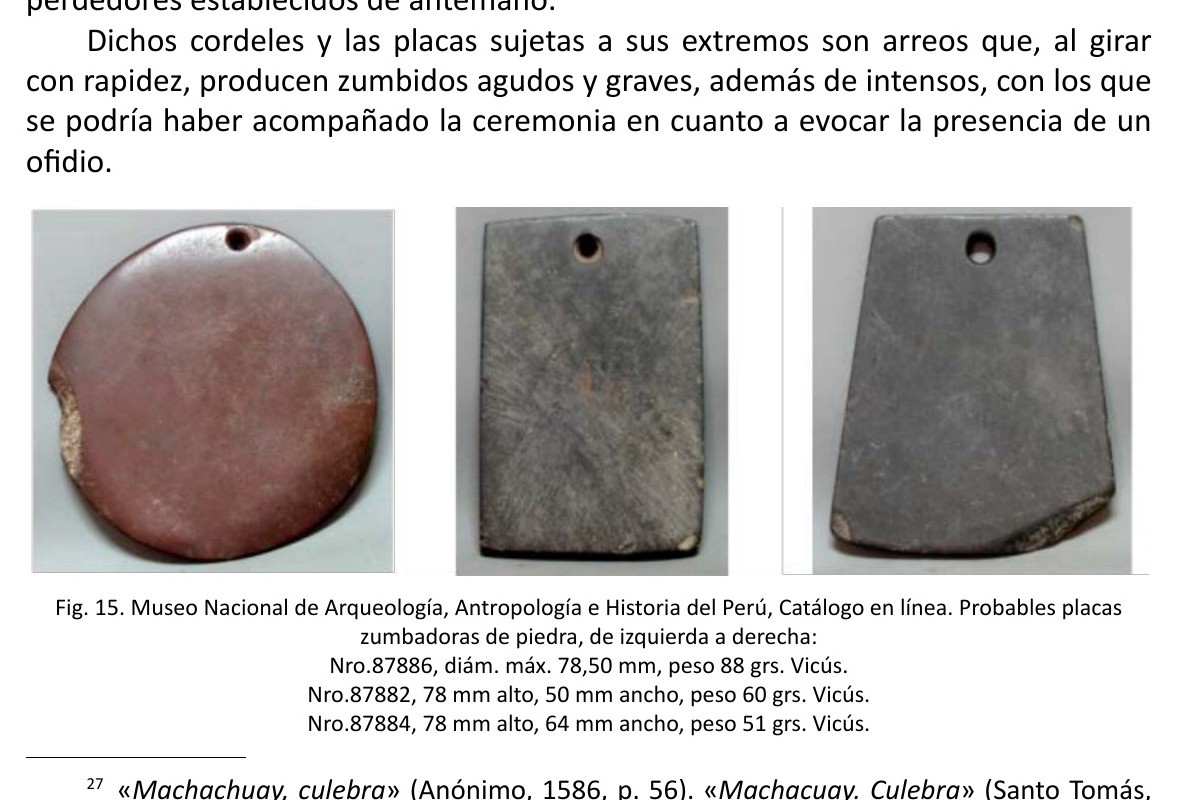
Three Vicús stone buzzing plaques
Peru - Piura region - far north coast; Vicús culture area - South America
Function not recorded Candidate only
placa zumbadora
Source term: probables placas zumbadoras de piedra
placa zumbadora (Spanish): 'buzzing plaque', bullroarer; Gentile 2018 p. 19 n. 9 gives churinga, bullroarer, bramadera and rombo as synonyms, after Pérez Bugallo 1993.
Three flat stones lie side by side in a photograph from the national museum in Lima: one almost round, one a small rectangle, one a trapezoid, none of them eight centimetres tall, each with a hole bored near an edge. The catalogue says only where they are thought to come from - Vicús, the culture of the Piura valleys on Peru's far northern coast - and what each one weighs. Margarita Gentile, gathering comparisons for the whirled plaques she had found on Llullaillaco, printed all three together under a single heading: probable stone buzzing plaques. That is the whole of the evidence. Nobody records where they were dug, or when, or whether a cord ever passed through those holes.
Probables placas zumbadoras de piedra, de izquierda a derecha: Nro. 87886, diám. máx. 78,50 mm, peso 88 grs. Vicús. Nro. 87882, 78 mm alto, 50 mm ancho, peso 60 grs. Vicús. Nro. 87884, 78 mm alto, 64 mm ancho, peso 51 grs. Vicús.
Probable stone buzzing plaques, from left to right: no. 87886, maximum diameter 78.50 mm, weight 88 g, Vicús; no. 87882, 78 mm high, 50 mm wide, weight 60 g, Vicús; no. 87884, 78 mm high, 64 mm wide, weight 51 g, Vicús.
Gentile 2018, Fig. 15 caption, p. 33
- Object
- Three flat stone plaques, each with a single hole near one edge, published together as one comparison set: 87886, nearly circular, 78.50 mm maximum diameter, 88 g; 87882, compact rectangular, 78 mm high and 50 mm wide, 60 g; 87884, trapezoidal, 78 mm high and 64 mm wide, 51 g. Museo Nacional de Arqueología, Antropología e Historia del Perú, Lima. No thickness is published for any of the three.
- Function
- Probable stone bullroarers in Gentile's caption; the single edge hole on each is compatible with free-air suspension, but no cord, wear study or acoustic test is published.
- Source
- Margarita E. Gentile, 'Placas zumbadoras y sogas sibilantes asociadas a las capacochacuna del volcan Llullaillaco', El Futuro del Pasado 9 (2018), pp. 15-42, DOI 10.14516/fdp.2018.009.001.001; Terminology note p. 19 n. 9, after Pérez Bugallo 1993, gives churinga, bullroarer, bramadera and rombo as names for the placa zumbadora
- Source location
Page references
Gentile 2018, Fig. 15 and caption at printed p. 33; terminology note p. 19 n. 9; MNAAHP accessions 87886, 87882 and 87884
- Source confidence
- low Chulucanas, Morropón province, Piura region - the public locality nearest the Cerro Vicús archaeological hill, about seven kilometres away - used as a culture-area anchor for the catalogue attribution 'Vicús'. Cerro Vicús itself has no verifiable public coordinate. The objects are held in Lima; the row points at the region the accessions are attributed to, on the museum-specimen precedent of the Clement Pilbara rows MUS2026-203 to -207, and no findspot is published.