No. BISCHOF1994-001
Asia drilled-monkey bone blade
Peru · Lima Region · Cañete Province · Asia (Omas) Valley · South America
Function not recorded
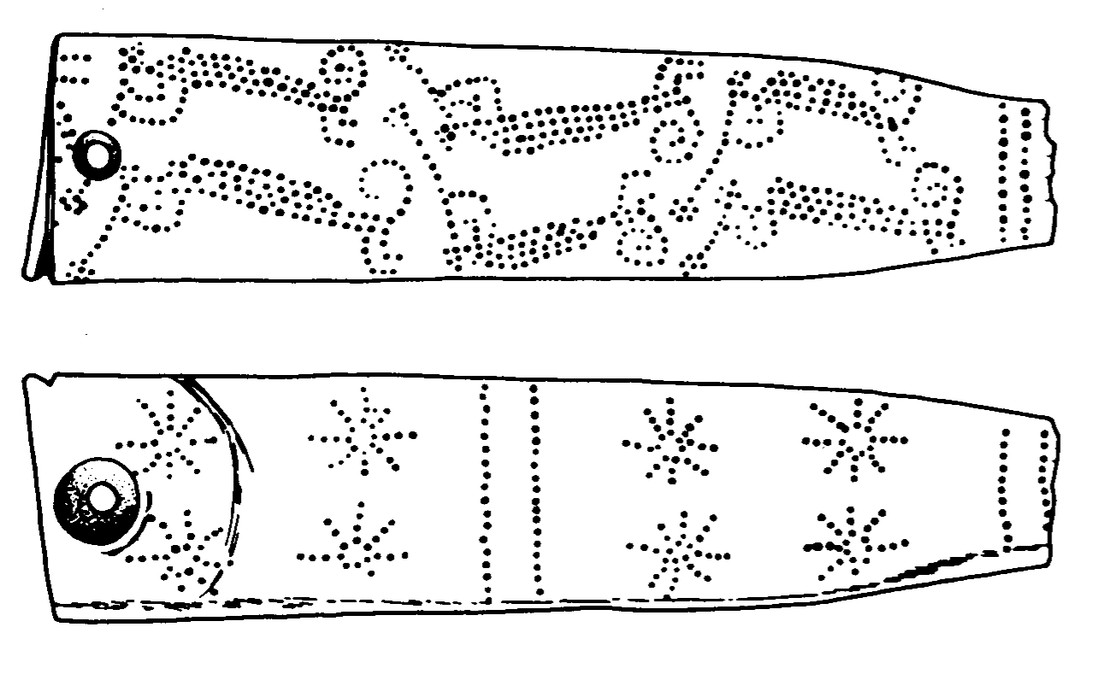
Source term: bone spatula fragment, reworked as a pendant (1994); bone bullroarer (2008)
Rows of tiny drilled dots turn this slip of bone into a picture. On one face monkeys stride in alternating pairs, handling what look like trumpets; on the other, starbursts. A hole is bored near the broad end. It comes from Asia Unit 1, a preceramic village at the mouth of the Omas River on Peru's central coast, where people nearly four thousand years ago left coca leaves and burned lime, kept trophy heads, and wove double-headed snakes into their cloth. Apart from textiles, the site gave up only three works of art. Henning Bischof, who photographed this one, first took it for a spatula reworked into a pendant. He later called it a bullroarer: its monkeys make music, like the monkeys engraved on the bone flutes of Caral, the great early city to the north.
On a bone bullroarer from Asia (Bischof 1994: Fig. 10b), monkeys handling trumpet-like instruments are associated with music, as on the Caral flutes.
Bischof 2008, p. 141 n. 19
Particulars
- Object
- Tapering bone blade with a hole drilled near its broad end; one face carries drilled-dot monkeys in alternating pairs, the other dotted starbursts.
- Function
- Not recorded.
Sources
- Henning Bischof, 'Context and Contents of Early Chavín Art', in W. J. Conklin and J. Quilter (eds), Chavín: Art, Architecture, and Culture (Cotsen Institute of Archaeology, 2008), pp. 137, 141 n. 19; C. M. Torres, same volume, p. 245 View
- Henning Bischof, 'Towards the Definition of Pre- and Early Chavin Art Styles in Peru', Andean Past 4 (1994), pp. 174, 178, 207 Fig. 10b View