No. MUS2026-201
Rome bone feather-blade
Italy · Rome (collecting locality; no findspot, no period assigned) · Europe · Mediterranean
Function not recorded Candidate only
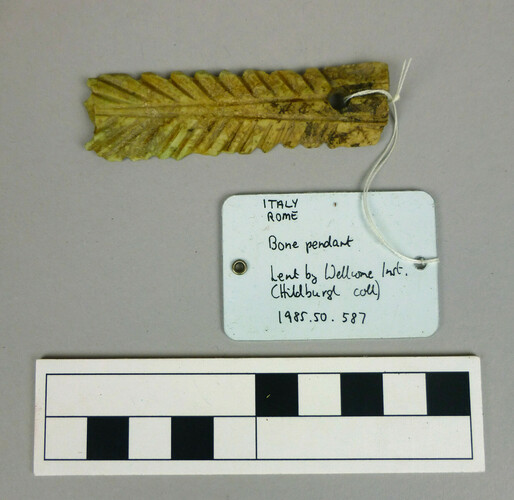
Source term: amulet
Walter Leo Hildburgh bought this small strip of bone in Rome in 1910, while he was assembling the amulet collection that would pass to the Wellcome and, in 1985, come to the Pitt Rivers on loan. It is carved to read as a feather or a leaf: a raised midrib runs its length, both edges are cut into fine serrations, and the tip closes in a shallow V-notch, while the back is left plain and flat. At the other end a single round hole is bored clean through. Green and blue staining across part of the surface is the signature of copper salts, which is what bone takes up lying beside bronze in the ground - so the piece has been buried. What makes it worth a second look is the shape: a thin, flat, terminally pierced blade, found in Italy, where the rhombos is better attested in words than in objects. Archytas of Tarentum, writing in the fourth century BC, described the rhomboi whirled in the mysteries as sounding low when swung gently and high when swung hard, and the Orphic verses list the whirled toy among the things with which the Titans lured the infant Dionysus away. This is the right shape in the right place.
Amulet. A piece of bone, carved with chevron pattern on one side, flat on the other. It has a single perforation at one end. There are traces of green/blue staining on part of the object.
Pitt Rivers Museum catalogue record 1985.50.587
Particulars
- Object
- Flat bone strip, 73 x 21 x 4 mm, carved on one face with a chevron/herringbone pattern reading as a feather or leaf - central midrib, serrated edges, V-notch at the tip - and flat on the other; single round perforation at the opposite, terminal end; traces of green/blue copper staining.
- Function
- Not recorded.
Source
Pitt Rivers Museum, University of Oxford, accession 1985.50.587. Collected (bought) in Rome 1910 by Walter Leo Hildburgh; Hildburgh bequest to the Wellcome 1955; on loan to the PRM from 1985. Record data via