CASTELLUCCIO2026-001 - archaeological find
Castelluccio bossed bone plaque
Italy - Val di Noto - province of Syracuse, Sicily - Europe - Mediterranean
Function not recorded Candidate only
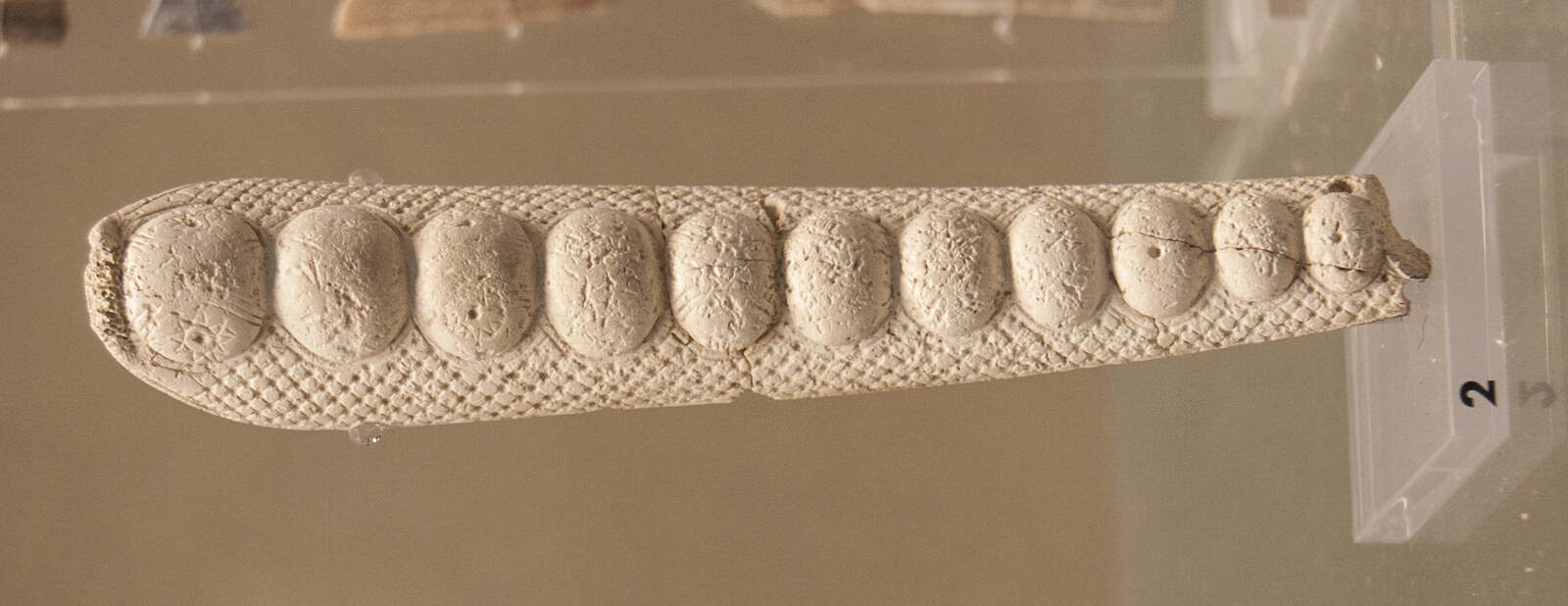
osso a globuli
Source term: osso a globuli / bossed bone plaque
osso a globuli (Italian): 'bossed bone', the Sicilian Early Bronze Age carved bone plaque worked with rows of raised knobs; English 'bossed bone plaque'.
Tomb 13 in the rock-cut necropolis above the Cava della Signora gave up, among its grave goods, a length of bone carved into a row of swollen knobs and edged with fine ruled lines. Sicilian archaeology has called these ossi a globuli nearly everything: imports proving very early sea trade, small idols, badges of rank, fittings for daggers, tallies for remembering by. Duccio Belgiorno added one more possibility, that they were whirled, and that the knobs and the incisions belong to an instrument. On this piece the holes sit inside the bosses rather than at an end, so from the photograph alone no one can say whether a cord ever passed through it.
gli ossi a globuli potrebbero essere strumenti musicali a carattere rituale del tipo 'rombo' (bull roarer)
the bossed bones could be ritual musical instruments of the 'rombo' (bullroarer) type
Duccio Belgiorno, quoted in Crescimanno, 'Ossi a globuli di Castelluccio - Noto (SR)', Preistoria in Italia
- Object
- A substantially complete carved bone plaque worked in relief with rows of raised bosses and fine incised lines; small holes pierce the bosses themselves rather than a plaque end. Most examples of this Sicilian Early Bronze Age class run under 10 cm, the longest known just 16 cm.
- Function
- Not recorded.
- Source
- Duccio Belgiorno, quoted in Crescimanno, 'Ossi a globuli di Castelluccio - Noto (SR)', Preistoria in Italia
- Source location
Page references
Preistoria in Italia object record, image 'osso n. 1'; Brandenburg 2018 conference program p. 2; Nicoletti 2019, Incontri 7(28), pp. 18-22
- Source confidence
- medium Published site coordinate for the Castelluccio di Noto excavations, the rock-cut necropolis in the Cava della Signora between Noto and Palazzolo Acreide; not a tomb coordinate.