No. MUS2026-115
Tembé (Tenetehara) bullroarer, Pará, 1957
Brazil · Rio Acará, eastern Pará · South America · Amazonia
Function not recorded
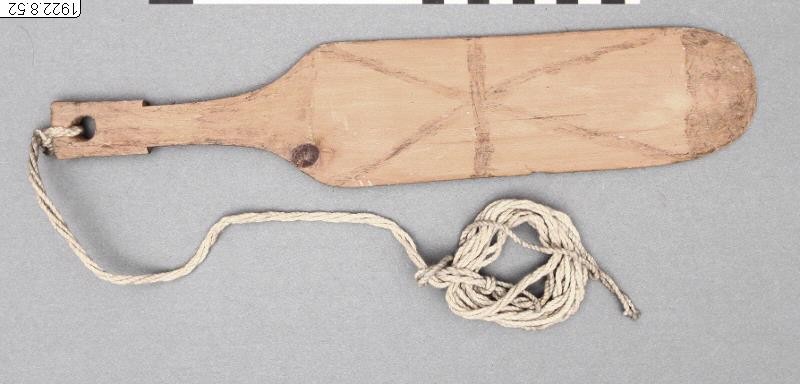
Source term: Zunidor
The Tembé who made this little roarer — eighteen centimetres of oblong board on a cotton cord — call themselves Tenetehara, simply 'people'. Their forebears came west out of Maranhão in the mid-nineteenth century to settle the rivers of Pará, pushing onto the Acará into the lands of the Turiwara. From the Acará, in 1957, the government's Indian Protection Service sent the board to the national Indian museum in Rio de Janeiro.
Zunidor confeccionado com prancha de madeira oblonga apresentando uma das extremidades entalhada e a outra exibindo um orifício de onde pende um fio de algodão
Bullroarer made from an oblong wooden board, one end carved and the other showing a hole from which a cotton thread hangs.
Museu Nacional dos Povos Indígenas / FUNAI, Item 8111 - Zunidor
Particulars
- Object
- An oblong wooden board, 18.2 cm long, one end notched and the other pierced, with a cotton cord hanging from the hole.
- Function
- Function not recorded.
Source
Museu Nacional dos Povos Indígenas / Museu do Índio (FUNAI), item 8111, 'Zunidor' (Tembé, Rio Acará, Pará; SPI collection, 1957)