No. LEDEN1915-001
Central Inuit Chesterfield Inlet caribou-bone bullroarer CMH IV-C-1402
Canada · Chesterfield Inlet · Kivalliq, Nunavut · North America · Arctic
Function not recorded
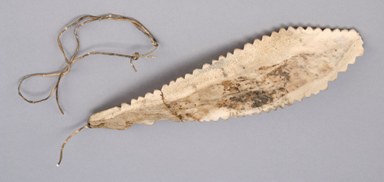
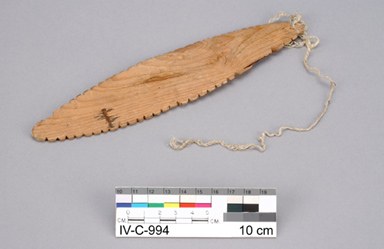
Source term: Bullroarer
This whirring blade came south with a song collector. Christian Leden, the Norwegian ethnomusicologist, spent 1913-1916 on the west coast of Hudson Bay filling wax cylinders with Inuit song — 'their intervals were so different from ours,' he wrote, 'that it was almost impossible to retain them' — and at Chesterfield Inlet, Igluligaarjuk, 'the place of few houses,' then a whalers' rendezvous with a brand-new trading post, he acquired this caribou-bone plate on its seal-skin cord. Inland, among the Caribou Inuit, such roarers were children's toys called anoreziut; this one kept neither its name nor its story.
Particulars
- Object
- Caribou-bone plate with a seal-skin cord through one end; 25.9 x 7.8 x 0.9 cm. Canadian Museum of History IV-C-1402.
- Function
- No function recorded.
Source
Canadian Museum of History IV-C-1402 / artifact 39687: 'Bullroarer', Central Inuit, origin Chesterfield Inlet; collected by Christian Leden (collector no. 430) by 1915; caribou bone and seal skin; photos D2003-12840/-12841