No. MUS2026-057
Thunner-spehl, whirled against thunderbolts
United Kingdom · Scotland · Europe · British Isles
Weather / fertility magic
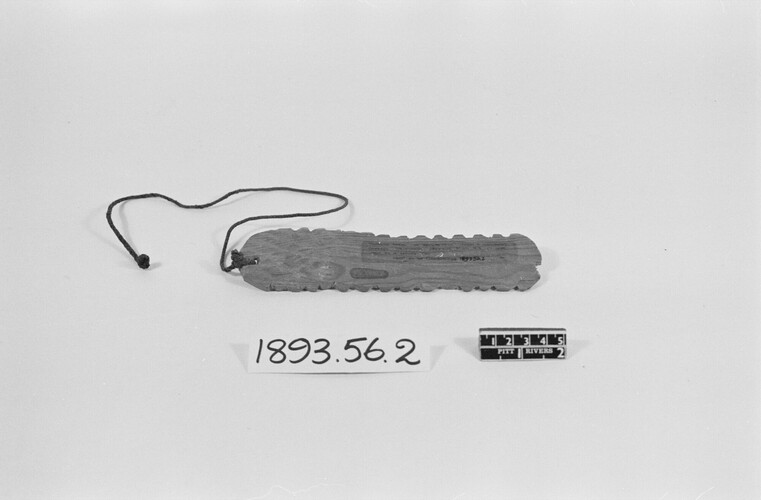
THUNNER-SPEHL
Source term: bull-roarer
Scots "thunner-spehl" — thunder-spell; a notched wooden slip whirled on a string to imitate or ward off thunder.
Etymology. Transparent Scots dialect compound naming the instrument as a charm or spell against thunder/lightning.
In Aberdeenshire and Kincardineshire boys whirled a notched shaving of wood on a string during thunderstorms, in the belief that the thunder would cease or that the thunderbolt would not strike. The anthropologist Alfred Cort Haddon, who gathered British bull-roarers for the chapter on the instrument in "The Study of Man" (1898), reported that it was known as a thunder-spell in parts of Scotland and in Aberdeen as a thunder-bolt, and that a Liverpool Museum informant told him the things were made by farm-servants and villagers and were quite common in those counties. The earliest notice, from Galloway in 1822, describes a thunder-spale whirled "beneath the school-yard 'dike'" as suggesting the notion of a distant thunder-clap. Two Scottish specimens entered the Pitt Rivers Museum in 1893, recorded under the local name thunner-spehl.
whirled round the head, under the belief that the thunder would cease, or that the thunderbolt would not strike
W. Gregor, Notes on the Folk-Lore of the North-East of Scotland (1881), 153, as quoted in Dictionaries of the Scots Language, SND s.v. "thunner spale"
Particulars
- Object
- Roughly carved slip of pine with serrated edges, 197 mm long, its whirling string threaded through a hole at one end; from Knockando parish, Elgin.
- Function
- Thunder-charm, whirled in storms to make the thunder cease or the thunderbolt miss; later swung simply for the noise.
Sources
- Pitt Rivers Museum, Oxford, object 1893.56.2 View · archived
- W. Gregor, Notes on the Folk-Lore of the North-East of Scotland (1881), p. 153, quoted in Dictionaries of the Scots Language
- Dictionaries of the Scots Language, Scottish National Dictionary, s.v. "thunner spale," quoting Gregor (1881), p. 153