No. HORNIMAN1906-001
Cambridgeshire cattle-driving bullroarer
United Kingdom · Cambridgeshire · Gamlingay or Over · Europe · British Isles
Play / practical
Source term: bullroarer / bull-roarer / 412.22 whirling aerophone
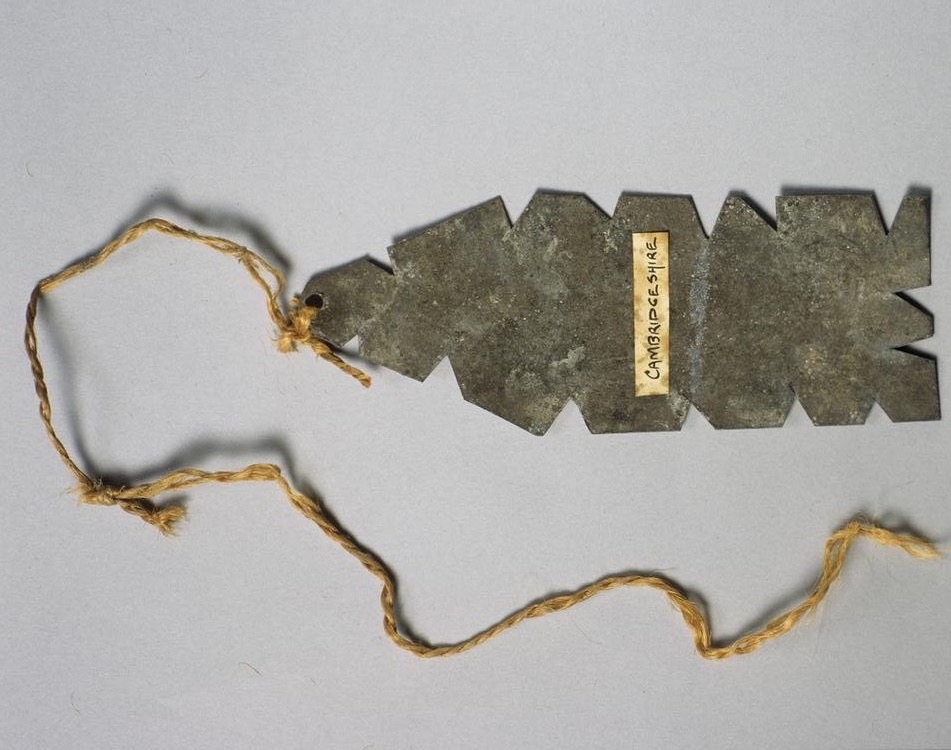
This zinc bullroarer was swung not in any rite but to move cattle: its whirring carries the pitch of the warble fly, a biting fly whose drone sends grazing cows into flight. Roughly rectangular, about 155 millimetres long, it has fourteen notches cut around its edge and a length of vegetable-fibre cord knotted through a hole at the tapered end. The Horniman Museum bought it from A. W. Rowlett in 1906; its register records Gamlingay in Cambridgeshire, and the object was later associated with Over in the same county. In Britain the bullroarer otherwise survived mainly as a boy's plaything, and the museum now shows this one in its music gallery under the heading "Adulthood and Survival." A companion blade from Offord dairy in neighbouring Huntingdonshire — tin cut with shears, notched the same way, on nearly four feet of string — was still being swung at cattle in 1906, proof the warble-fly trick was regional dairy practice rather than one farm's invention.
Bullroarers were used for driving cattle. Their sound frightened the cattle as it was similar to that of the warble fly, a biting fly.
Horniman Museum and Gardens, object 6.243 (catalogue description)
Particulars
- Object
- Small notched blade of sheet zinc on a vegetable-fibre cord.
- Function
- Used for driving cattle by imitating the sound of the warble fly, which frightened cattle.