No. HAD1898-042
Montgomeryshire Wales remembered roarer
United Kingdom · Montgomeryshire · Wales · Europe · British Isles
Play / practical
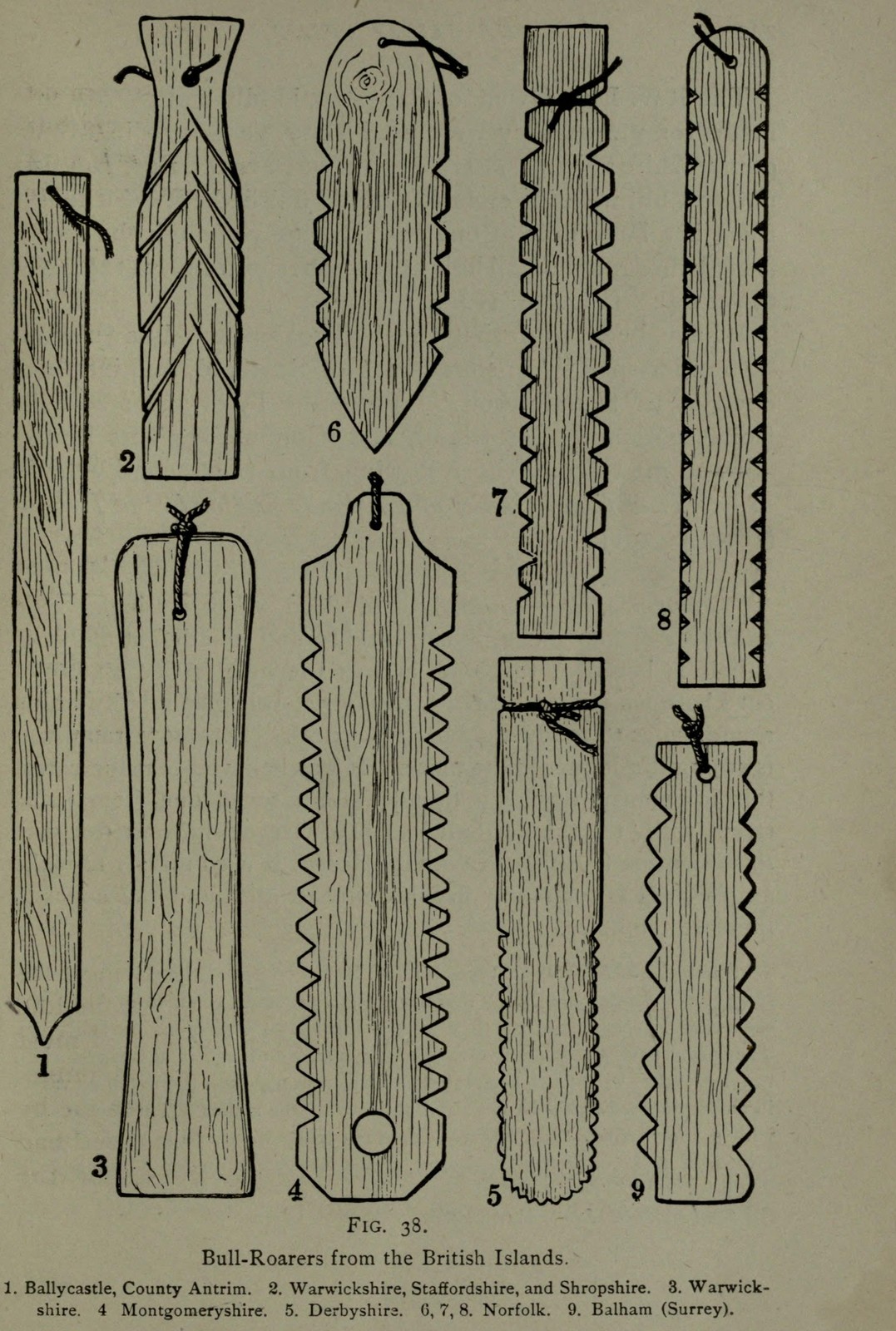
roarer
Source term: roarer / bull-roarer
"Roarer": the local Montgomeryshire name for the whirled wooden bull-roarer.
Etymology. Plain vernacular English name formed from the sound the instrument makes.
There was no Montgomeryshire bull-roarer left to collect by the 1890s, so the Rev. Elias Owen of Oswestry had one made for Alfred Haddon in the form he remembered from sixty years earlier in that Welsh county, where it was simply called a "roarer." Owen (1833–1899) was a Welsh cleric and folklorist, author of Welsh Folk-Lore (1896), who gathered old customs from elderly parishioners on his rounds as a diocesan school inspector. Across the British Isles Haddon found the object surviving only as a children's plaything, whirled for its noise under a scatter of local names — roarer in Wales, bull, boomer, thunder-spell, hummer.
The Rev. Elias Owen, of Oswestry, kindly had a "roarer" made for me as they were used sixty years ago in Montgomeryshire in Wales.
Haddon 1898, The Study of Man, ch. X "The Bull-Roarer," p. 280
Source
Haddon 1898, The Study of Man, Chapter X: The Bull-Roarer